
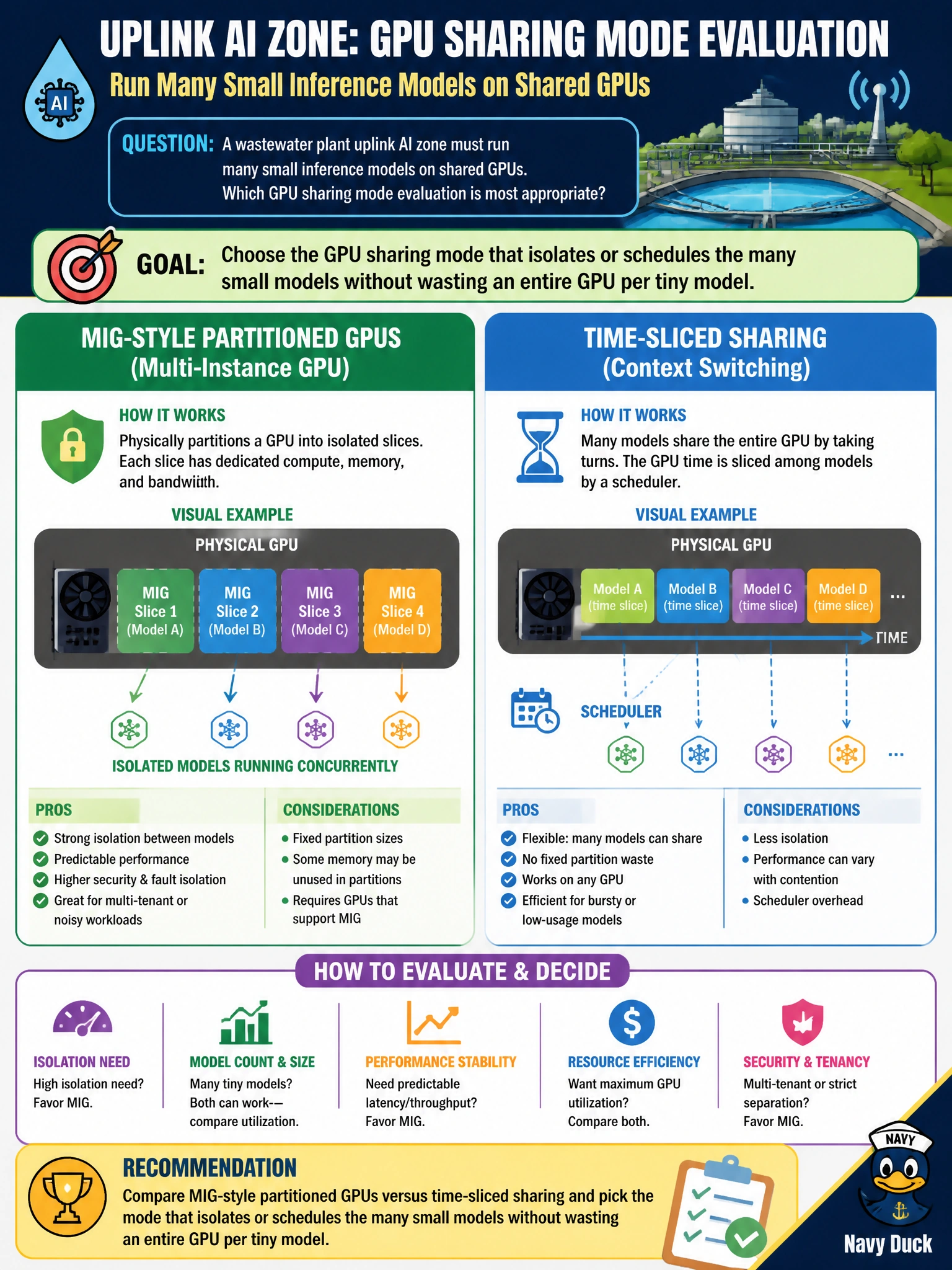
A wastewater plant uplink AI zone must run many small inference models on shared GPUs. Which GPU sharing mode evaluation is most appropriate?
Select an answer to reveal the explanation.
Short Explanation
Lots of little models on one GPU is like apartment living—you can put up real walls (MIG-style partitions) or take timed turns in the kitchen (time-slicing). You'll waste the GPU if you pin each tiny model to its own full card, and fusing them into joint training batches or reserving big double-precision slices won't match small inference needs. Match the sharing mode to the herd of small jobs.
Full Explanation
Wastewater plant uplink AI zones running many small inference models on shared GPUs should compare MIG-style partitioned GPUs versus time-sliced sharing and pick the mode that isolates or schedules those models without wasting an entire GPU per tiny model. That sharing-mode evaluation works because small civic inference jobs rarely need a full accelerator; the design choice is how to pack them with acceptable isolation and predictability for plant operations. Pinning each tiny model to a dedicated full GPU with exclusive power allocation fails because it wastes an entire accelerator per small inference job and defeats the purpose of shared GPUs. Comparing MPS-based concurrent kernels versus multi-GPU NVLink scaling to fuse the many small models into joint distributed training batches fails because the uplink zone needs concurrent small-model inference, not joint distributed training, and NVLink scale-out does not solve inference sharing. Comparing time-sliced scheduler quotas versus MIG memory slices but reserving double-precision compute slices sized for large-model training for each tiny model fails because small quantized inference does not need FP64 large-model slices, and oversizing each slice wastes shared capacity. Exam caveat: MIG partition sizes and counts are hardware-generation specific; a mode that fits today’s cards may not map 1:1 after a GPU refresh—re-evaluate when hardware changes. Operational check: prototype both MIG and time-slicing with the plant’s real small-model mix, measure latency isolation under noisy neighbors, and select the mode that meets wastewater inference SLOs at acceptable GPU count.
Prefer to study offline? Printable PDF study book + test engine ($7.50, unofficial). These questions stay free here.