
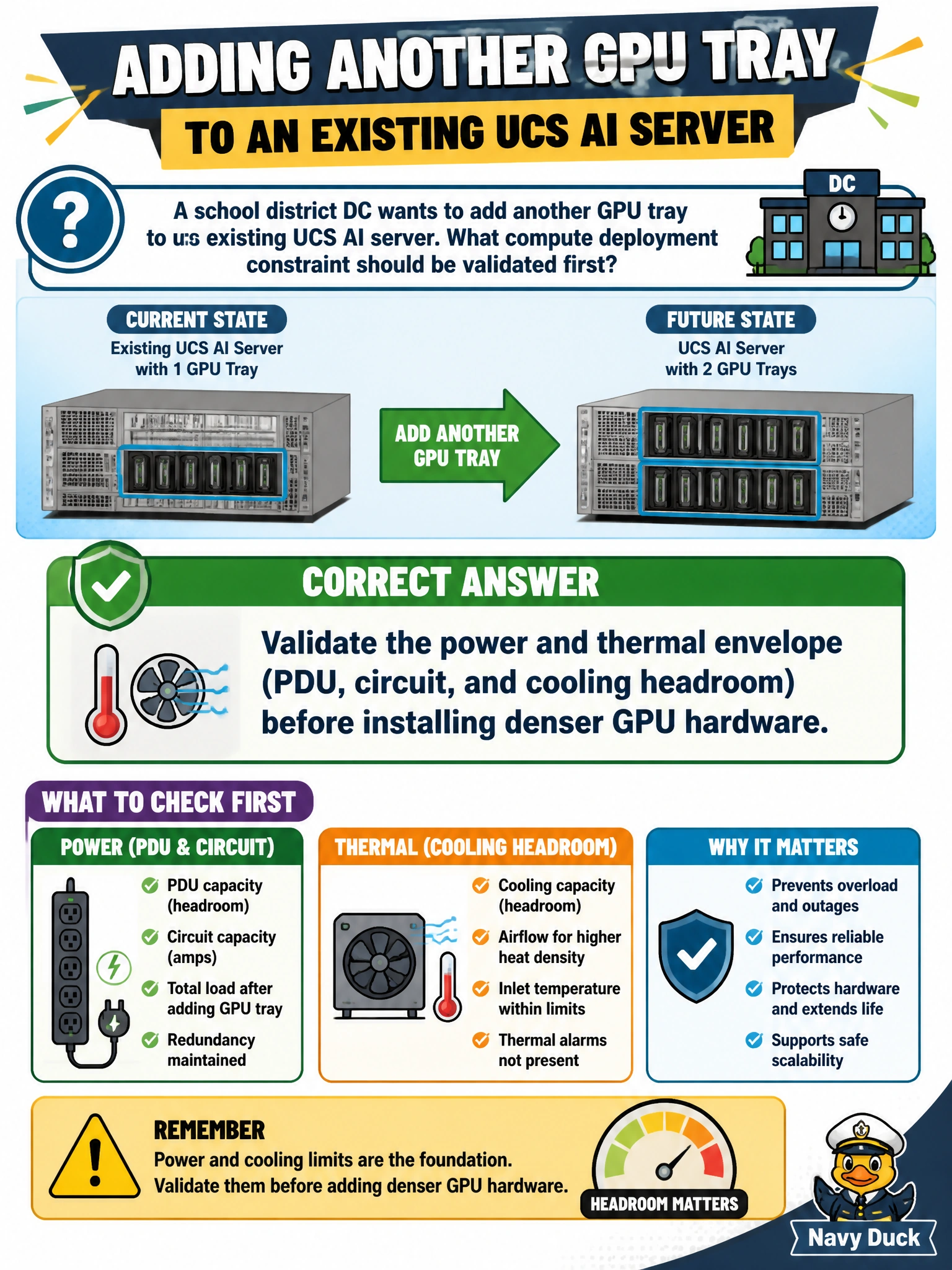
A school district DC wants to add another GPU tray to an existing UCS AI server. What compute deployment constraint should be validated first?
Select an answer to reveal the explanation.
Short Explanation
Cramming another GPU tray in without checking power and cooling is like plugging a space heater into a Christmas-light string—something pops. Confirm the envelope first, then add density.
Full Explanation
School-district DCs adding another GPU tray to an existing UCS AI server must validate the power and thermal envelope—PDU, circuit, and cooling headroom—before installing denser hardware. Prioritizing fabric interconnect uplink capacity and QoS policy (VSAN, priority queues) before scaling east-west training traffic over the power and thermal envelope risks oversubscribing PDUs or cooling; validate the power and thermal envelope before adding GPU capacity. Validating available PCIe bifurcation and NVLink bridge topology (x16 slots, peer links) before installing denser GPU hardware ahead of the power and thermal envelope fails as incomplete change control: correct slot wiring and peer links can still exceed PDU or cooling headroom, and discovery-by-outage is not an acceptable school-district validation method. Verifying only the Intersight firmware bundle and UCS service profile (BIOS, VIC, GPU VBIOS) before enabling the new GPU tray revision assumes software compatibility implies facility compatibility — but shared PDU circuits and shared cooling zones mean the real constraint is the rack's aggregate headroom, not any single tray's firmware listing. Exam caveat: nameplate watts, derating, and simultaneous training peaks differ; budget headroom for inrush and for other racks on the same PDU, not only the steady-state average of one server. Operational check: calculate post-install rack power and cooling against measured PDU capacity and CRAC/CRAH headroom, obtain facilities sign-off, then install and re-measure under a full training load before declaring the tray production-ready.
Prefer to study offline? Printable PDF study book + test engine ($7.50, unofficial). These questions stay free here.