
A library consortium DC will share GPUs across municipal departments. What virtualization/sharing control should be evaluated?
Select an answer to reveal the explanation.
Short Explanation
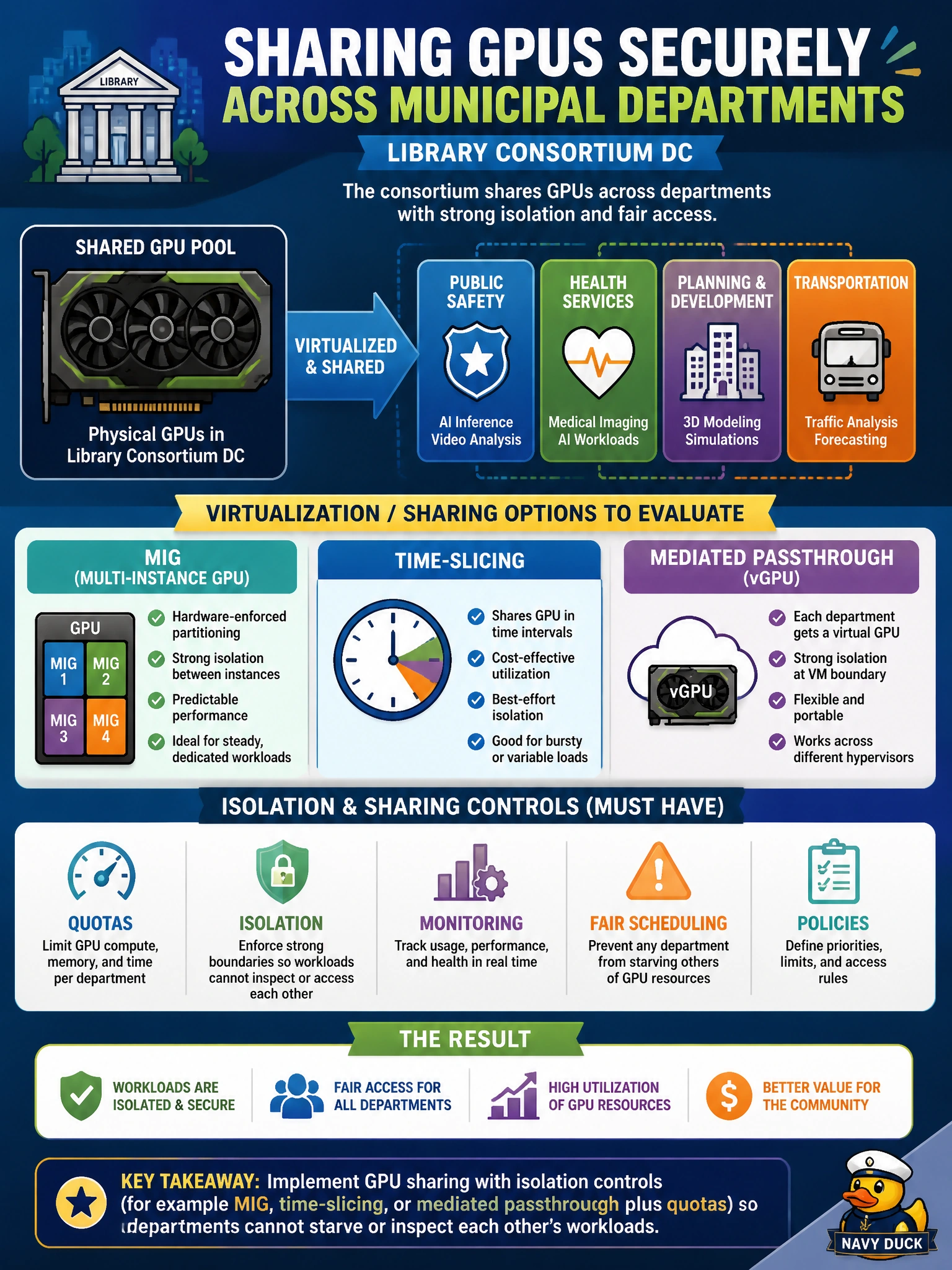
Shared GPUs without guardrails are a community pool with no lanes—one cannonball and everyone else climbs out. Isolation plus quotas (MIG, time-slice, mediated devices) lets departments share iron without dunking each other’s jobs.
Full Explanation
Library consortium DCs sharing GPUs across municipal departments must implement GPU sharing with isolation controls—MIG, time-slicing, or mediated passthrough plus quotas—so departments cannot starve or inspect each other’s workloads. That virtualization/sharing evaluation works because multi-tenant civic GPU pools need both utilization and hard tenancy boundaries: fair share, memory isolation where offered, and auditability across departments. Enabling NVIDIA MPS with a single shared CUDA context across departments plus uniform scheduling limits fails because a shared CUDA context allows concurrent execution without memory, fault, or visibility isolation, and uniform scheduling limits provide no hard per-department quotas to prevent starvation or workload inspection. Advertising GPU capacity using Kubernetes extended resources with the NVIDIA device plugin plus namespace quotas fails because scheduler accounting only counts allocations at schedule time and provides no device-runtime enforcement of fair share, memory isolation, or confidentiality between departments. Configuring uniform MIG geometries on pooled GPUs with mediated passthrough and best-effort scheduling fails because predictable slices without enforced quotas still let one department consume available slices and starve others, and best-effort scheduling with low quota management offers no fair-share or auditability guarantee. Exam caveat: time-slicing and MIG are not identical—MIG offers stronger partition isolation; time-slicing offers flexibility with weaker noisy-neighbor guarantees—pick based on whether departments need hard isolation or soft fairness. Operational check: run concurrent jobs from two departments, confirm quotas prevent one from consuming the pool, verify isolation properties of the chosen mode, and retain audit logs of GPU assignment for consortium governance reviews.
Prefer to study offline? Printable PDF study book + test engine ($7.50, unofficial). These questions stay free here.