
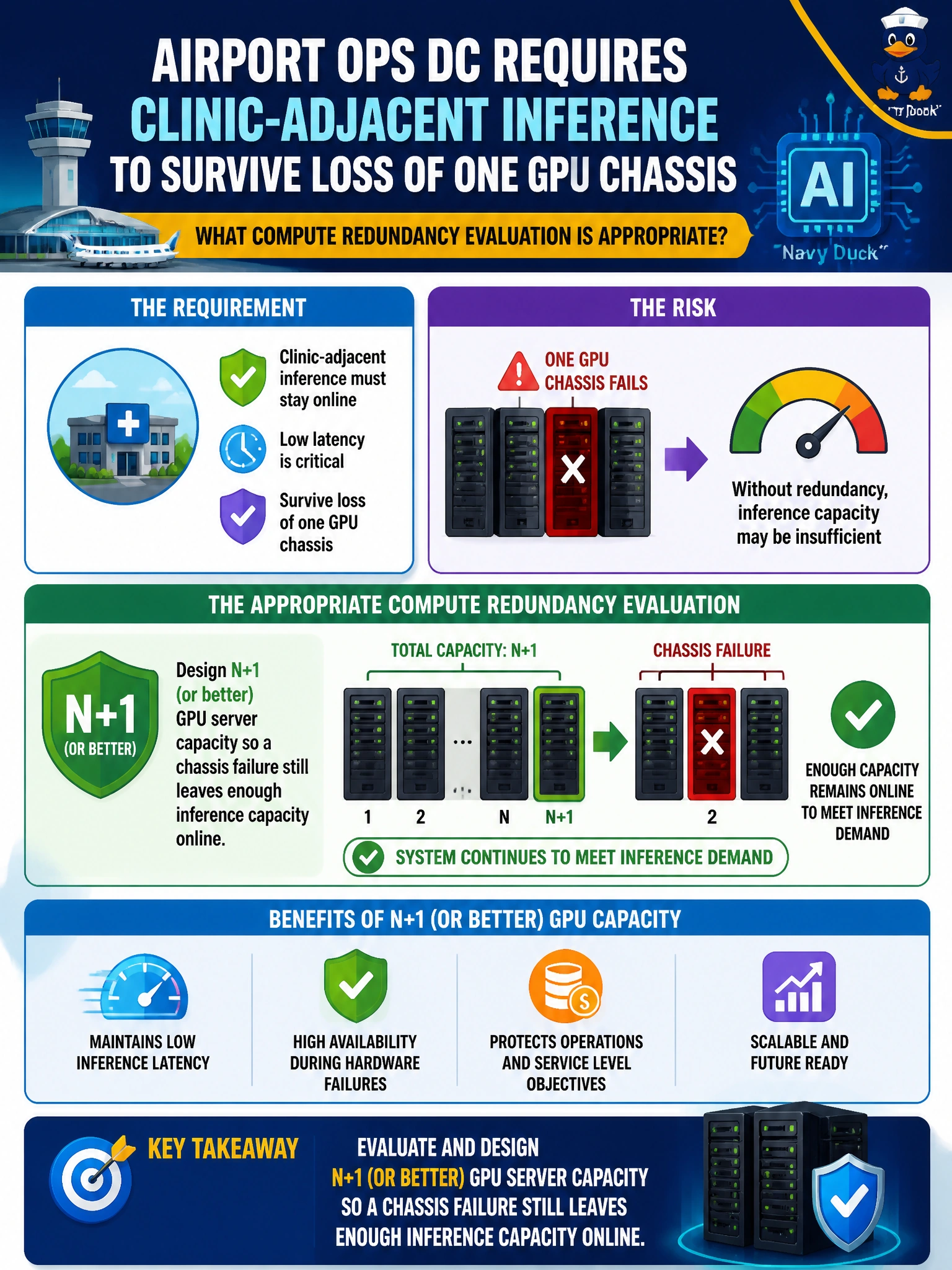
An airport ops DC requires clinic-adjacent inference to survive loss of one GPU chassis. What compute redundancy evaluation is appropriate?
Select an answer to reveal the explanation.
Short Explanation
Think spare tire: you don’t wait for the blowout to wonder if you packed one. N+1 GPU servers mean one chassis can leave the party and clinic inference still has somewhere to run. Extra power headroom for thermal events won't save you when a whole chassis drops, since you'll still be short the servers you lost.
Full Explanation
Airport ops DCs that require clinic-adjacent inference to survive loss of one GPU chassis must design N+1 (or better) GPU server capacity so a chassis failure still leaves enough inference online. That redundancy evaluation works because civic clinical-adjacent serving is an availability problem: replicas and spare capacity must live on independent failure domains, not merely as files on the same box. Compute redundancy is sized to the outage you refuse to accept during airport operations. Provisioning N+1 GPU power budget headroom across racks to sustain peak inference throughput during thermal events fails because it sizes power and thermal headroom, not surviving server capacity — a chassis failure still removes whole inference replicas that extra wattage cannot replace. Distributing inference replicas across dual GPU trays in paired chassis sharing a common management backplane module fails because that shared backplane remains a common failure domain — a backplane or paired-chassis event can take out both trays, so replicas are not on independent chassis. Validating CPU-based inference autoscaling to absorb GPU load when a chassis fails during peak clinic hours fails because clinic-adjacent inference requires GPU throughput and latency SLOs that CPU autoscaling cannot meet at peak, so capacity is still missing during the outage. Exam caveat: N+1 server count is insufficient if power, ToR, or storage are still shared single points; redundancy must cover the actual blast radius. Operational check: fail one GPU chassis in a controlled test, confirm remaining capacity meets clinic-adjacent inference RPS/latency SLOs, and verify model artifacts are replicated off-chassis so rebuild does not wait on the dead node’s disks.
Prefer to study offline? Printable PDF study book + test engine ($7.50, unofficial). These questions stay free here.