
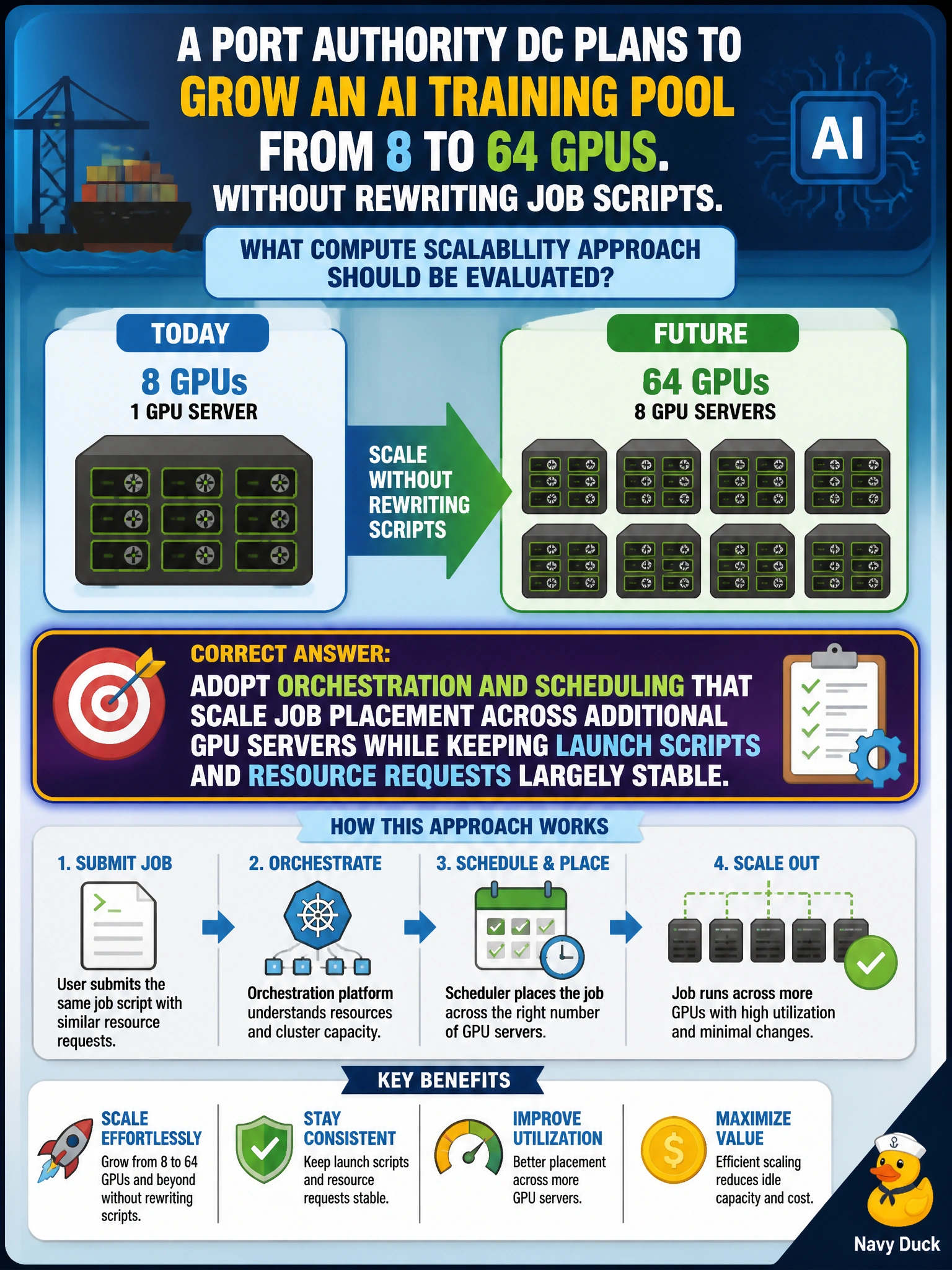
A port authority DC plans to grow an AI training pool from 8 to 64 GPUs without rewriting job scripts. What compute scalability approach should be evaluated?
Select an answer to reveal the explanation.
Short Explanation
Growing from 8 to 64 GPUs shouldn’t mean rewriting the cookbook every time you buy another oven. A real scheduler and orchestration layer lets the same job recipe land on more iron—scripts stay calm while the pool expands.
Full Explanation
Adopting dataset sharding and storage caching that scales data staging across additional GPU servers while keeping launch scripts and resource requests largely stable does not scale job placement; it optimizes data delivery, but a scalable design must accommodate fiscal-year growth across new accelerators without redesign. Adopting inference autoscaling that scales model replica placement across additional GPU servers while keeping launch scripts and resource requests largely stable breaks when the pool grows for training; inference autoscalers manage serving replicas, not distributed training job placement and rank assignment, which orchestration and scheduling automatically manage across a growing pool. Adopting virtual machine scheduling that scales independent VM placement across additional GPU servers while keeping launch scripts and resource requests largely stable does not scale training; VM schedulers place independent VMs, not coordinated multi-GPU jobs, while orchestration and scheduling abstract job placement and automatically adapt as GPU capacity grows. Adopting dataset sharding and storage caching on expanded servers without scaling training job placement fails as a scalability evaluation—it is a data-staging optimization on fixed scheduling, not a design that absorbs new accelerators. Exam caveat: stable launch scripts still need compatible CUDA/driver/runtime images across the expanded pool; orchestration cannot hide incompatible node software. Operational check: add a canary GPU server to the port authority cluster, submit the same job spec used at 8 GPUs, confirm placement onto new capacity without script edits, and verify accounting/quotas still enforce fair share as the pool approaches 64 GPUs.
Prefer to study offline? Printable PDF study book + test engine ($7.50, unofficial). These questions stay free here.