
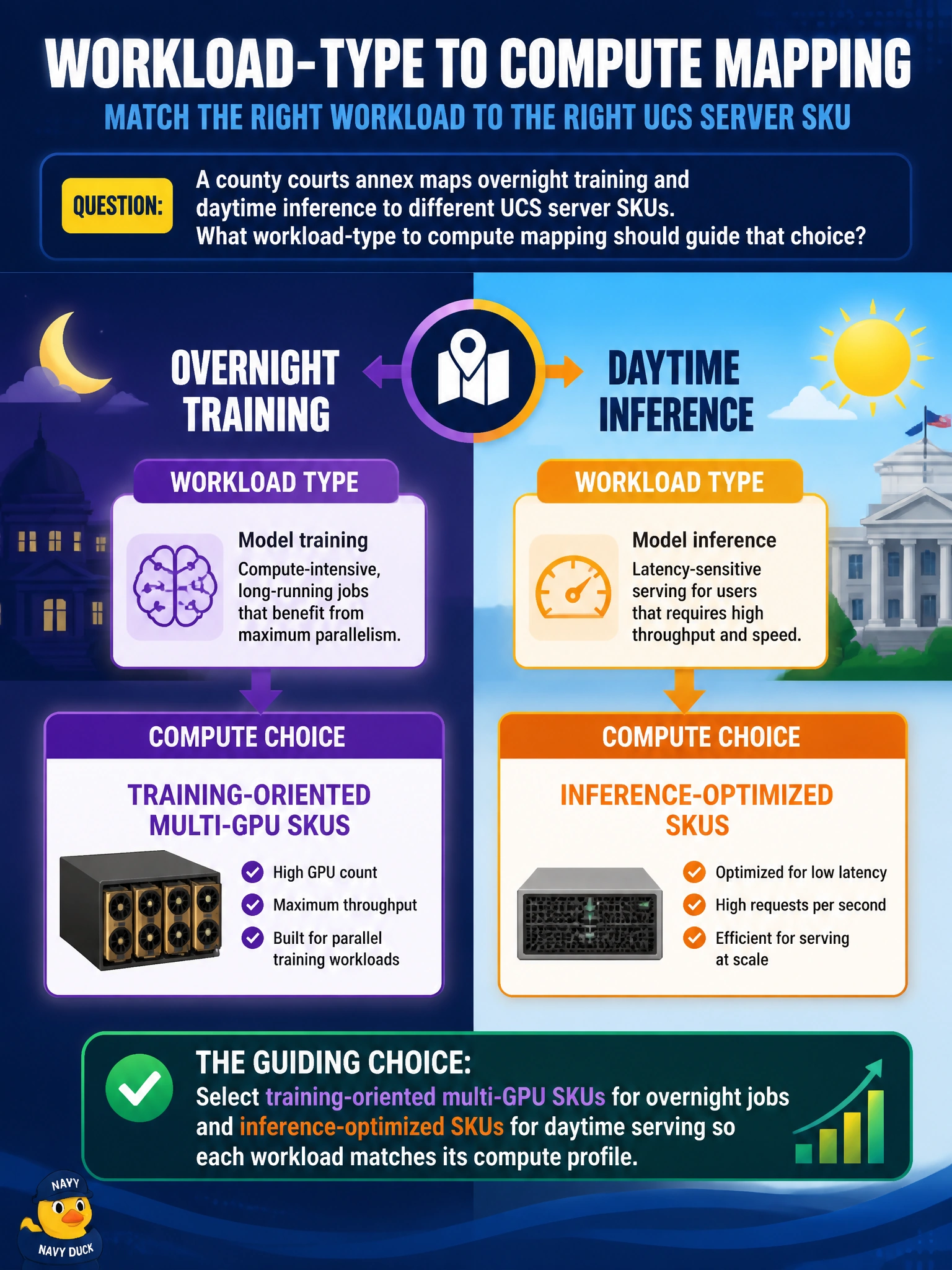
A county courts annex maps overnight training and daytime inference to different UCS server SKUs. What workload-type to compute mapping should guide that choice?
Select an answer to reveal the explanation.
Short Explanation
Training and inference are different sports—marathon vs sprint—so they often want different shoes. Map the heavy overnight trainers to multi-GPU training SKUs and the snappy daytime servers to inference-friendly iron; don't let spares, power and firmware savings, or wear worries pick the SKU.
Full Explanation
County courts annex environments that map overnight training and daytime inference to different UCS server SKUs are applying workload-type to compute mapping. Selecting training-oriented multi-GPU SKUs for overnight jobs and inference-optimized SKUs for daytime serving works because the two profiles differ in GPU density, NVLink appetite, batching, and latency sensitivity. Evaluating AI compute deployment means matching SKUs to those profiles instead of forcing one chassis type to pretend it is optimal for both.
Deploying training-oriented multi-GPU SKUs for overnight jobs and daytime serving to consolidate qualification effort and streamline spare inventory handling fails conceptually: overbuying training density for small interactive daytime models wastes power and capital while under-serving the latency features inference SKUs provide. Selecting inference-optimized SKUs for overnight jobs and daytime serving to lower power draw and simplify shared firmware maintenance procedures fails because it ignores the GPU density, NVLink bandwidth, and batched throughput that overnight training demands, leaving training starved while optimizing for the wrong efficiency metric. Selecting high-memory CPU UCS SKUs for overnight jobs and inference-optimized SKUs for daytime serving to isolate sustained accelerator wear patterns fails because high-memory CPUs lack the GPU density and interconnect needed for overnight training, so training would miss its window while wear isolation substitutes a maintenance concern for workload-type to compute mapping.
Exam caveat: two SKUs increase spare-parts and image complexity; standardization can still win if a single SKU truly meets both profiles under measured load—mapping is analysis, not a mandate for SKU sprawl. Operational check: benchmark overnight training throughput on the training SKU and daytime p99 latency on the inference SKU with real courts models; reject a one-SKU compromise if either window misses its civic SLO.
Prefer to study offline? Printable PDF study book + test engine ($7.50, unofficial). These questions stay free here.