
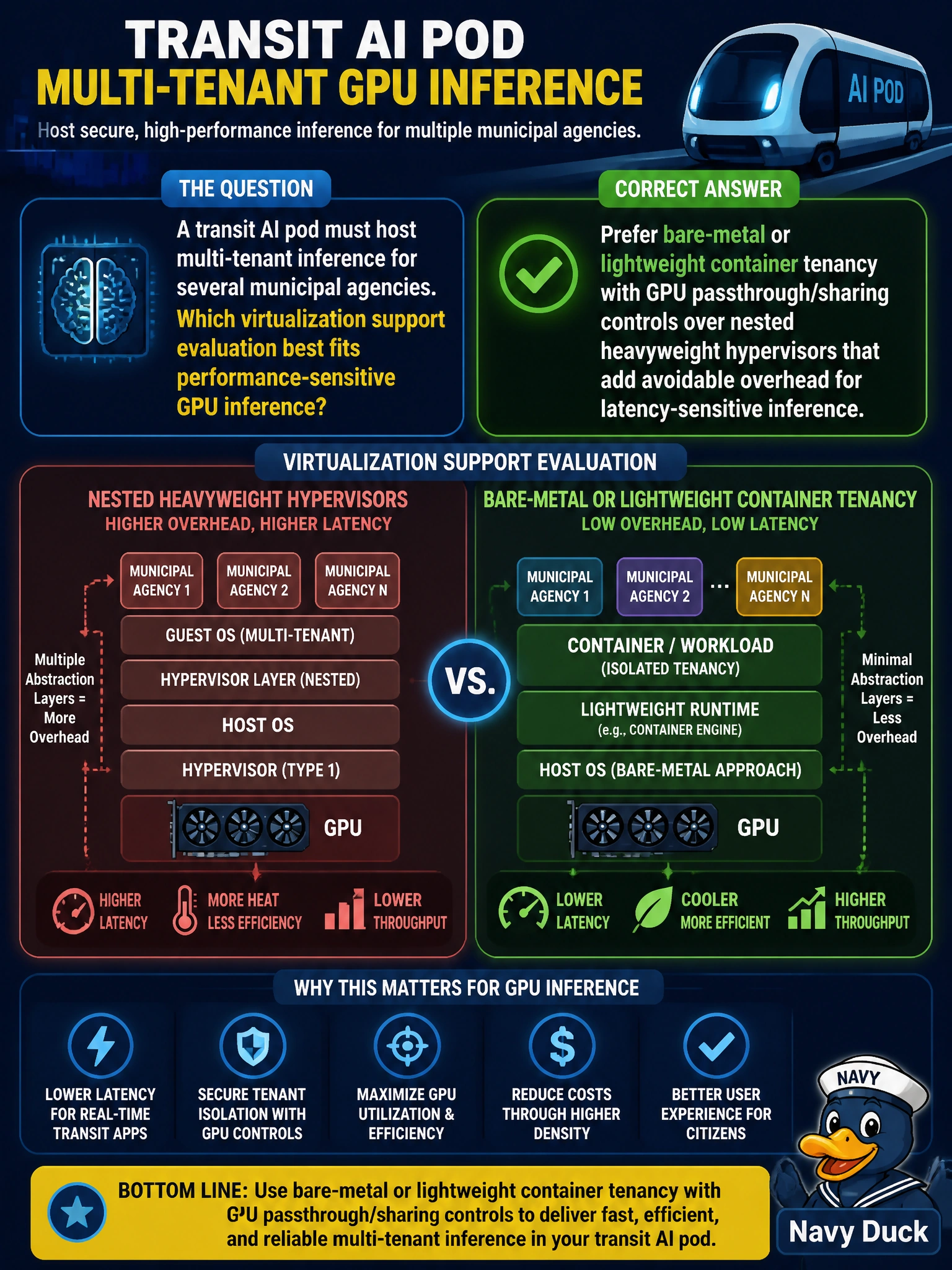
A transit AI pod must host multi-tenant inference for several municipal agencies. Which virtualization support evaluation best fits performance-sensitive GPU inference?
Select an answer to reveal the explanation.
Short Explanation
Multi-tenant inference is like sharing a workshop — you've got GPU passthrough, but you don't want cross-NUMA remote memory pooling adding remote delays you'll feel on every call. MIG sharing is clean, but transparent cross-container page deduplication adds background scanning and jitter you can't absorb on the hot path. You'll usually get real inference speed from bare-metal or lean containers with proper GPU controls, not from nesting Kata VM runtimes inside your pods.
Full Explanation
Transit AI pods hosting multi-tenant inference for several municipal agencies must evaluate virtualization support against latency-sensitive GPU performance. Preferring bare-metal or lightweight container tenancy with GPU passthrough or controlled sharing works because those approaches deliver isolation and tenancy without the deep overhead nested hypervisors add to every inference call. Civic SLAs for citizen-facing transit APIs usually cannot absorb unnecessary virtualization layers on the hot path.
Preferring bare-metal container tenancy with GPU passthrough and cross-NUMA remote memory pooling fails as a performance strategy: passthrough is efficient, but pooling memory across NUMA nodes forces remote accesses over the interconnect that add latency and jitter latency-sensitive inference cannot absorb. Preferring lightweight container tenancy with MIG-partitioned GPU sharing and transparent cross-container page deduplication fails for latency-sensitive serving: MIG provides controlled sharing, but background page scanning for deduplication adds CPU overhead and jitter and weakens cross-container isolation without improving p99 inference latency. Preferring lightweight container tenancy with SR-IOV GPU sharing and nested Kata VM runtimes inside inference pods fails for performance-sensitive inference: the nested VM layer reintroduces avoidable virtualization overhead on the hot path that outweighs its isolation hardening for latency-sensitive agency workloads.
Exam caveat: "lightweight" still requires real tenancy controls (namespaces, device plugins, quotas); bare-metal without mediation can leak one agency’s workload into another’s capacity. Operational check: compare p99 inference latency and GPU utilization under container/passthrough tenancy versus nested VMs for the same transit models, and document the isolation mechanism each agency receives before production cutover.
Prefer to study offline? Printable PDF study book + test engine ($7.50, unofficial). These questions stay free here.