
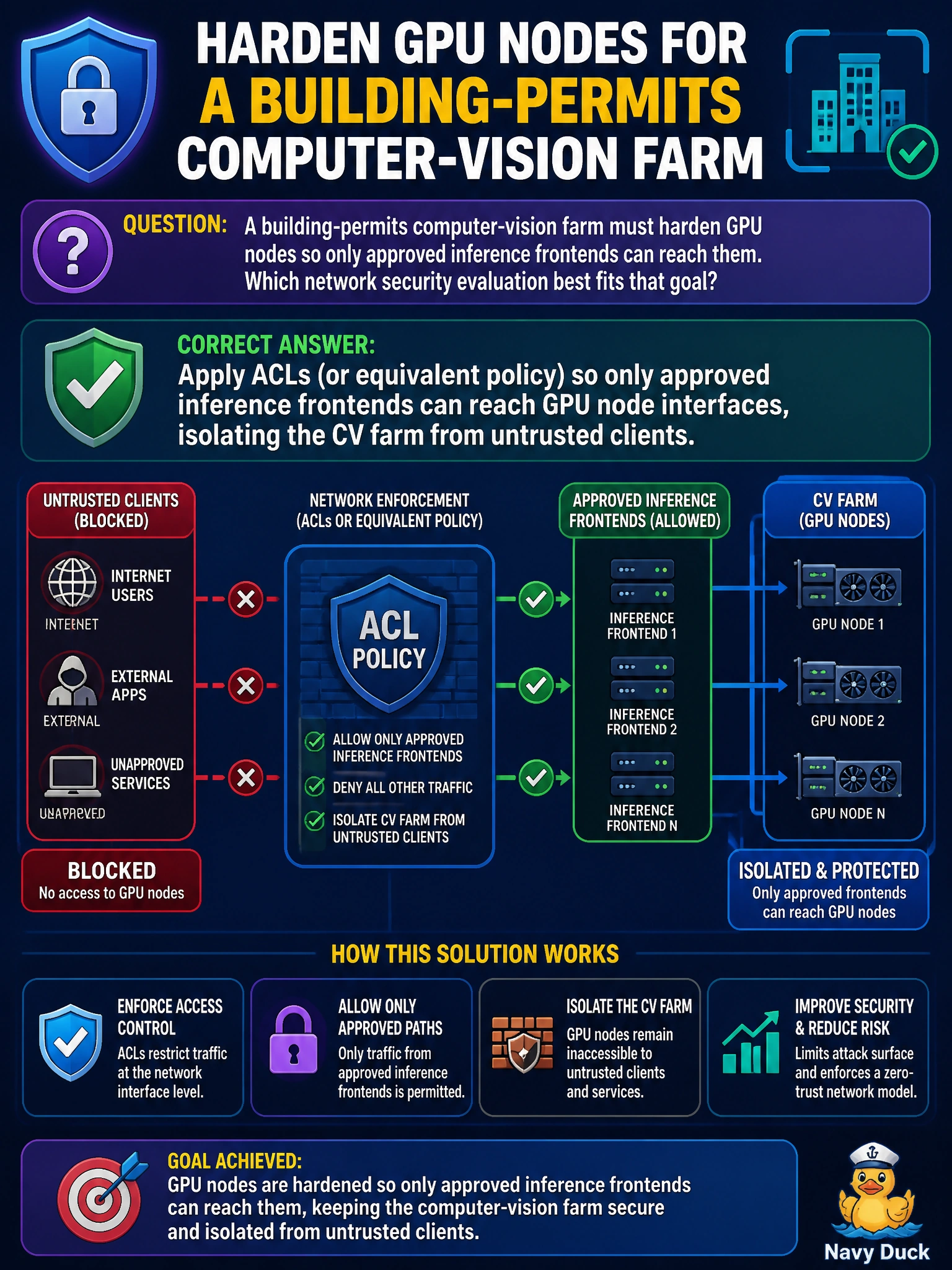
A building-permits computer-vision farm must harden GPU nodes so only approved inference frontends can reach them. Which network security evaluation best fits that goal?
Select an answer to reveal the explanation.
Short Explanation
GPUs are the vault; inference frontends are the tellers with keys. You don't leave the vault door open to the whole building. Tight ACLs—or fabric policy that does the same job—keep only the approved frontends talking to those nodes.
Full Explanation
Building-permits computer-vision farms hold high-value GPU nodes that should accept traffic only from approved inference frontends. Enabling DHCP snooping with dynamic ARP inspection on inference frontend VLANs validates IP-to-MAC bindings for client sessions, but it does not enforce which approved inference frontends may reach GPU node interfaces; address integrity is not an access-control allowlist, and RoCE lossless behavior does not remove the need for reachability filtering. Hardening preserves RoCE/training performance while still enforcing reachability policy at leaf or policy-engine layers.
Deploying MACsec encryption on spine-leaf links secures RoCE transport between GPU nodes and approved inference frontends, but it does not restrict which frontends can reach GPU node interfaces; link-layer confidentiality is not access control and leaves the frontend allowlist requirement unmet. Isolating GPU management interfaces in a dedicated management VRF with authenticated jump-host access controls platform operations for patching and monitoring, yet it does not govern whether approved inference frontends can reach GPU data interfaces; it addresses admin-plane access, not the frontend-to-GPU reachability policy. Dismissing ACLs because lossless fabrics supposedly cannot coexist with security controls is a false dichotomy, and replacing them with DHCP snooping or dynamic ARP inspection is equally insufficient: neither provides an allowlist of approved inference frontends at the GPU node interface, and both fail to enforce the required reachability control.
Exam caveat: overly broad deny ACLs can break legitimate health checks, orchestration agents, and storage mounts—policy must whitelist the full approved frontend and control-plane set, not only the user-facing API VIP. Operational check: from an untrusted municipal VLAN, attempt reachability to GPU data/management IPs and confirm deny; from approved frontends, confirm allow; review ACL counters and change tickets so permit-farm hardening stays aligned after frontend IP changes.
Prefer to study offline? Printable PDF study book + test engine ($7.50, unofficial). These questions stay free here.