
A fleet telematics AI zone plans to enable an RDMA fabric for GPU training. What network feature readiness should be re-evaluated before cutover?
Select an answer to reveal the explanation.
Short Explanation
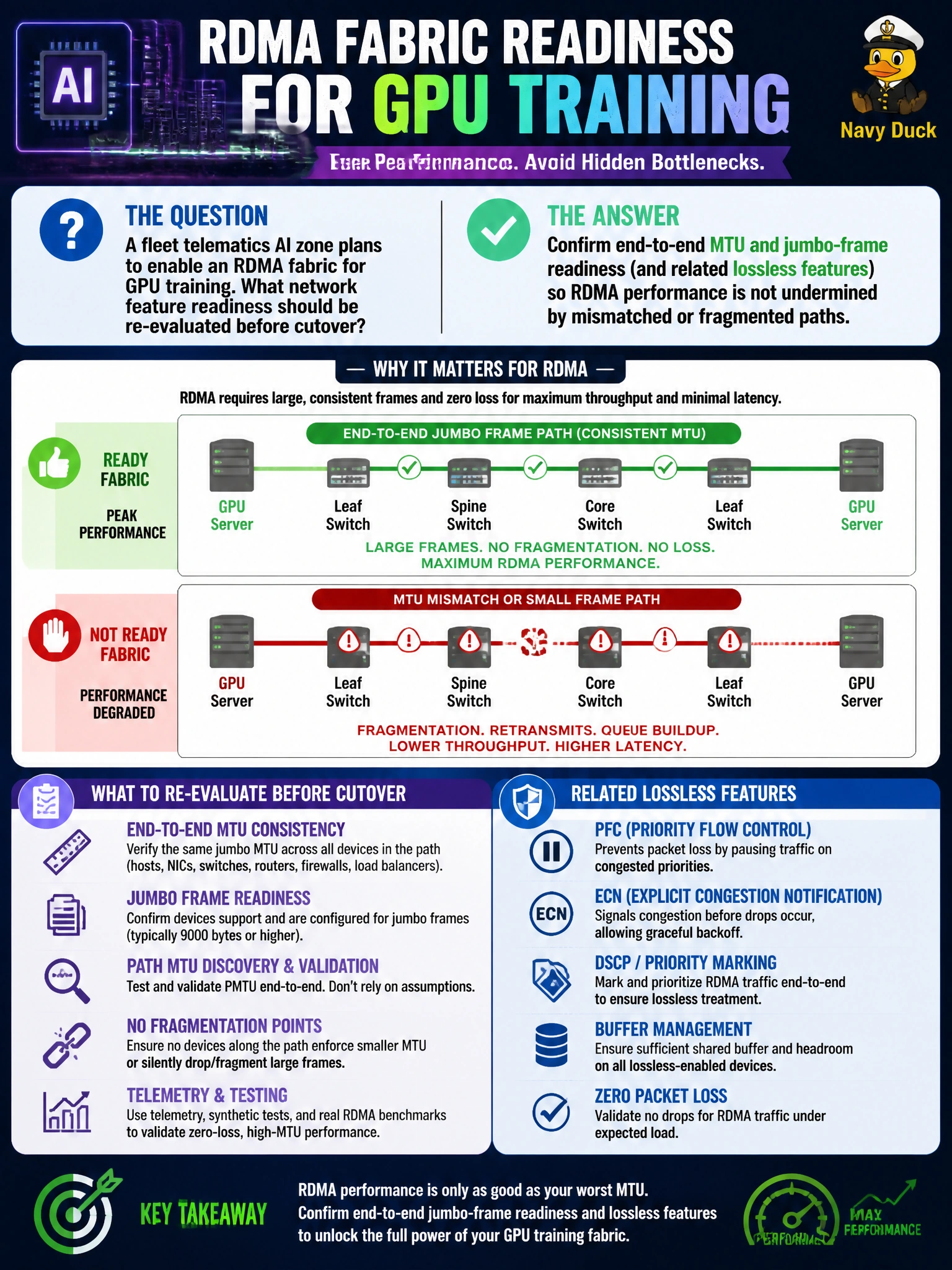
RDMA hates surprises—like mailing a giant poster through a tiny mail slot. If MTU and jumbo readiness aren’t solid end to end, packets get chopped up and the fast path falls apart. Check the whole path before you flip RDMA on.
Full Explanation
Fleet telematics AI zones enabling RDMA for GPU training must re-check end-to-end MTU and jumbo-frame readiness (plus related lossless features such as PFC/ECN where used) before cutover. That evaluation works because RoCE/RDMA performance assumes consistent large frames and a path that does not silently fragment or drop under congestion. A single undersized hop—TOR, spine, border, or storage leaf—undermines the fast path and shows up as poor collectives even when NICs and GPUs are healthy. Verifying egress QoS queue assignments and WRED drop profiles for backup replication does not give RDMA collectives prioritized lossless handling across the fabric: those settings tune lossy drop behavior for TCP backup traffic, not the consistent MTU plus PFC/ECN lossless behavior that RoCE requires inside the GPU fabric. Validating MLAG peer-link timers and STP root priorities on leaf uplinks does not sustain lossless RDMA behavior during rapid path failover: MLAG timers and spanning-tree control Layer 2 redundancy and loop prevention, whereas RDMA losslessness depends on consistent MTU plus PFC/ECN congestion handling across the fabric. Confirming TCP MSS clamping values and PMTUD probe settings on the border leaf cannot avoid RDMA fragmentation during large collective transfers: MSS clamping and PMTUD are TCP path controls, while RoCE/RDMA runs over UDP without TCP segmentation, so fragmentation is prevented only by matching end-to-end MTU along the fabric path. Exam caveat: jumbo readiness is necessary but not sufficient; PFC storms, mis-mapped priority groups, and asymmetric ECN marking can still ruin RDMA even when MTU matches. Operational check: verify identical MTU and jumbo capability from GPU NIC through every hop to peer NICs and storage, run RDMA bandwidth/latency baselines, and document lossless/congestion settings before declaring the telematics RDMA fabric ready.
Prefer to study offline? Printable PDF study book + test engine ($7.50, unofficial). These questions stay free here.