
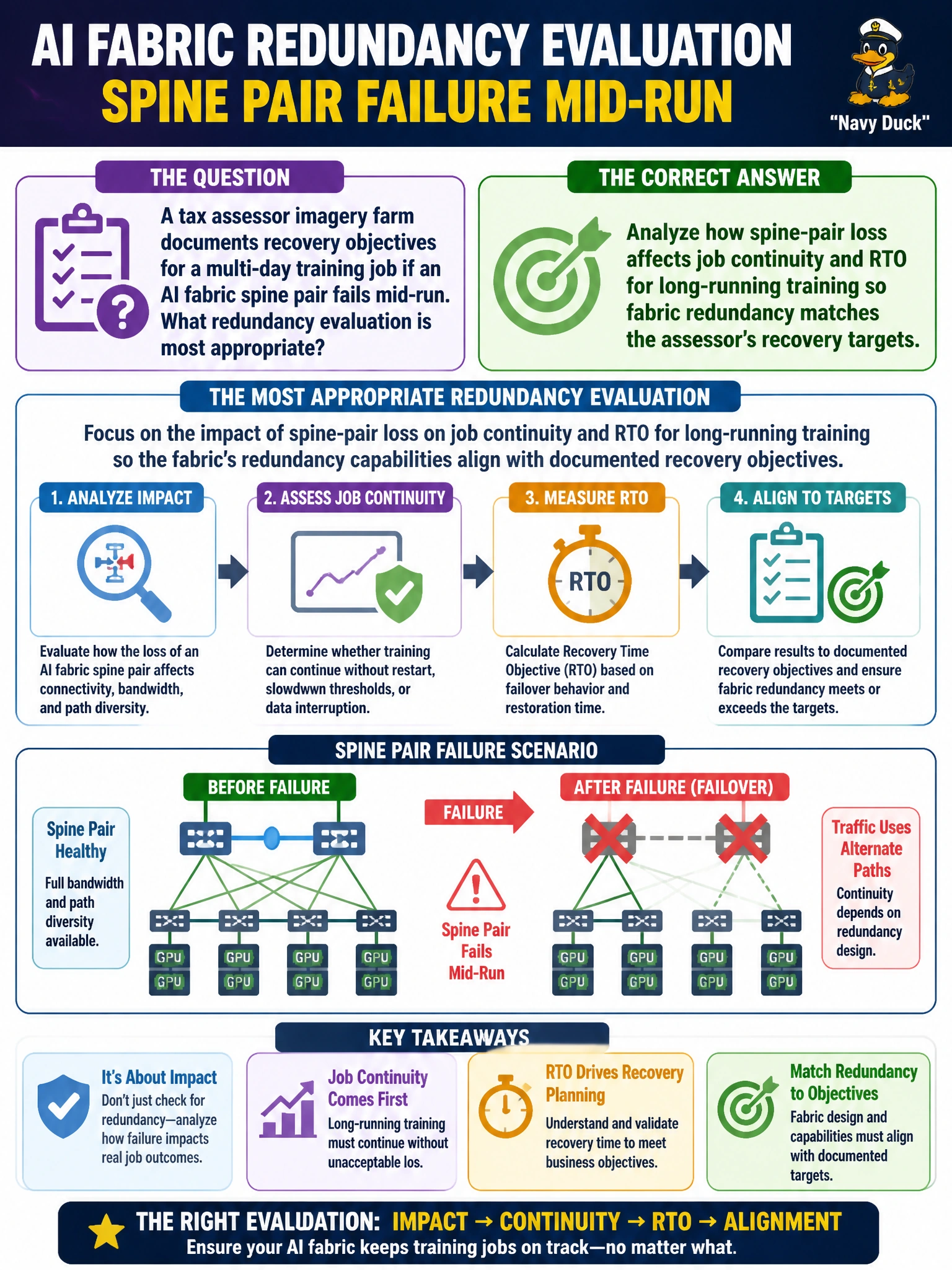
A tax assessor imagery farm documents recovery objectives for a multi-day training job if an AI fabric spine pair fails mid-run. What redundancy evaluation is most appropriate?
Select an answer to reveal the explanation.
Short Explanation
A multi-day train is like a marathon—if the road collapses at mile twenty, you care how fast you get runners moving again. Spine-pair failure isn’t just a blinky light; it can yank the job’s path out from under it. Map that fabric hit to real RTO, not wishful thinking.
Full Explanation
Measuring ECMP reconvergence time after spine-pair loss alone to validate fabric RTO risks unplanned training downtime; reconvergence milliseconds do not prove the long-running job continues, and imagery-farm RTO depends on collective stall, timeout and restart behavior as well as fabric path availability. Evaluating checkpoint write and reload speed after spine-pair loss still overlooks fabric redundancy; fast checkpoint I/O measures model-state recovery cost, not whether redundant paths preserve job continuity, and a spine-pair failure can still stall all-reduce operations even if checkpoints reload quickly. Mapping those outcomes to the assessor’s documented recovery targets ensures dual spines (and related leaf/uplink redundancy) are justified by civic RTO needs rather than by cabling aesthetics alone.
Benchmarking collective throughput under spine-pair loss fails as a redundancy evaluation for recovery objectives—it measures degraded-case bandwidth, not job continuity and RTO, so it cannot validate whether a multi-day training run recovers within the assessor’s targets when both spines are down.
Exam caveat: redundancy analysis must include both unplanned failure and planned maintenance; a design that survives cable cuts but not spine software upgrades still misses civic change windows. Operational check: run a failure-mode worksheet for spine-pair loss (checkpoint interval, expected restart time, partial-fabric degraded modes), compare to written RTO, and verify monitoring alerts fire when redundant paths are lost so assessor ops can decide abort-versus-continue before the window expires.
Prefer to study offline? Printable PDF study book + test engine ($7.50, unofficial). These questions stay free here.