
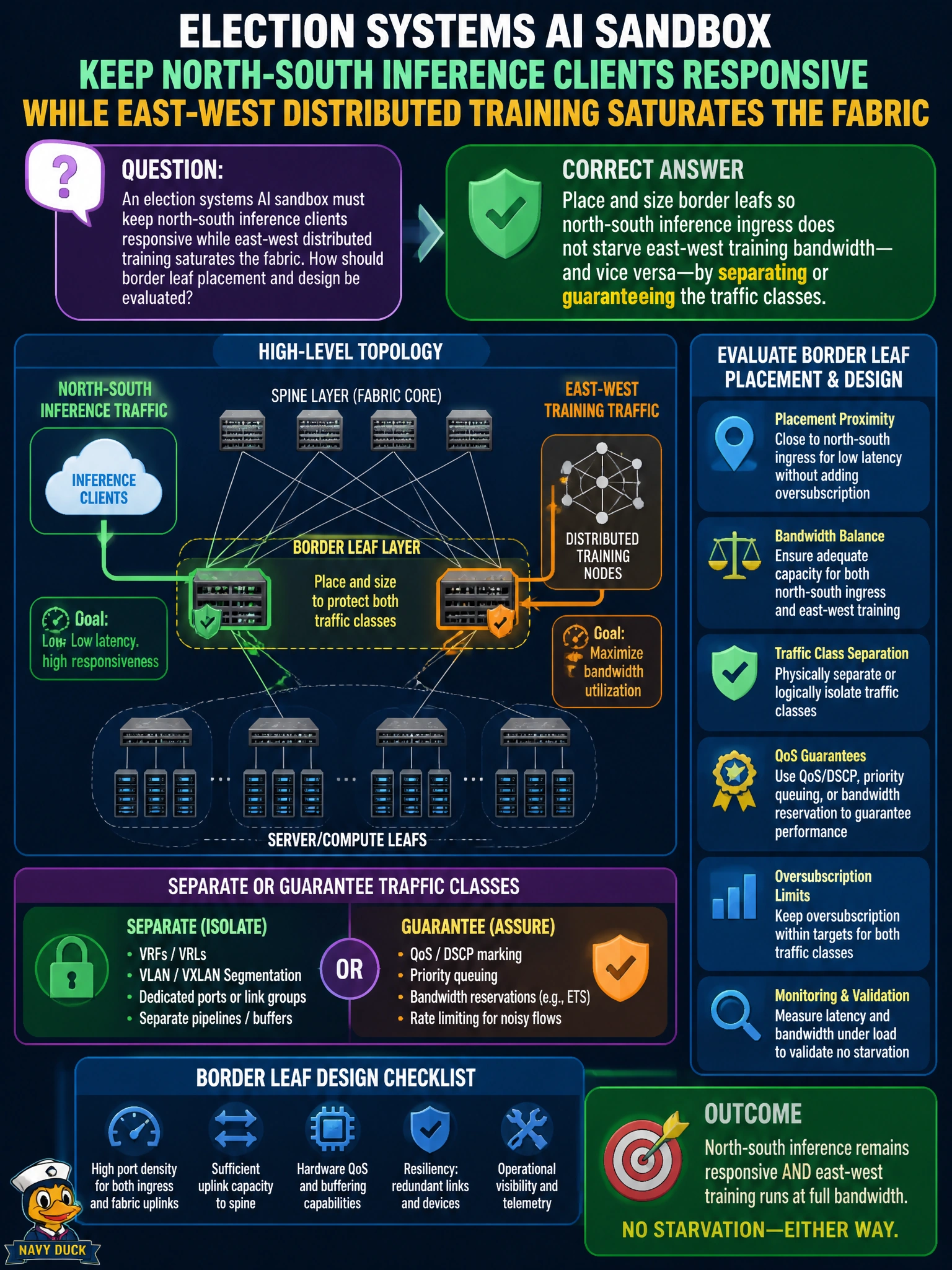
An election systems AI sandbox must keep north-south inference clients responsive while east-west distributed training saturates the fabric. How should border leaf placement and design be evaluated?
Select an answer to reveal the explanation.
Short Explanation
Think of a busy two-lane bridge: one lane for local shoppers (inference) and one for heavy trucks (training). If you just share the same ECMP lanes and trust hash tweaks to keep it even, you'll still stall shoppers when trucks flood the bridge. Border leafs are that on-ramp—size and place them so north-south clients and east-west collectives can coexist.
Full Explanation
Relying on core routers to shape north-south inference and storage endpoints to throttle east-west training ignores the role of border-leaf design as the control point where external clients meet the AI fabric; without enforcement at that control point, upstream shaping and endpoint throttling cannot reliably separate or guarantee traffic classes for both training and inference when both peak together. Placing and sizing border leafs so inference ingress does not starve training—and training does not starve inference—works because border leafs are the control point where external clients meet the AI fabric. Separating classes (distinct border leafs, VRFs, or guaranteed QoS/bandwidth) lets elections staff query models without collapsing training jobs, and lets collectives finish without black-holing interactive clients.
Having north-south inference and east-west training share ECMP spine paths with hashed polarization control to keep balanced bandwidth fails because ECMP spreading and polarization tuning only distribute flows across links and cannot separate or guarantee bandwidth between elephant east-west flows and latency-sensitive north-south queries when training saturates the fabric; inference will still starve on the shared paths. Placing border leafs with isolated north-south inference VRFs and enforcing spine-level PFC pauses to guarantee east-west training throughput fails because isolated VRFs alone provide route separation without data-plane bandwidth guarantees, and spine-level PFC pauses spread backpressure across shared buffers causing head-of-line blocking that stalls responsive inference without preserving mutual fairness.
Exam caveat: "separate or guarantee" does not always mean physically discrete hardware; logical isolation plus admission control can suffice if capacity math still holds under peak training and peak inference together. Operational check: measure inference p99 latency and training iteration time while both loads run, confirm border leaf and uplink headroom, and document the policy (ACL/QoS/leaf assignment) that enforces class coexistence for election windows.
Prefer to study offline? Printable PDF study book + test engine ($7.50, unofficial). These questions stay free here.