
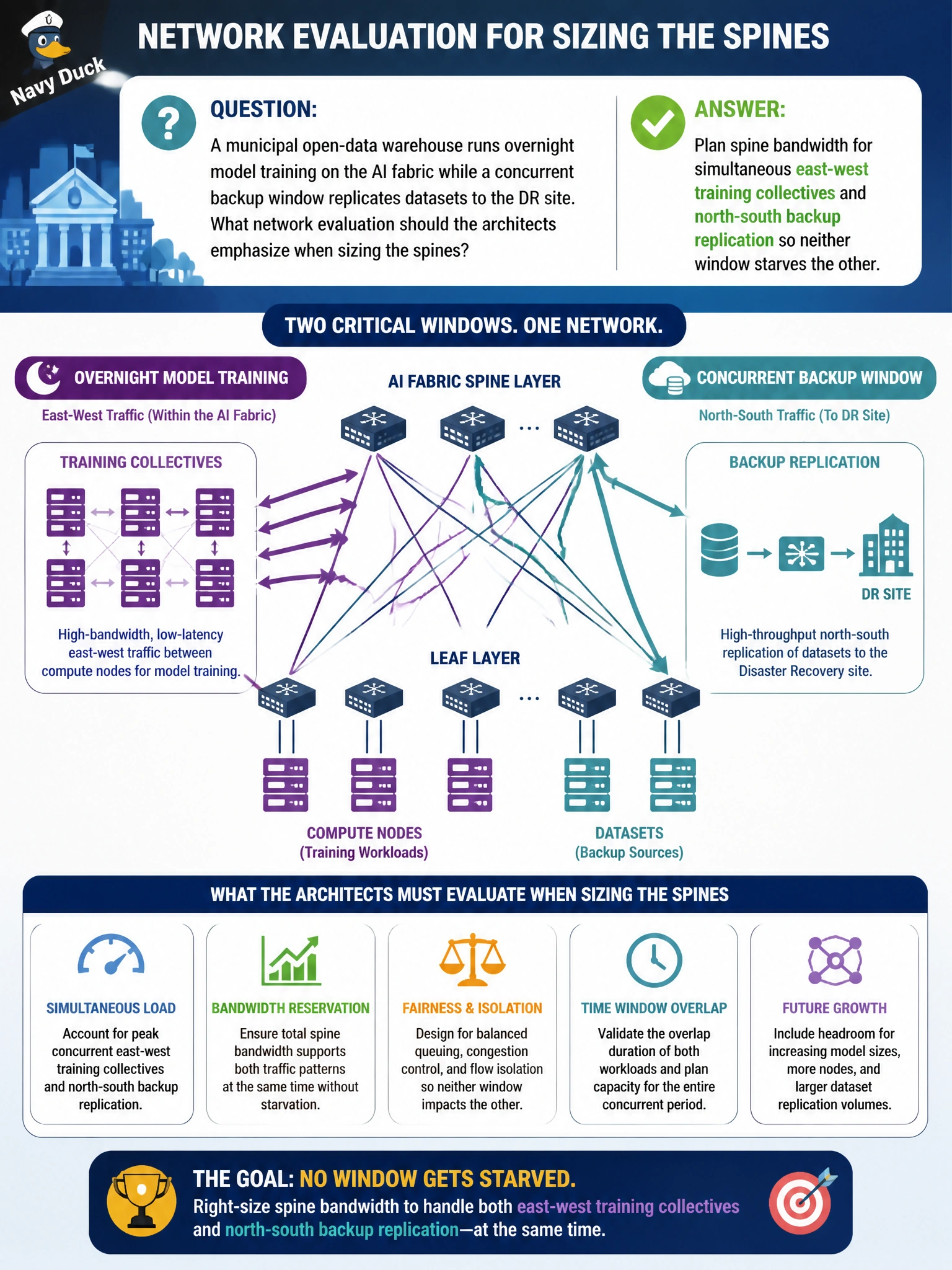
A municipal open-data warehouse runs overnight model training on the AI fabric while a concurrent backup window replicates datasets to the DR site. What network evaluation should the architects emphasize when sizing the spines?
Select an answer to reveal the explanation.
Short Explanation
You've got two firehoses sharing one pipe — training collectives pushing east-west while backup replication pushes north-south. You'll stall one window if you're relying on web-style 4:1 oversubscription, ECN alone, or PFC pauses on training, so size the spine bisection for both floods at full rate together.
Full Explanation
Planning spine capacity for simultaneous east-west training collectives and north-south backup replication using 4:1 oversubscription for web traffic conflicts with operational resilience; the spine must be provisioned with low oversubscription suitable for AI collectives and backup replication simultaneously over the data plane. Those two flows both need spine (and often border-uplink) capacity at once. Planning spine bandwidth for simultaneous east-west training and north-south backup works because contention planning is the core network evaluation for overlapping AI and data-protection windows: if either class can starve the other, the city either misses training SLAs or fails backup RPO. Architects should treat the spines as shared critical infrastructure sized for the concurrent case, not for whichever workload was louder in the last meeting.
Planning spine capacity for simultaneous east-west training collectives and north-south backup replication using 4:1 oversubscription for web traffic fails conceptually because 4:1 oversubscription is engineered for bursty web access, not for sustained GPU collectives overlapping multi-terabyte replication; that ratio starves bisection and risks missing both training completion targets and backup RPO. Sizing spine bandwidth for simultaneous east-west training collectives and north-south backup replication relying on ECN marking to absorb collective incast fails because ECN only signals congestion and does not create capacity for sustained all-reduce incast overlapping replication; without sufficient spine bisection, queues remain saturated and both training SLAs and backup RPO suffer. Provisioning spine bandwidth for simultaneous east-west training collectives and north-south backup replication preferring backup with PFC pause on training fails because pausing training collectives stalls synchronization, risks head-of-line blocking, and violates the requirement that neither window starves the other; municipal training and backup still need shared nonblocking capacity with fair scheduling or QoS, not priority pause of GPU traffic.
Exam caveat: concurrent-window sizing assumes realistic schedules; if operations can hard-separate training and backup into non-overlapping windows with proven enforcement, peak simultaneous demand drops—but many cities cannot guarantee that separation under change freezes and overnight ops. Operational check: model spine utilization with both training all-reduce/broadcast traffic and DR replication at peak rates, document QoS or scheduling guarantees, and verify neither window breaches RPO/RTO or training completion targets when both run together.
Prefer to study offline? Printable PDF study book + test engine ($7.50, unofficial). These questions stay free here.