
Parks IoT AI edge backhaul adds a second pod and must extend the AI fabric cleanly. What should architects evaluate?
Select an answer to reveal the explanation.
Short Explanation
You'll want a fabric where a second pod plugs in cleanly, since prioritizing internet egress for north-south traffic won't help you scale east-west across pods. Design for clean extension across pods and sites. Enforcing PFC pause frames handles link-level flow control and stretching Layer 2 VLANs just expands broadcast domains, so they won't give you clean multi-pod fabric extension.
Full Explanation
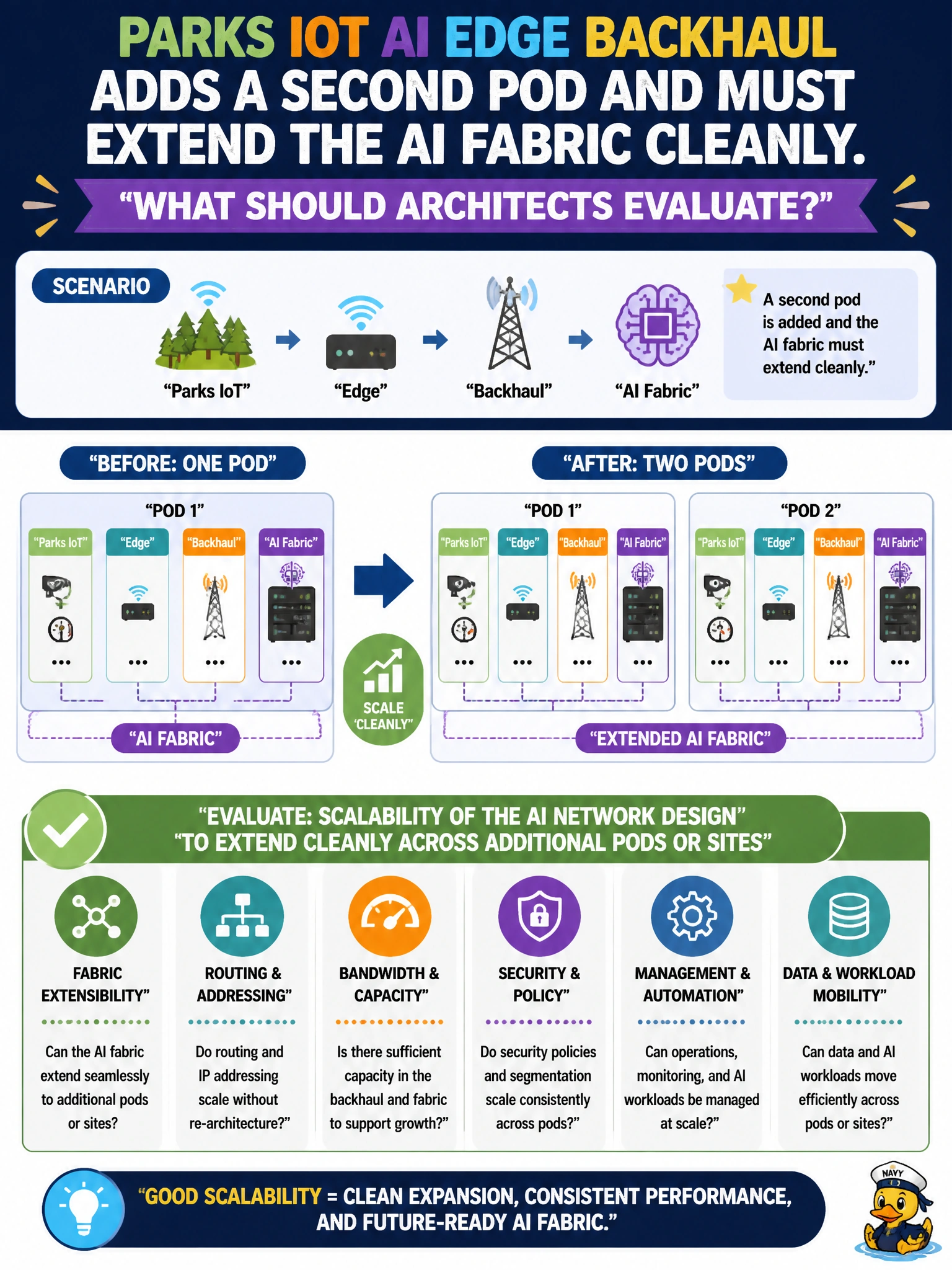
When parks IoT AI edge backhaul adds a second pod and must extend the AI fabric cleanly, architects should evaluate scalability of the AI network design to extend cleanly across additional pods or sites. Growth should plug into an addressing and topology plan that already expected another pod, preserving redundancy and operations patterns rather than prioritizing internet egress for north-south traffic, which does not help extend the fabric across pods.
Evaluating efficiency of the AI network design to prioritize internet egress for north-south traffic is a north-south egress concern and does not address the stem's requirement to extend the AI fabric across additional pods or sites. Reliability of the AI network design to enforce PFC pause frames on edge inference links addresses link-level flow control only and does not extend the fabric to new pods or sites. Capacity of the AI network design to stretch Layer 2 VLANs across pods or sites expands broadcast domains and failure scope rather than enabling clean, scalable fabric expansion across a second pod.
Exam caveat: Scalability to extend AI fabrics across pods or sites is a core evaluation attribute when municipal AI footprints grow—not internet egress prioritization for north-south traffic, PFC pause-frame enforcement on edge inference links, or stretching Layer 2 VLANs across pods or sites.
Operational check: before racking the second parks AI pod, validate that IP/topology plans absorb it cleanly, keep dual paths on the new pod, and run a connectivity and failure test that proves extension rather than internet egress prioritization, PFC pause-frame enforcement, or Layer 2 VLAN stretch checks.
Prefer to study offline? Printable PDF study book + test engine ($7.50, unofficial). These questions stay free here.