
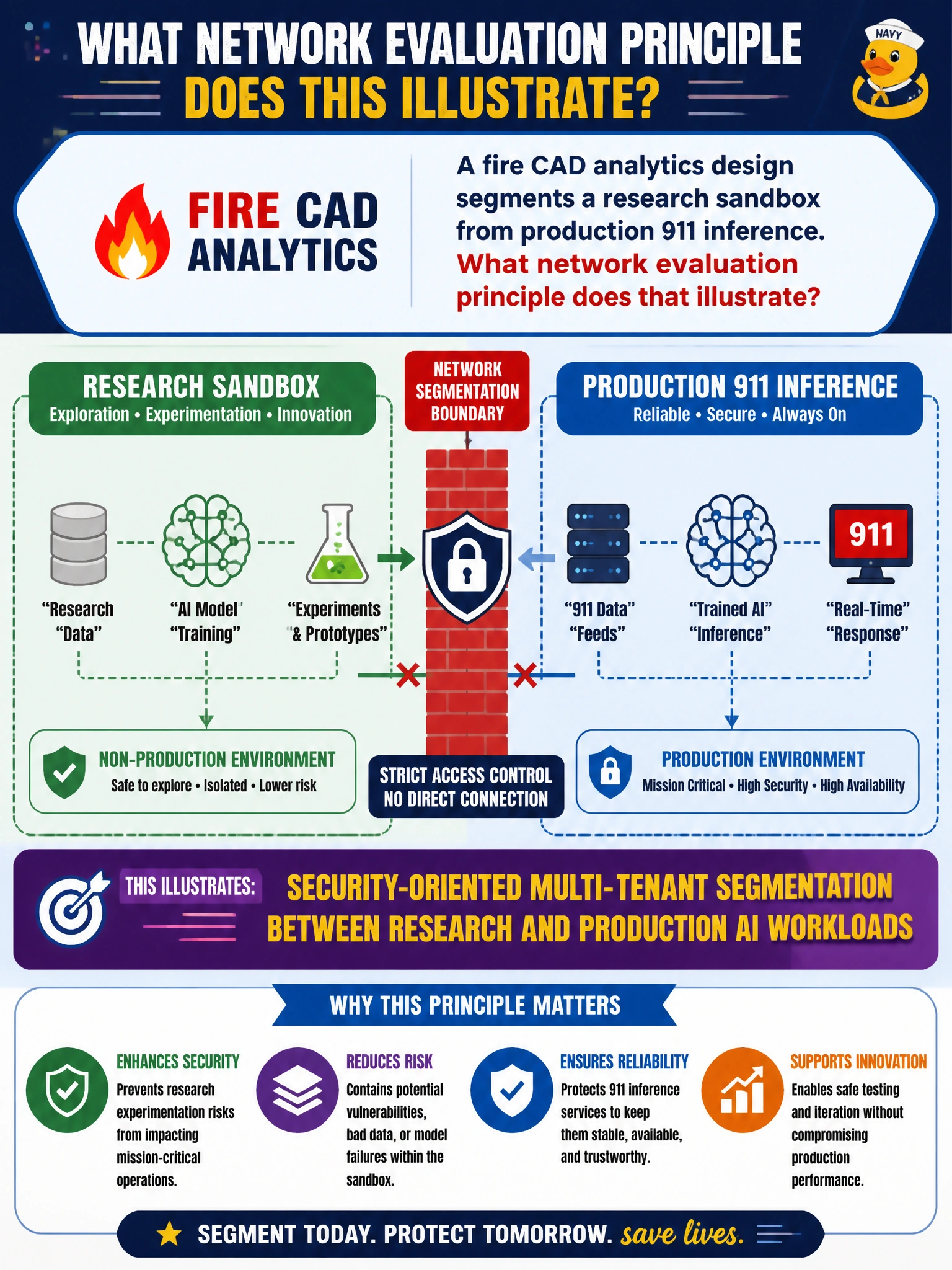
A fire CAD analytics design segments a research sandbox from production 911 inference. What network evaluation principle does that illustrate?
Select an answer to reveal the explanation.
Short Explanation
Research toys and live 911 inference should not share a trust domain. Segment tenants so experiments can't spill into production. Tuning that segmentation for latency, throughput, or observability won't give you the security containment you need.
Full Explanation
A fire CAD analytics design that segments a research sandbox from production 911 inference illustrates security-oriented multi-tenant segmentation between research and production AI workloads. Experiments and untrusted research tooling must not share the same trust domain as live 911 inference, so policy and network boundaries contain blast radius if a sandbox goes wrong. That principle protects emergency inference availability and integrity while research continues elsewhere.
Latency-optimized multi-tenant segmentation between research and production AI workloads is a performance goal, not the trust-boundary problem; faster segmentation says nothing about whether a research mistake can still reach production 911 inference. Throughput-oriented multi-tenant segmentation between research and production AI workloads maximizes throughput, which if anything increases contact between research and production workloads rather than containing a sandbox failure's blast radius. Observability-oriented multi-tenant segmentation between research and production AI workloads may help operations see both environments, but optimizing segmentation for visibility is an observability choice, not the segmentation that keeps a sandbox mistake from reaching live 911 inference.
Exam caveat: Multi-tenant segmentation between research and production AI is a network evaluation security principle—especially where production serves 911 or other safety-critical inference. Operational check: verify distinct VRFs/VLANs/policies between fire research sandbox and production 911 inference, keep authentication on GPU APIs, and probe for cross-tenant reachability before promoting any sandbox experiment toward production.
Prefer to study offline? Printable PDF study book + test engine ($7.50, unofficial). These questions stay free here.