
A police evidence AI zone needs predictable latency for synchronous distributed training. Which criterion should network evaluation emphasize?
Select an answer to reveal the explanation.
Short Explanation
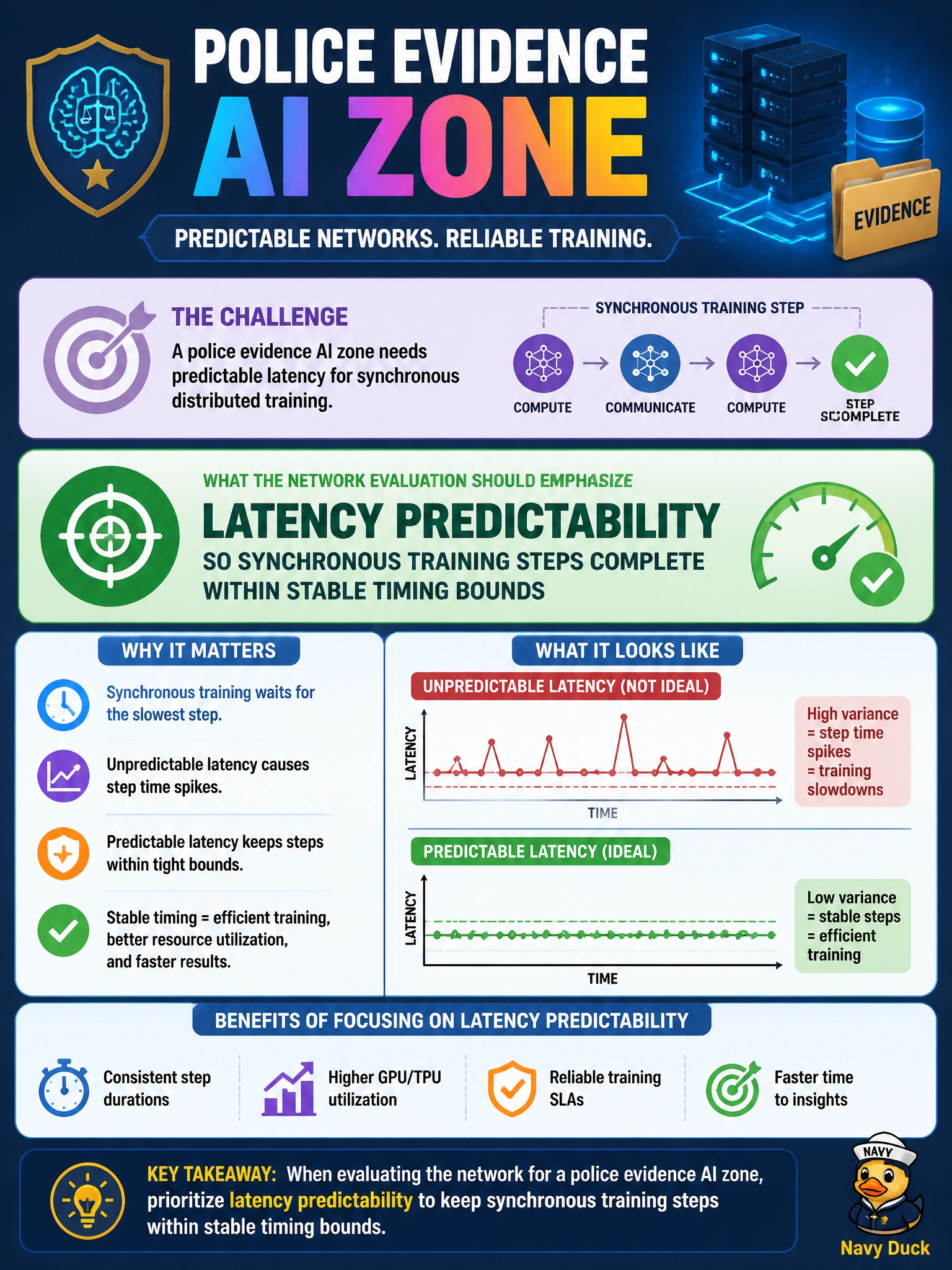
Sync training is a drum circle—every GPU has to hit the beat. Predictable latency keeps your circle tight; steady throughput and smoothed-out mean times don't tell you you'll hit it. And nailing predictable deadlines for your evidence queries won't save your training flows either.
Full Explanation
A police evidence AI zone that needs predictable latency for synchronous distributed training should emphasize latency predictability so synchronous training steps complete within stable timing bounds. Synchronous collectives wait on the slowest participant; unbounded jitter stretches barriers and wastes GPU cycles even when average bandwidth looks healthy on paper. Evidence-zone training therefore evaluates delay distribution, not only stable data delivery rates. Throughput predictability so synchronous training steps sustain stable data delivery rates misses the sync barrier problem: a link can deliver stable average rates while still carrying the latency variance that stalls every GPU at each synchronous step. Latency averaging so synchronous training steps achieve stable mean completion times fails because a stable mean smooths over the tail-latency spikes that matter most; synchronous collectives wait on the single slowest completion, not the average. Latency predictability so evidence query steps complete within stable response deadlines applies the right measure to the wrong workload; it bounds jitter for evidence queries while leaving the GPU sync-training barriers unprotected. Exam caveat: For synchronous distributed training, predictable latency is a primary evaluation criterion—not throughput predictability for stable delivery rates, latency averaging for stable mean times, or latency predictability aimed at evidence query deadlines. Operational check: measure latency distribution (not only mean completion times) across the evidence AI zone under load, keep training off high-jitter paths, and validate predictability for synchronous training steps themselves, not just evidence query steps.
Prefer to study offline? Printable PDF study book + test engine ($7.50, unofficial). These questions stay free here.