
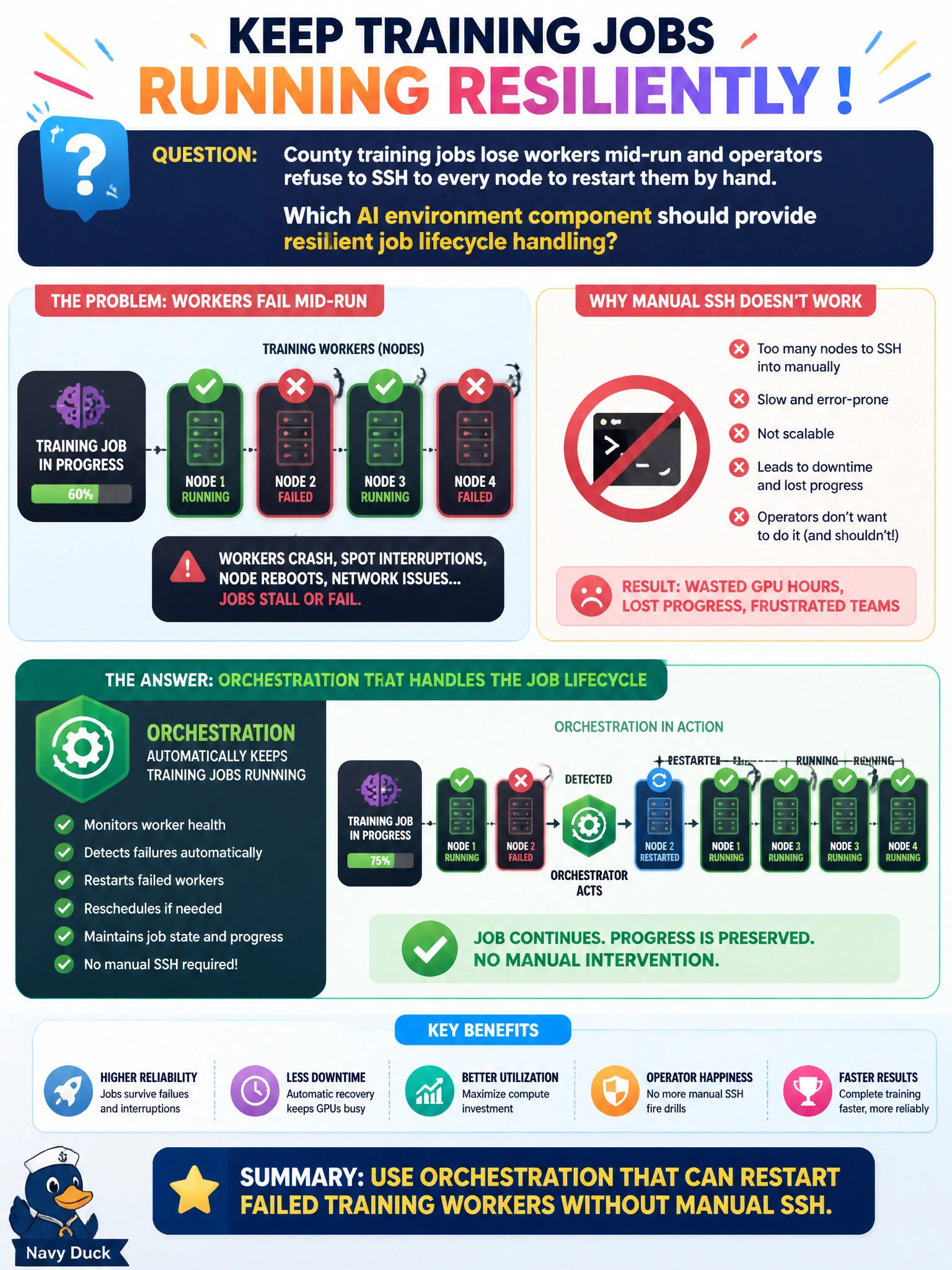
County training jobs lose workers mid-run and operators refuse to SSH to every node to restart them by hand. Which AI environment component should provide resilient job lifecycle handling?
Select an answer to reveal the explanation.
Short Explanation
When a training worker face-plants, orchestration should pick it back up — not page someone to SSH around the rack like it is 1999. Resilient job lifecycle is why orchestration sits in the AI component list. A monitoring dashboard won't restart workers for you — you'll just get charts and alerts, and your versioned object storage and container registry can't revive jobs on their own because they don't schedule work.
Full Explanation
Orchestration that can restart failed training workers without manual SSH provides resilient job lifecycle handling for county training fleets. The correct component works because schedulers detect worker loss, reschedule or restart tasks, and keep multi-node jobs progressing without operators SSHing node-by-node like an emergency pager tree. Resilient lifecycle automation is a core reason orchestration appears in the AI environment component list alongside compute and storage.
A monitoring dashboard that restarts failed training workers without manual SSH fails because dashboards only observe and alert on metrics; they have no scheduler to detect worker loss and restart training tasks automatically. Versioned object storage that revives failed training workers without manual SSH fails because it only stores checkpoint artifacts for resume; it is not cluster-aware orchestration and cannot reschedule or restart failed workers. A container registry that redeploys failed training workers without manual SSH fails because it only stores and versions image artifacts; it does not provide lifecycle recovery or restart failed workers for municipal training SLAs.
Exam caveat: blind retries without root-cause limits, health checks, or backoff can thrash bad nodes and hide underlying hardware or data faults. Operational check: kill a training worker in a controlled test job and confirm orchestration restarts it without manual SSH; document retry and alert policy; reject monitoring-dashboard, versioned-object-storage, and container-registry options when resilient job lifecycle is required.
Prefer to study offline? Printable PDF study book + test engine ($7.50, unofficial). These questions stay free here.