
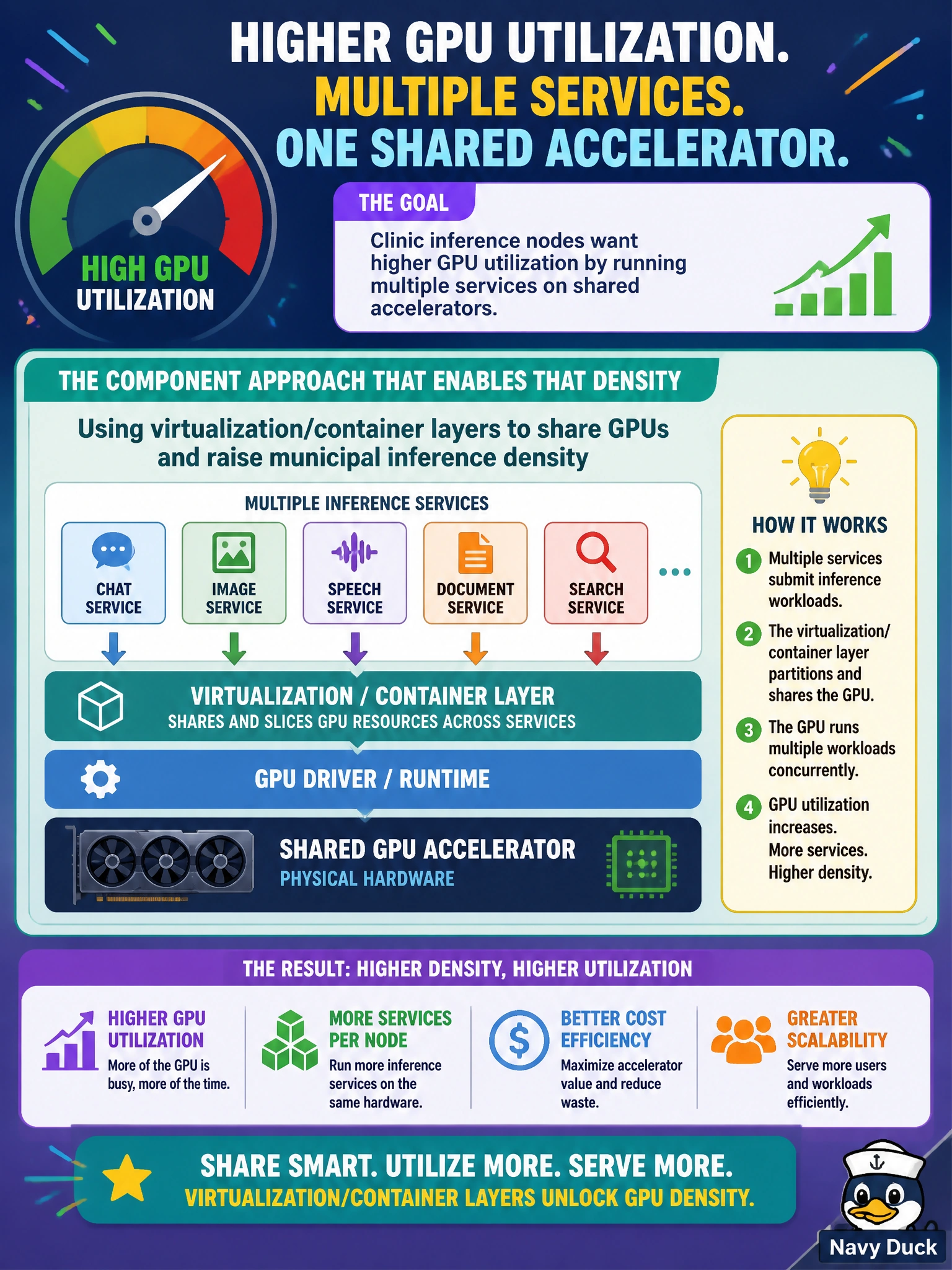
Clinic inference nodes want higher GPU utilization by running multiple services on shared accelerators. Which component approach primarily enables that density?
Select an answer to reveal the explanation.
Short Explanation
Sharing a GPU across well-isolated services is like carpooling a scarce taxi so you'll get more from it, which faster GPU-to-GPU links can't give you since they just move data between GPUs. Virtualization and containers let you pack more inference onto the same accelerators safely. Adding NVLink fabric won't let you split one GPU among services, so you won't get that density.
Full Explanation
Using virtualization/container layers to share GPUs and raise municipal inference density primarily enables higher utilization when clinic nodes run multiple services on shared accelerators. The correct approach works because packaging and GPU-sharing mechanisms let several isolated inference services co-reside, reducing idle accelerator time versus one tiny model per dedicated box. Density with isolation is the component goal.
Using NVLink fabric interconnects to share GPUs and raise municipal inference density fails because NVLink provides high-bandwidth GPU-to-GPU interconnect for data movement between accelerators, which does nothing to let multiple isolated services share compute slices on the same GPU; it addresses inter-GPU bandwidth, not accelerator sharing density. Using weight quantization toolkits to share GPUs and raise municipal inference density fails conceptually because reducing model precision and footprint lowers per-model resource needs but provides no packaging or isolation mechanism to let multiple services co-reside on a shared accelerator; it addresses model efficiency, not GPU sharing utilization. Using PCIe power-capping controls to share GPUs and raise municipal inference density fails because capping power draw only constrains energy and thermal envelopes and never consolidates isolated services onto shared accelerators; it addresses power management, not computational density.
Exam caveat: GPU sharing can introduce noisy-neighbor latency; MIG, quotas, or careful placement may be required for clinical SLOs. Operational check: enable container/virt GPU sharing with isolation controls, measure utilization before/after consolidation, keep clinical SLOs, and reject NVLink fabric interconnects, weight quantization toolkits, or PCIe power-capping controls as substitutes for real density strategies.
Prefer to study offline? Printable PDF study book + test engine ($7.50, unofficial). These questions stay free here.