
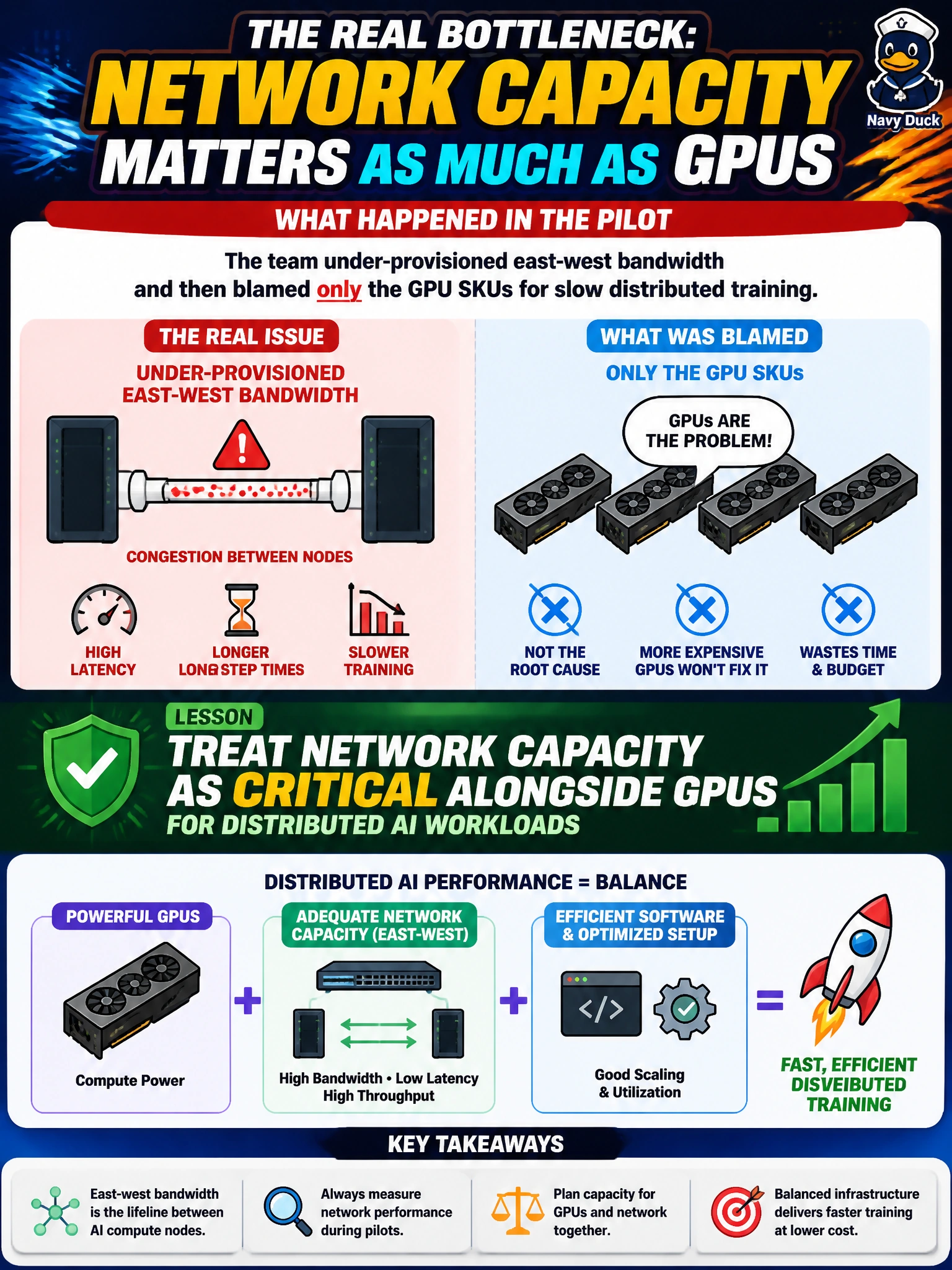
A housing AI pilot under-provisions east-west bandwidth and then blames only the GPU SKUs for slow distributed training. What component lesson should the team apply?
Select an answer to reveal the explanation.
Short Explanation
A cluster with 100 GPUs and a skinny network is like a stadium with thousands of exits but only two doors. Gradients move as fast as the fabric lets them. Size network and compute together.
Full Explanation
Distributed training of large models across a GPU cluster is jointly constrained by compute and fabric capacity. Treating network capacity as a first-class concern—not an afterthought—is essential for predicting training completion and avoiding unexpected slowdowns. Teams that prioritize additional GPU nodes to offset congestion during collective communication phases end up with more compute contending for the same undersized fabric, so the cluster still chokes on synchronization and gradient exchange. Expanding north-south internet capacity to accelerate gradient synchronization between training racks misses the point: inter-rack gradient traffic runs over the east-west fabric, so bigger internet pipes leave the real bottleneck untouched. Upgrading to faster GPU SKUs while keeping existing leaf-spine oversubscription ratios intact simply feeds faster GPUs into the same congested fabric, so collective communication still stalls and the team keeps blaming GPU SKUs instead of the under-provisioned network. Exam caveat: faster GPU SKUs can still have a place in a hardware refresh, but they can never substitute for fabric capacity when diagnosing why a specific training run is slow. Operational check: measure gradient exchange patterns in your training workload, validate fabric topology supports the all-reduce or ring-allreduce collective, monitor link utilization during training, and co-schedule compute and network capacity planning.
Prefer to study offline? Printable PDF study book + test engine ($7.50, unofficial). These questions stay free here.