
City architects draft a minimum inventory for a new municipal AI stack. Which set best reflects the Domain 1 component list for AI environments?
Select an answer to reveal the explanation.
Short Explanation
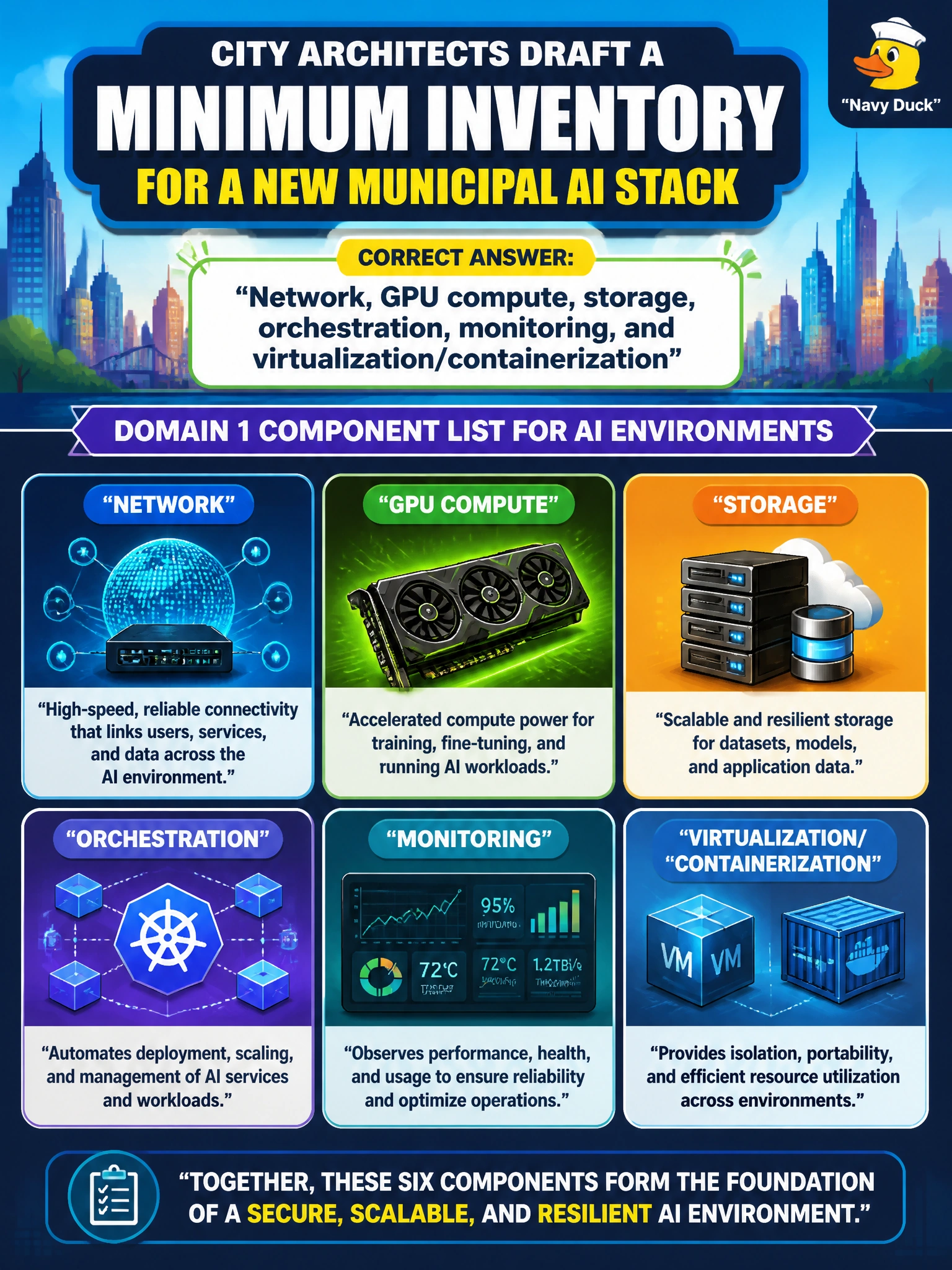
An AI stack is a band, not a solo act — network, GPUs, storage, orchestration, monitoring, and virt/containers all play. Swapping GPUs for CPU compute with only hypervisor clustering, narrowing to file-only storage with workflow-only orchestration and OS-only virtualization, or keeping the network but stacking only database, ETL, and dashboard tools won't give you the full inventory either. Tick through the whole component list before you call the design complete.
Full Explanation
The Domain 1 AI environment component inventory is best reflected by network, GPU compute, storage, orchestration, monitoring, and virtualization/containerization together. The correct set works because municipal AI stacks are multi-plane systems: connectivity, accelerators, data path, scheduling, observability, and workload packaging all appear in the fundamentals list. Incomplete inventories that omit whole classes fail the skill.
Network, CPU compute, block storage, orchestration, monitoring, and hypervisor clustering fails because it swaps GPU compute for CPU compute and reduces virtualization/containerization to hypervisor clustering alone—without accelerators and container packaging, it is not the Domain 1 AI environment list. Network, GPU compute, file storage, workflow orchestration, monitoring, and OS virtualization fails because it narrows the broad classes to subtypes—file-only storage instead of storage, workflow orchestration instead of orchestration, and OS virtualization without containers—so it does not match the full Domain 1 component breadth. Network, database clusters, ETL pipelines, dashboard services, feature store, and model registry fails because it is a data/MLOps application stack that retains the network but still omits GPU compute, storage, orchestration, monitoring, and virtualization/container infrastructure the Domain 1 list requires.
Exam caveat: naming the list is necessary but not sufficient—each component still needs sizing and integration appropriate to the workload. Operational check: use a checklist covering network, GPUs/compute, storage, orchestration, monitoring, and virt/containers before design sign-off; reject CPU-for-GPU swaps, narrowed-subtype-only, or data-tooling-only "inventories" on architecture reviews and exams.
Prefer to study offline? Printable PDF study book + test engine ($7.50, unofficial). These questions stay free here.