
Records-lake designers need fast scratch space for training checkpoints and separately shared datasets many jobs can read. How should they map block versus file storage roles?
Select an answer to reveal the explanation.
Short Explanation
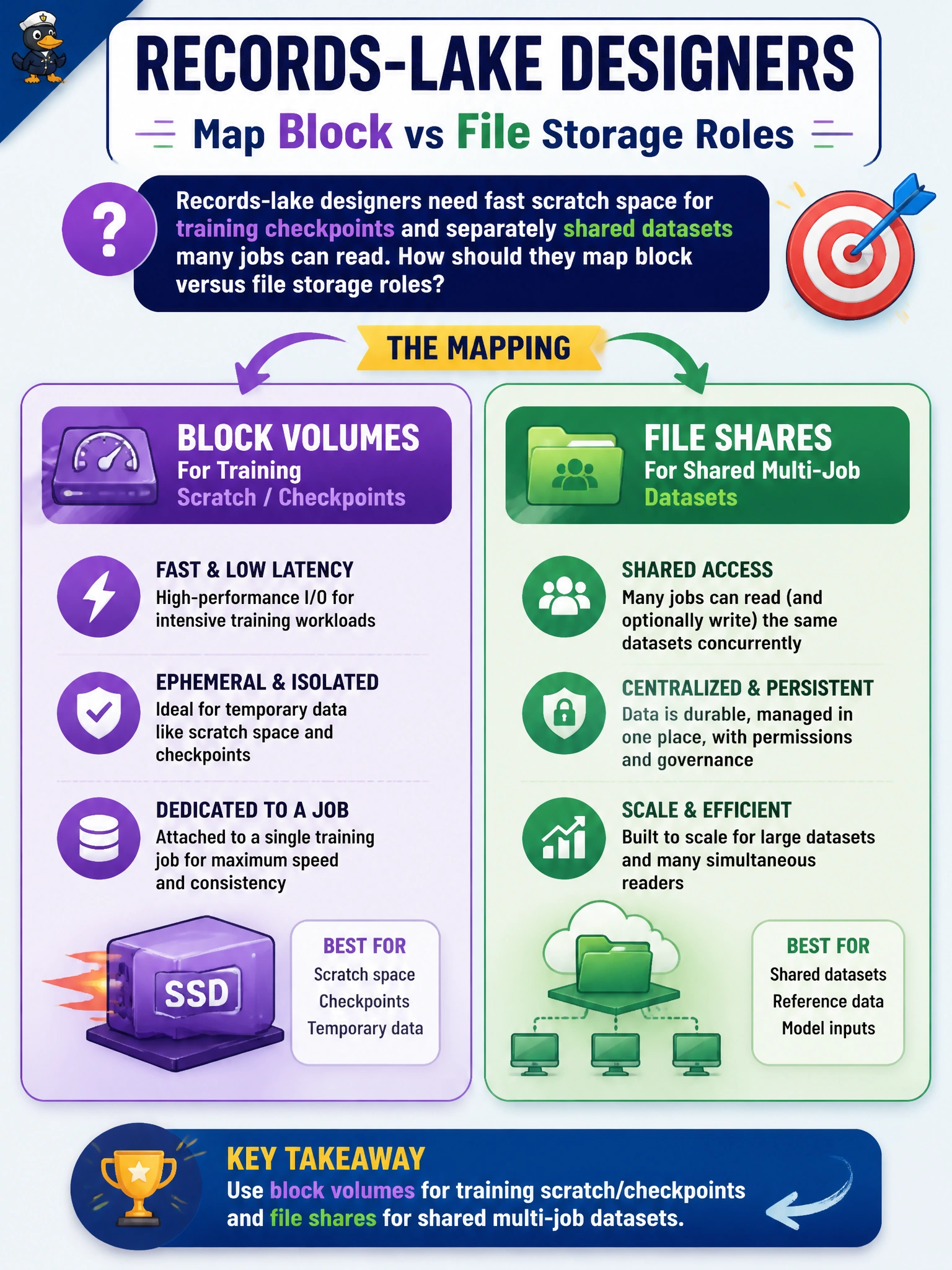
Block volumes are the athlete's private whiteboard for scratch and checkpoints; file shares are the team binder everyone can read. Mix them on purpose — do not pretend email or social CDNs are your training data plane. Matching media to the data path is half the storage battle.
Full Explanation
Mapping block volumes to training scratch/checkpoints and file shares to shared multi-job datasets correctly assigns storage roles in an AI data path. Block storage commonly delivers high-performance, job-local scratch and checkpoint volumes; file shares provide concurrent read access to common datasets across many training jobs. Records-lake designers should match access pattern to storage type rather than forcing one medium for every need.
Using only email attachments as the training data plane fails because email is not a high-throughput, multi-job training storage architecture. Storing all hot checkpoints exclusively on public social media CDNs fails conceptually on performance, control, confidentiality, and suitability—CDNs are not municipal training scratch. Eliminating storage entirely and keeping tensors only in switch TCAM fails because switch TCAM is not a training checkpoint/dataset store and cannot replace block/file roles.
Exam caveat: shared file datasets still need permissions and caching strategy so one noisy job cannot corrupt or starve others; block checkpoint volumes need backup/replication policy. Operational check: provision block volumes for scratch/checkpoints, expose file shares for shared corpora, measure checkpoint I/O, and reject email/CDN/TCAM distractors for the training data plane.
Prefer to study offline? Printable PDF study book + test engine ($7.50, unofficial). These questions stay free here.