
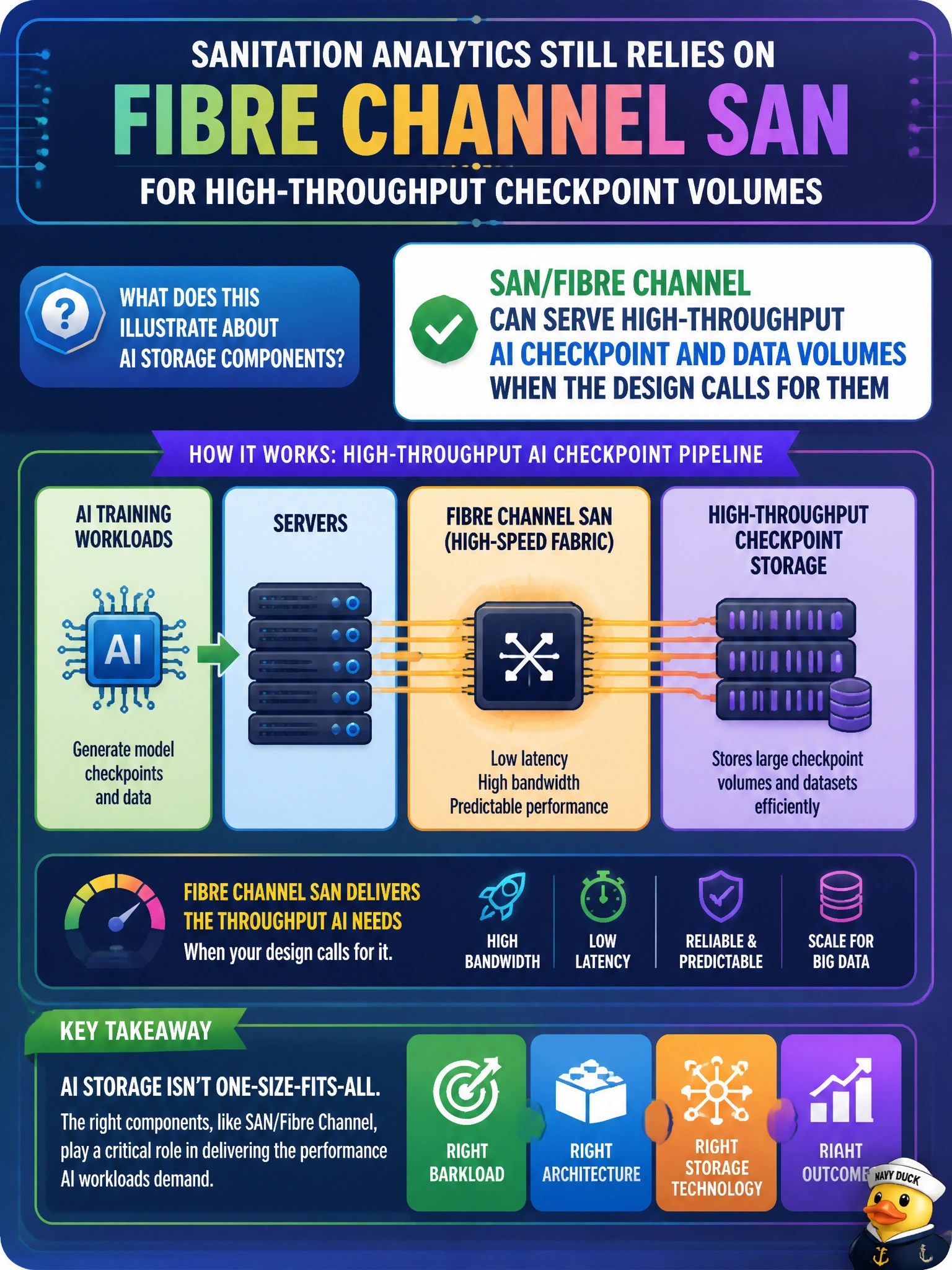
Sanitation analytics still relies on Fibre Channel SAN for high-throughput checkpoint volumes. What does this illustrate about AI storage components?
Select an answer to reveal the explanation.
Short Explanation
Checkpoint writes from hundreds of GPUs are a firehose. Your storage fabric—SAN, Fibre Channel, or Ethernet—must be sized to handle it. You won't get POSIX shared-file access from zoning alone, as you'll need a clustered file system on top of the SAN volumes serving your checkpoints.
Full Explanation
Checkpoint and data serving for large-model AI requires reliable, high-throughput storage fabric. SAN (Storage Area Networks) with Fibre Channel can provide that when properly sized and tuned for the aggregate bandwidth of distributed training. Claiming SAN/Fibre Channel can provide POSIX shared-file access for training jobs when the zoning allows concurrent mounts is incorrect—SAN presents block volumes, and concurrent shared-file access requires a clustered or parallel file system layered above the SAN, not zoning alone. NVMe-over-Fabrics (NVMe-oF) and modern Ethernet have become more common for new deployments, but existing SAN infrastructure should be evaluated on actual throughput and latency, not confused with the idea that zoning alone creates POSIX shared-file access for training jobs. Claiming SAN/Fibre Channel can retain versioned S3-style checkpoint objects when audit policies call for lineage tracking is incorrect—versioned object retention with lineage is an S3-compatible object storage capability, while Fibre Channel SAN serves block volumes without native S3 versioning. Claiming SAN/Fibre Channel can stripe shared training reads across nodes when checkpoint restores need parallel throughput is incorrect—the scenario shows Fibre Channel SAN directly serving high-throughput checkpoint volumes, not providing parallel-file-system striping for shared reads. Exam caveat: fabric choice depends on available infrastructure, total aggregate throughput need, and operational team expertise; evaluate each fabric against the workload's actual requirements. Operational check: measure peak checkpoint write rate across all GPU workers during training, validate that SAN or Ethernet fabric can sustain that throughput without saturation, and stress-test with a non-critical training run before committing mission-critical workloads.
Prefer to study offline? Printable PDF study book + test engine ($7.50, unofficial). These questions stay free here.