
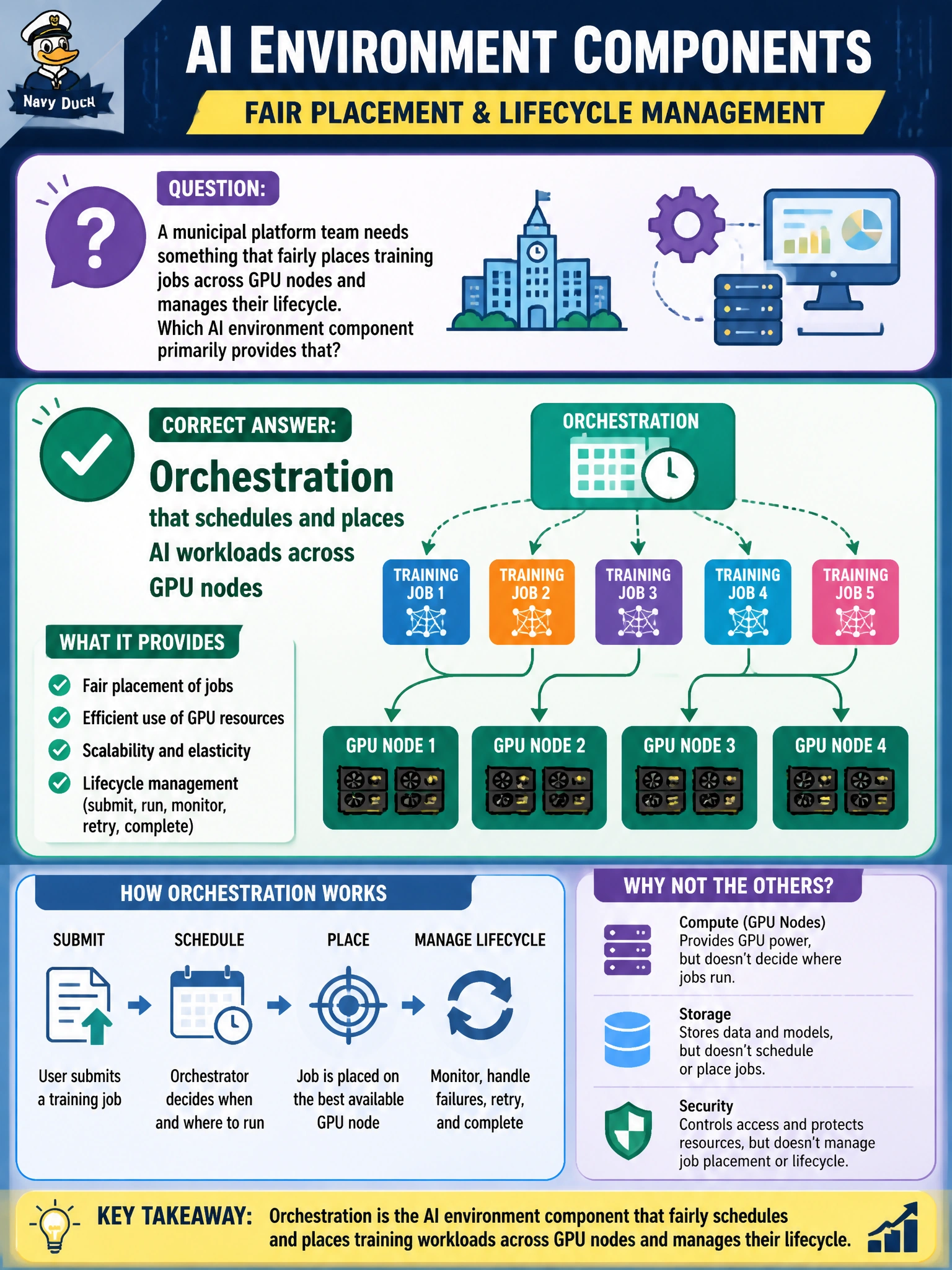
A municipal platform team needs something that fairly places training jobs across GPU nodes and manages their lifecycle. Which AI environment component primarily provides that?
Select an answer to reveal the explanation.
Short Explanation
Orchestration is the air-traffic control tower for GPU jobs — who gets which node, when, and how restarts happen. Observability, model registries, and data pipelines don't schedule GPU work or manage training lifecycles. Without orchestration, you're juggling queue tracking with alert rules, model versioning with artifact placement, and batched data shards, and you'll still have no scheduler to place jobs or handle restarts.
Full Explanation
Orchestration that schedules and places AI workloads across GPU nodes primarily provides fair placement and job lifecycle management for municipal training fleets. The correct component works because schedulers assign jobs to accelerators, queue work, restart or reschedule failures, and enforce sharing policies—air-traffic control for GPU capacity. Domain AI environment inventories treat orchestration as distinct from observability, model registries, and data pipelines.
Observability that tracks queues and places alert rules across GPU nodes fails because tracking queues for visibility and placing alert rules does not schedule, place, or lifecycle-manage training jobs on GPU nodes. A model registry that versions models and places artifacts across GPU nodes fails conceptually: versioning models and distributing artifacts is not cluster scheduling or job lifecycle management. A data pipeline that batches inputs and places data shards across GPU nodes fails because batching inputs and sharding data does not runtime-place or lifecycle-manage GPU training jobs themselves.
Exam caveat: orchestration misconfiguration (wrong affinities, missing GPU device plugins, unfair queues) can strand capacity even when nodes are healthy. Operational check: verify the platform scheduler can place training jobs across the GPU pool, test failure restart behavior, and discard observability, model-registry, or data-pipeline-only options when the requirement is fair placement and lifecycle management.
Prefer to study offline? Printable PDF study book + test engine ($7.50, unofficial). These questions stay free here.