
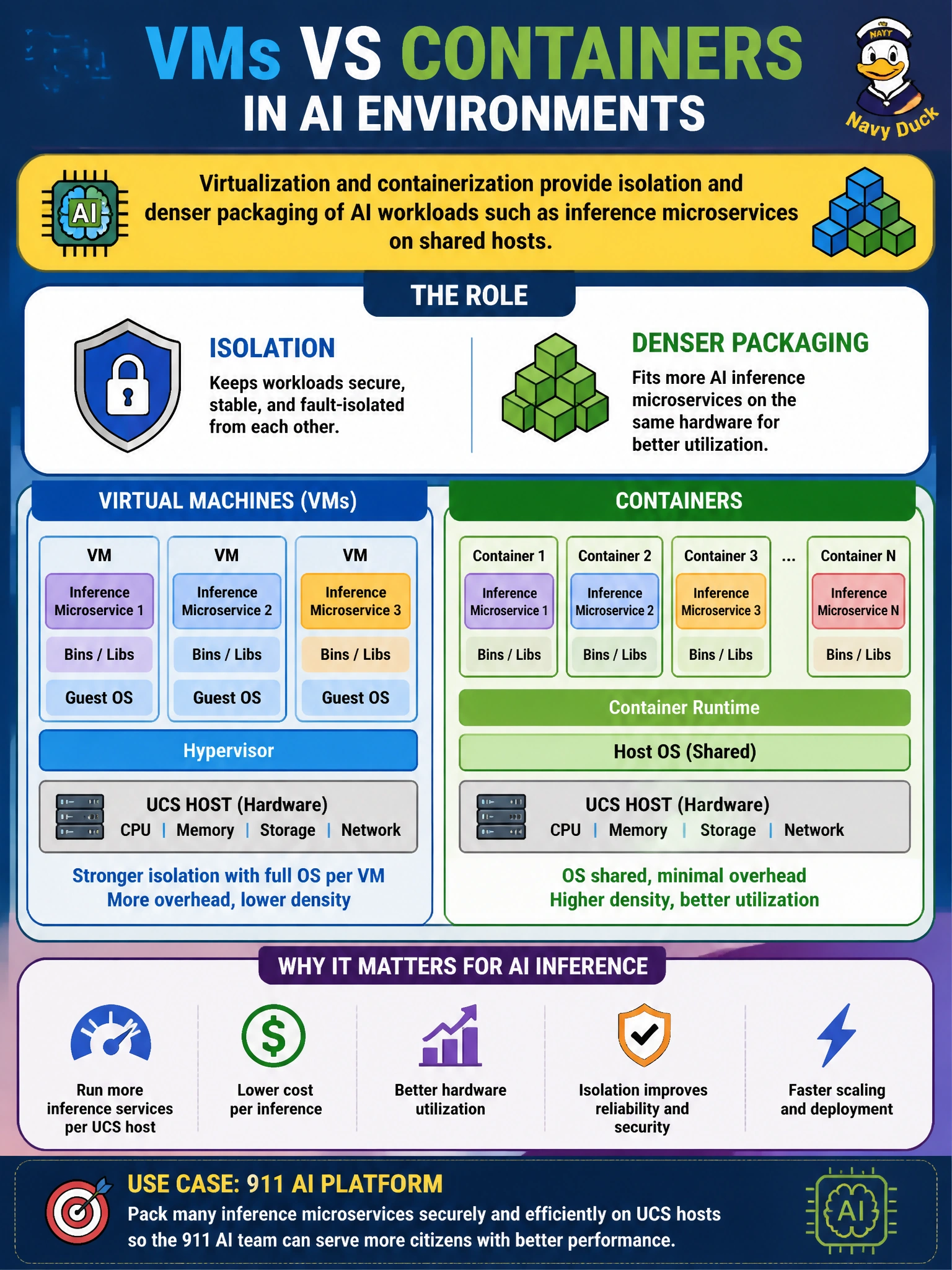
A 911 AI team must pack many inference microservices onto UCS hosts and debates VMs versus containers. What role do virtualization and containerization play in AI environments?
Select an answer to reveal the explanation.
Short Explanation
Containers are not just for web servers. They carve up a GPU cluster so each model job gets its own sandbox and cannot crash the neighbor. That matters for reliable AI infrastructure.
Full Explanation
Containers provide isolation and denser packaging of AI workloads while allowing administrators to reserve dedicated GPU allocation per container and enforce resource quotas. That isolation benefits every workload—from training jobs competing for GPU time to inference services that must not interfere with each other. Claiming they enable fractional GPU sharing for inference microservices on shared hosts using SR-IOV virtual functions is wrong: virtualization and containerization isolate and pack workloads on existing physical GPUs, but they do not expose GPUs as SR-IOV virtual functions; fractional GPU access requires separate mechanisms such as MIG, time-slicing, MPS, or vGPU via device plugins and runtimes. Claiming they optimize collective communication for training workloads on shared hosts through NCCL topology tuning overstates their role: containers isolate workloads but do not by themselves tune NCCL topology or optimize low-level fabric paths. Claiming they collect GPU telemetry from shared hosts and drive autoscaling of inference microservices on clusters is equally wrong: virtualization and containerization package workloads but do not inherently collect telemetry or autoscale replicas; that requires separate monitoring and orchestration. Exam caveat: containers add a thin overhead compared to bare metal, but that cost is usually worth the isolation and operational clarity for multi-tenant GPU clusters. Operational check: when deploying AI containers on GPUs, configure resource limits, admission policies, and monitoring so no single container starves others; validate that GPU device plugin correctly maps container requests to physical devices.
Prefer to study offline? Printable PDF study book + test engine ($7.50, unofficial). These questions stay free here.