
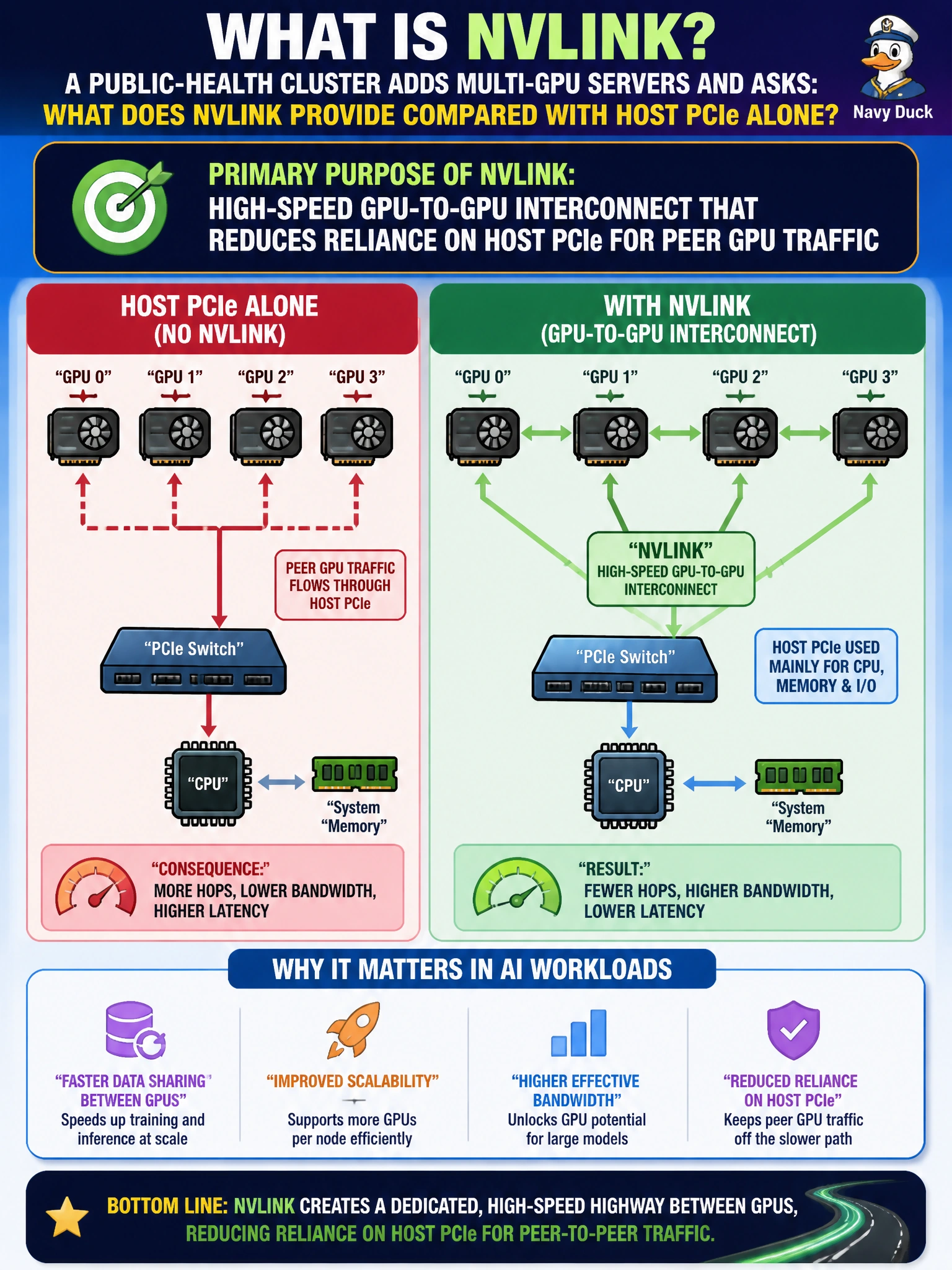
A public-health cluster adds multi-GPU servers and asks what NVLink provides compared with host PCIe alone. What is the primary purpose of NVLink in this AI compute stack?
Select an answer to reveal the explanation.
Short Explanation
NVLink is the express lane between GPUs so they can pass tensors without squeezing everything through the host PCIe toll booth. When multi-GPU servers train together, that peer link matters. You don't get a host PCIe switch fabric, node-to-node InfiniBand across servers, or shared NVMe storage for checkpoints.
Full Explanation
NVLink’s primary purpose in a multi-GPU AI compute stack is a high-speed GPU-to-GPU interconnect that reduces reliance on host PCIe for peer GPU traffic. It works because training and multi-GPU inference move large tensors between accelerators; a dedicated peer link improves bandwidth and latency versus funneling all peer traffic through the CPU/PCIe complex. Public-health multi-GPU servers benefit when collective operations and model-parallel traffic stay on the NVLink fabric.
A host PCIe switch fabric that aggregates CPU-to-GPU bandwidth for local inference throughput fails because it still funnels traffic through the host/PCIe complex rather than providing a dedicated GPU-to-GPU peer link. A node-to-node InfiniBand fabric that scales distributed training traffic across separate servers fails because NVLink is an intra-server GPU interconnect, not a scale-out network between separate nodes. A shared NVMe storage fabric that streams training checkpoints to GPU memory during job restarts fails because that is a storage/restore data path, not accelerator-to-accelerator peer traffic.
Exam caveat: NVLink topology and domain size vary by platform; assuming infinite all-to-all peer bandwidth without checking topology leads to uneven scaling. Operational check: confirm multi-GPU servers expose NVLink connectivity for peer traffic, measure GPU-GPU communication paths versus PCIe-only baselines, and eliminate host-PCIe-switch/InfiniBand/NVMe-storage distractors when the question asks what NVLink provides versus host PCIe alone.
Prefer to study offline? Printable PDF study book + test engine ($7.50, unofficial). These questions stay free here.