
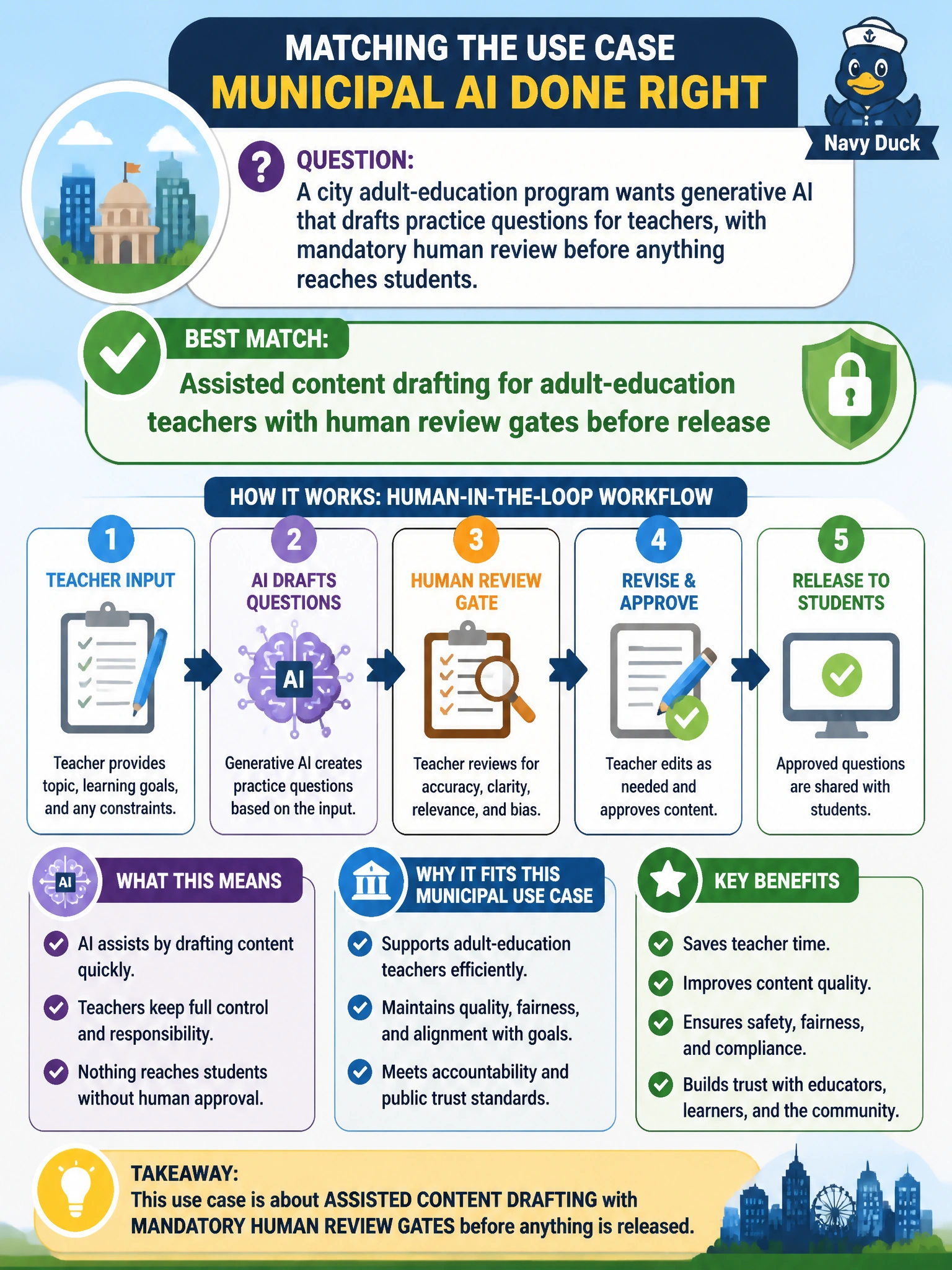
A city adult-education program wants generative AI that drafts practice questions for teachers, with mandatory human review before anything reaches students. Which framing best matches this municipal AI use case?
Select an answer to reveal the explanation.
Short Explanation
Picture a teaching assistant that sketches quiz drafts, then the teacher red-pens them before class. That's assisted GenAI content with a review gate at the teacher level—not handing drafts straight to learners, and not some other grade level's workflow or an enrollment report. Keep the humans in the loop and keep the use case about drafting help for this teacher.
Full Explanation
Assisted generative drafting for adult-education teachers with mandatory human review matches municipal AI use-case framing that keeps educators in the loop and keeps sensitive learner decisions out of unsupervised automation. The correct option works because GenAI drafts practice questions as a productivity aid; teachers edit, reject, or approve before anything reaches students. That aligns with civic education constraints: content quality, bias review, age-appropriateness, and auditability remain human responsibilities while the model accelerates first drafts.
Personalized practice delivery to adult learners with automated feedback for self-study fails because it sends GenAI-driven practice and feedback straight to the learners themselves, with no teacher review gate before students see it—opposite of the stem's requirement that a human review the drafted questions before anything reaches students. Curriculum alignment drafts for primary-school teachers with departmental sign-off stages fails because it targets primary-school curriculum alignment rather than the stem's adult-education practice-question drafting, and a departmental sign-off is a different governance step than the teacher-level human review gate the stem specifies. Enrollment trend summaries for city program administrators with supervisor approval before publication fails because it is an administrative reporting use case about enrollment trends, not a content-generation tool that drafts practice questions for teachers to review.
Exam caveat: "human review" must be real—rubber-stamping model drafts still fails policy even if a checkbox exists. Operational check: require teacher sign-off metadata before release, prohibit sending drafted questions straight to learners for this pilot, document prompt/source constraints, and treat direct-to-learner delivery, other-grade-level workflows, or administrative enrollment reporting as out-of-scope distractors when the requirement is teacher-facing content drafting with review gates.
Prefer to study offline? Printable PDF study book + test engine ($7.50, unofficial). These questions stay free here.