
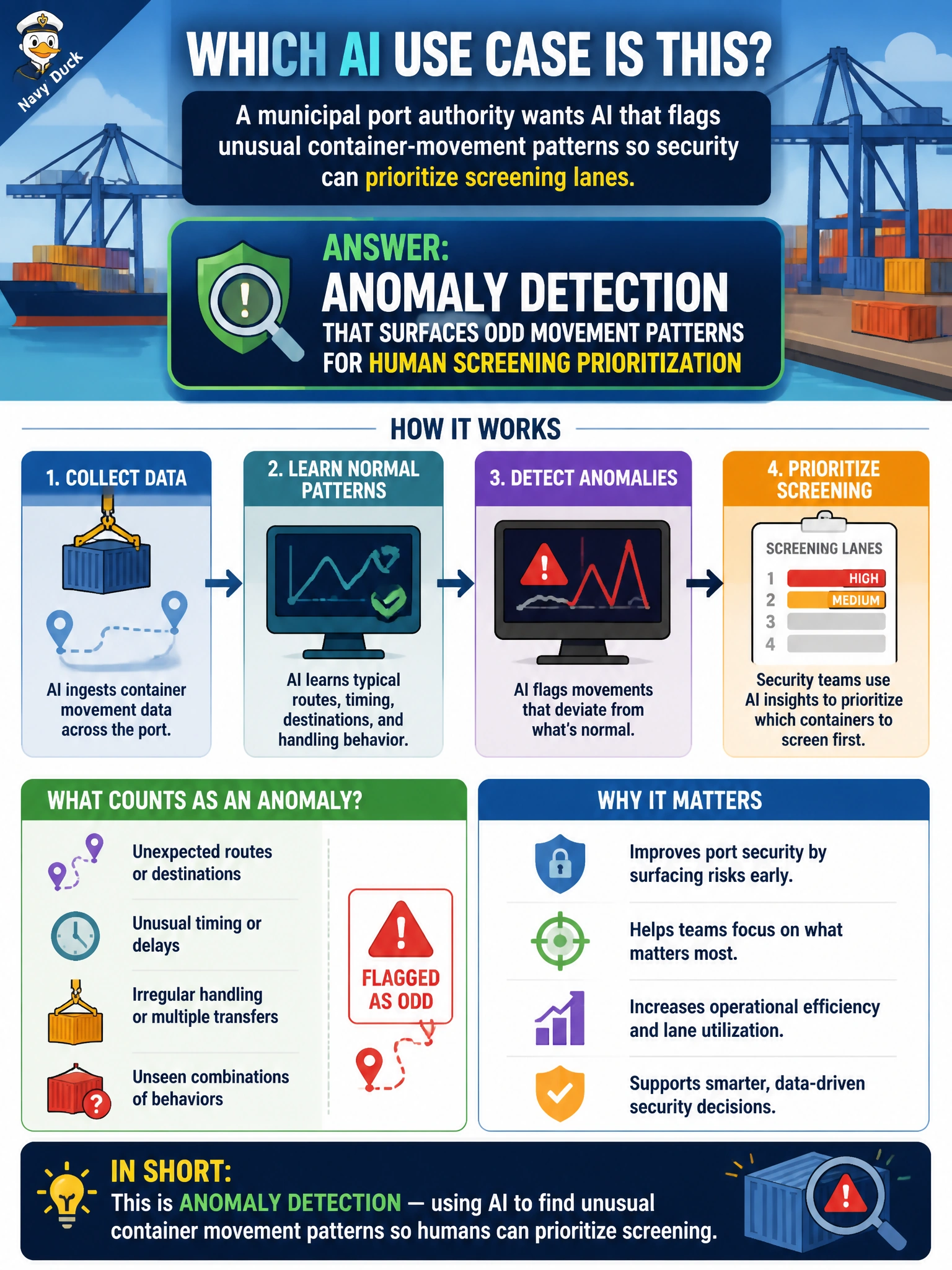
A municipal port authority wants AI that flags unusual container-movement patterns so security can prioritize screening lanes. Which AI use case does this primarily represent?
Select an answer to reveal the explanation.
Short Explanation
Think of it like a smoke detector for container yards — it's not forecasting expected volumes, labeling tracks as routine, or summarizing alerts. The model watches for weird movement patterns and pokes security so people can look closer where it matters. That is classic municipal anomaly detection for ops prioritization.
Full Explanation
Anomaly detection for municipal port security works because the operational goal is to surface unusual container-movement patterns so human screeners can prioritize lanes—not to forecast expected movement volumes for human screening prioritization, label movement tracks as routine for human screening prioritization, or condense movement pattern alerts for human screening prioritization. The correct use case matches Domains that separate detection-and-triage AI from expected-volume forecasting, routine-track classification, and alert summarization. Pattern-deviation models score or flag outliers relative to learned normal yard behavior; operators then decide which lanes or containers warrant deeper inspection. That preserves accountability while still compressing a noisy yard into a ranked worklist.
Demand forecasting that predicts expected movement volumes for human screening prioritization fails because it predicts expected volumes rather than detecting unusual container-movement patterns for security triage. Image classification that labels movement tracks as routine for human screening prioritization fails because it classifies tracks into a routine category rather than detecting anomalous movement patterns for screening prioritization. Report summarization that condenses movement pattern alerts for human screening prioritization fails because it summarizes alerts after they are generated instead of flagging live unusual movement patterns for human screening prioritization.
Exam caveat: anomaly scores are not proof of wrongdoing; threshold drift, seasonal traffic, and sensor gaps can inflate false positives or hide real outliers if baselines are stale. Operational check: define the feature sources (yard sensors, gate events, camera tracks), set review SLAs for top-ranked alerts, log human dispositions, and verify that demand forecasting, image classification, and report summarization alternatives are explicitly out of scope for this security lane workflow.
Prefer to study offline? Printable PDF study book + test engine ($7.50, unofficial). These questions stay free here.