
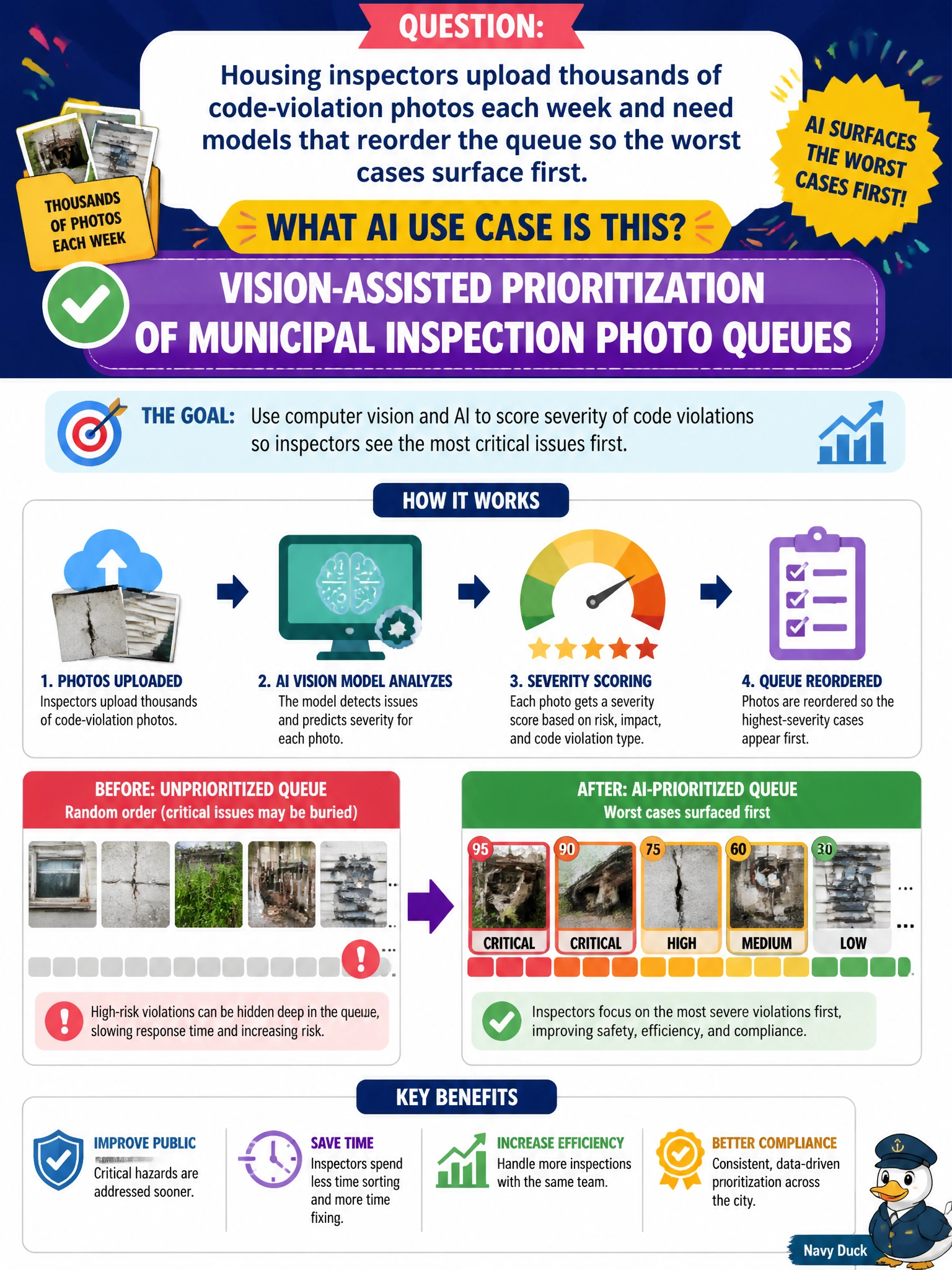
Housing inspectors upload thousands of code-violation photos each week and need models that reorder the queue so the worst cases surface first. What AI use case is this?
Select an answer to reveal the explanation.
Short Explanation
It is like a smart inbox that puts the smokiest fire photos at the top of the pile. Computer vision helps rank which violation pictures look urgent so inspectors spend eyes on the right cases first. The humans still decide — the model just sorts the queue.
Full Explanation
Vision-assisted prioritization of municipal inspection photo queues works because computer-vision models can score severity, hazard cues, or urgency from code-violation images and reorder the inspector worklist so the worst cases surface first. The use case is triage support: inspectors still adjudicate and enforce. That fits civic housing operations where photo volume overwhelms manual sorting and where ranking by visual severity improves response time without inventing legal outcomes.
Metadata-based prioritization of municipal inspection photo queues fails because sorting by file metadata such as upload time, uploader, or district tags does not assess visual severity or hazard cues in the images; it reorders by administrative attributes unrelated to surfacing the worst violation cases first. Complaint-text prioritization of municipal inspection photo queues fails because ranking by written tenant or caller narratives analyzes text descriptions, not the uploaded violation photos; the stem asks for models that score severity from the images themselves to reorder the photo queue. Tabular-model prioritization of municipal inspection photo queues fails because scoring structured rows such as permit records or case histories does not interpret pixel-level violation evidence; it is a structured-data ranking task, not vision-assisted triage of inspection photo queues.
Exam caveat: vision scores can bias toward photogenic damage types or camera quality differences across neighborhoods if training data is skewed. Operational check: calibrate severity labels with inspector feedback, measure precision of top-of-queue cases, keep human override for enforcement actions, and confirm the pipeline prioritizes uploaded violation images by urgency rather than ranking by file metadata, complaint text, or tabular-model scores.
Prefer to study offline? Printable PDF study book + test engine ($7.50, unofficial). These questions stay free here.