
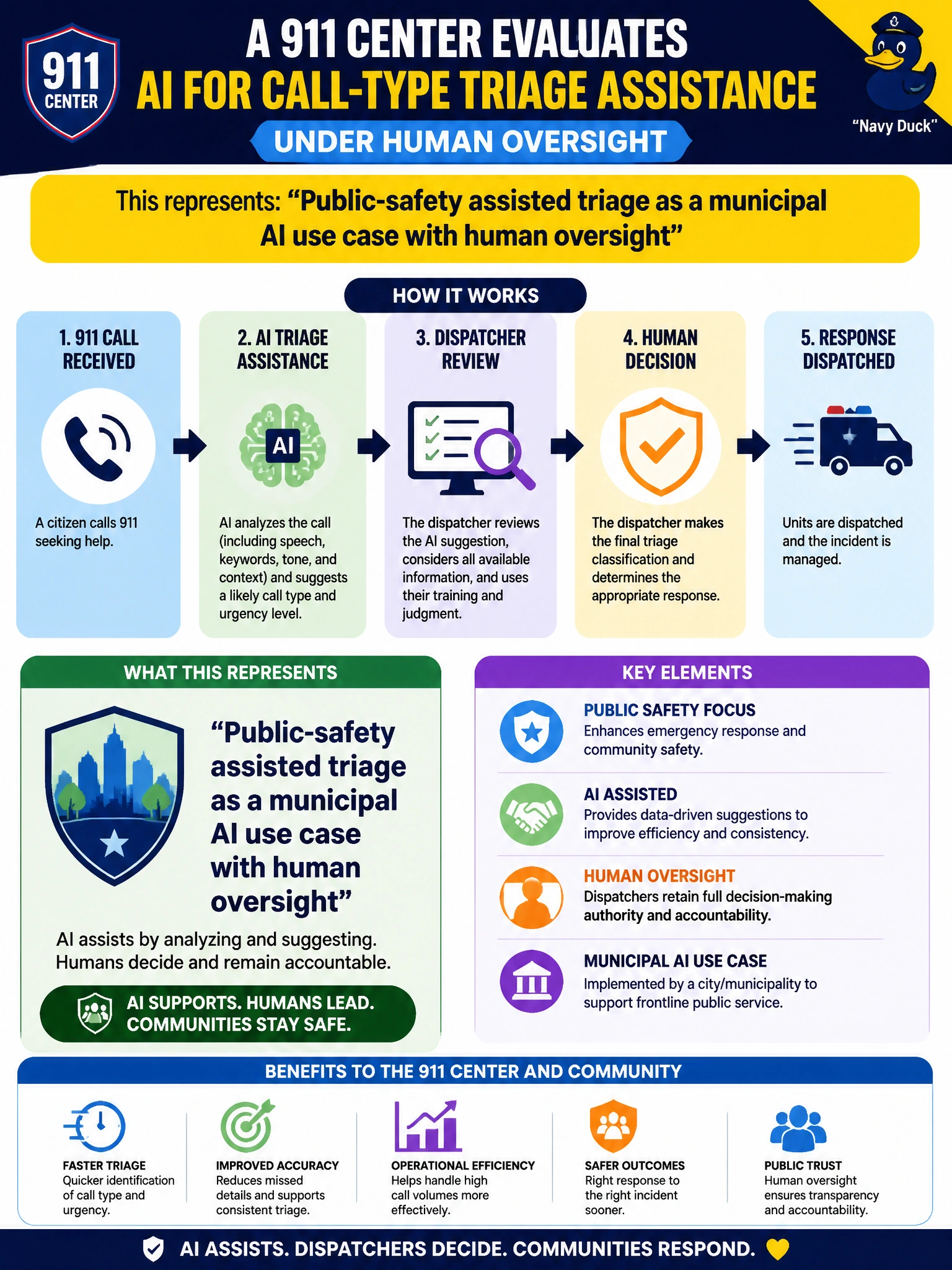
A 911 center evaluates AI for call-type triage assistance under human oversight. What use case does this represent?
Select an answer to reveal the explanation.
Short Explanation
You'll use it as a co-pilot for call-type triage while you stay accountable. It's assisted triage under human oversight, not automated dispatch that executes the response on its own.
Full Explanation
A 911 center evaluating AI for call-type triage assistance under human oversight represents a public-safety assisted-triage municipal AI use case. The system supports call takers with suggestions; humans remain accountable for the live decision path. Public-safety automated dispatch as a municipal AI use case with human oversight would carry out dispatch actions, not just suggest a call type; the stem describes triage assistance under human oversight, not automated execution of dispatch. Public-safety call documentation as a municipal AI use case with human oversight is a documentation workflow aid, not live call-type triage assistance; the stem describes triage suggestions under human oversight, not post-call documentation. Public-safety 311 inquiry routing as a municipal AI use case with human oversight targets non-emergency 311 requests rather than 911 call-type triage, so it is unrelated to emergency call-type assistance. Exam caveat: assisted triage still demands rigorous validation, bias and failure-mode review, latency SLOs, and clear escalation—human oversight is necessary but not sufficient alone. Operational check: pilot the assistant in the live call path with mandatory human confirmation, measure suggestion quality and latency under peak load, log overrides, and keep a disable switch that returns dispatch fully to human-only operation if the model misbehaves.
Prefer to study offline? Printable PDF study book + test engine ($7.50, unofficial). These questions stay free here.