
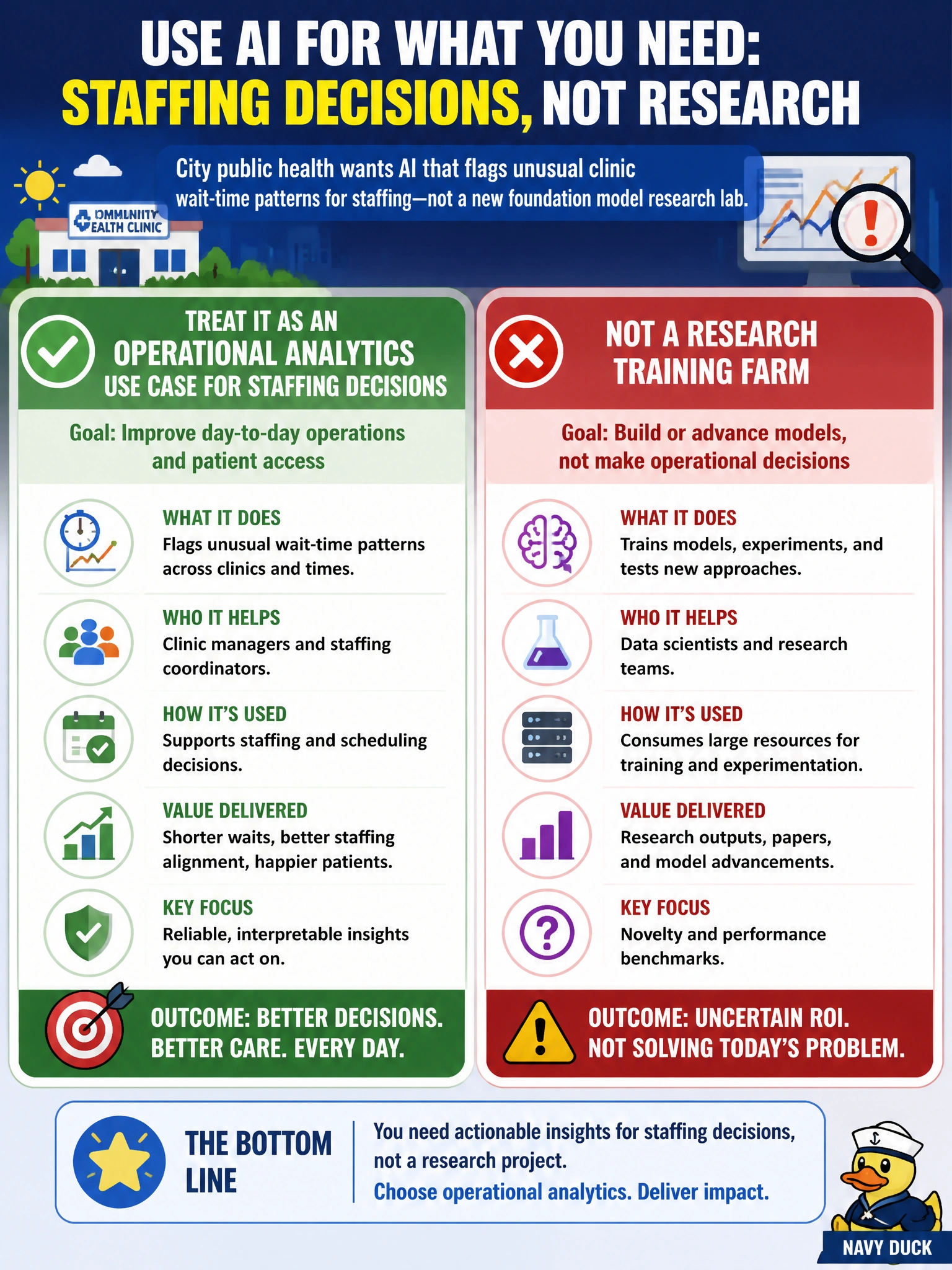
City public health wants AI that flags unusual clinic wait-time patterns for staffing—not a new foundation model research lab. Which use-case framing fits?
Select an answer to reveal the explanation.
Short Explanation
You'll miss weird wait-time spikes if you settle for monthly average dashboards or nightly compliance exports, and narrative briefs don't flag them either. That's why it's operational analytics — a smoke alarm for staffing, not a passive summary nobody acts on.
Full Explanation
City public health wanting AI that flags unusual clinic wait-time patterns for staffing is an operational analytics use case—detect anomalies or trends to inform staffing—not a multi-month foundation-model research training farm. Framing it correctly keeps the civic DC focused on pipelines, features, alerting, and decision support rather than monthly-average dashboards, passive compliance exports, or narrative summary briefs that don't flag unusual patterns. Treating the project as a capacity planning dashboard for staffing reviews using monthly average wait summaries mismatches the staffing-analytics need, which calls for flagging unusual patterns, not smoothing them into monthly averages that hide spikes. Treating it as an archival compliance workflow for staffing audits using nightly average wait exports fails because the stem asks for flagging unusual patterns to drive staffing, not a passive archive nobody acts on until later. Treating it as a generative summary tool for staffing briefs using clinic wait-time narratives confuses flagging unusual patterns with just summarizing narratives, providing readable briefs without the anomaly signal managers need for staffing. Exam caveat: operational analytics may still use ML models on accelerators; the distinction is purpose and lifecycle (ops staffing signals versus monthly-average dashboards, compliance exports, or narrative summaries that lack anomaly flagging), not a blanket GPU ban. Operational check: define wait-time features and alert thresholds for clinic managers, deploy scoring or anomaly detection on an ops schedule, and avoid scoping the project as a capacity planning dashboard using monthly average summaries, an archival compliance workflow using nightly exports, or a generative summary tool for briefs unless leadership explicitly funds that different mission.
Prefer to study offline? Printable PDF study book + test engine ($7.50, unofficial). These questions stay free here.