
During a change window, utility WAN routers may be configured only through an HTTP API that carries YANG models. Which interface matches that constraint?
Select an answer to reveal the explanation.
Short Explanation
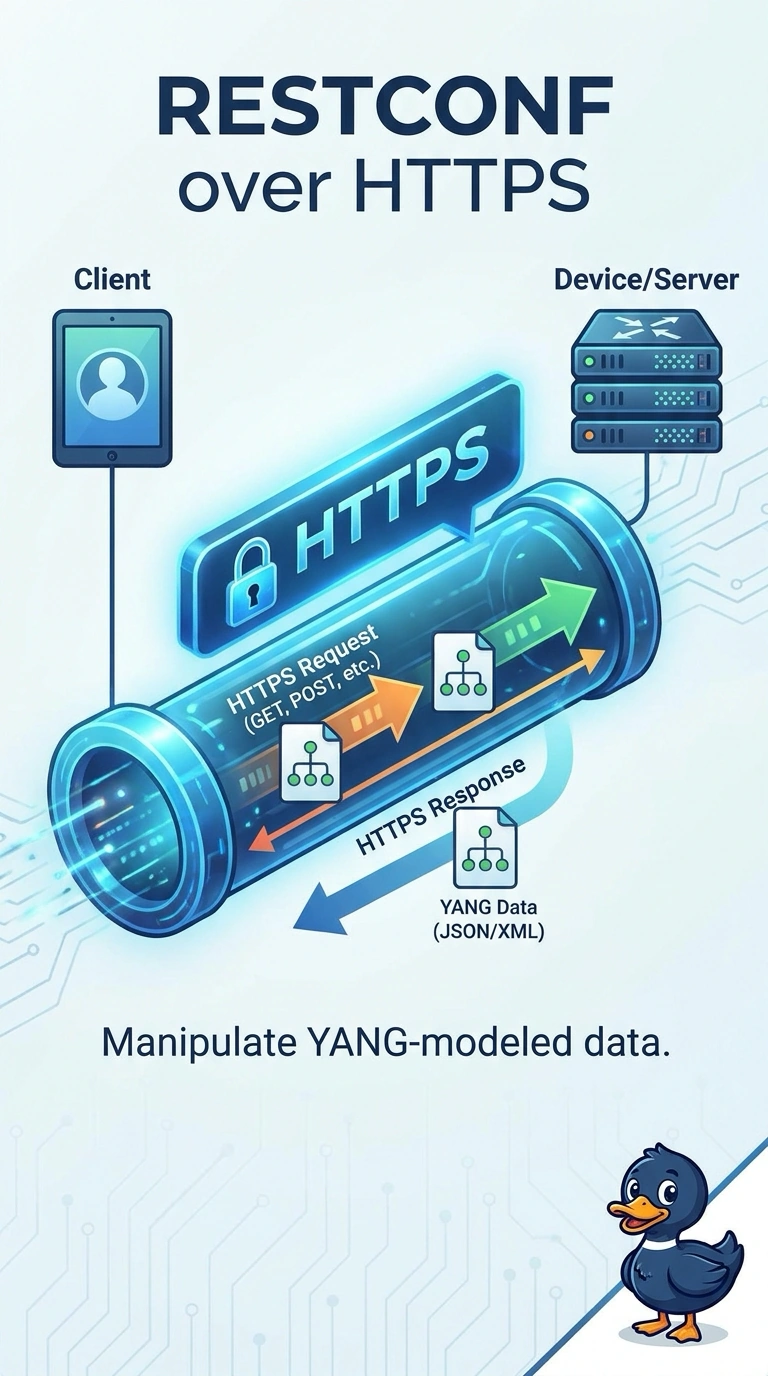
You can match the change window by looking for the interface that uses both HTTPS and YANG. RESTCONF manipulates YANG-modeled data over HTTPS, while a NETCONF session lacks the permitted HTTP interface, a general REST API does not carry YANG, and OpenStack targets a different kind of system.
Full Explanation
Use RESTCONF over HTTPS to manipulate YANG-modeled data, so it meets both parts of the change-window constraint: the routers may be configured only through the permitted HTTP API, and the interface must carry YANG models onto the routers. A NETCONF session carries YANG, but it is not the HTTP API the window permits, so it fails the transport requirement even though the modeling capability is correct. A general REST API exchanges documents over HTTP, but without carrying YANG models it does not meet the required data-model requirement for this change. OpenStack is a VIM for cloud instances and networks, not a controller for these utility WAN routers, so it is aimed at a different kind of system and does not provide the required configuration path. RESTCONF also supports event notification streams; its usual configuration operations use HTTPS methods. Practical check: confirm that the router accepts a YANG edit through its RESTCONF HTTPS endpoint and that a generic document without a YANG model does not satisfy the same configuration requirement.