
An orchestrator must place a single tracking process built for the host kernel, and the shipping line does not need a separate guest kernel or a strong guest boundary. What should it schedule?
Select an answer to reveal the explanation.
Short Explanation
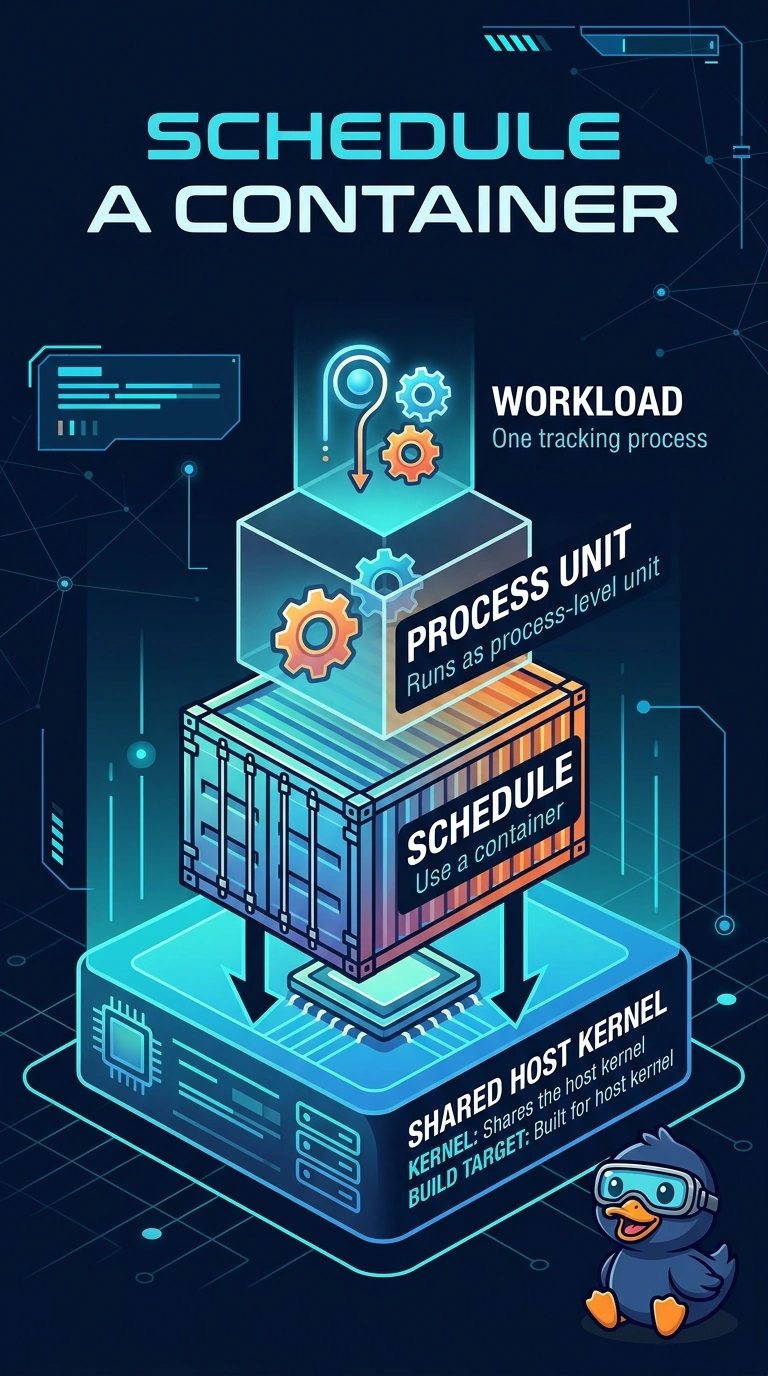
You do not rent a whole second house for one suitcase that already fits in the hallway closet. You run the workload in a container, because your process shares the host kernel and in Kubernetes the scheduler places a Pod containing the container on a node. A guest kernel, a strong guest boundary, and a hand-installed server copy each solve a requirement this process does not have.
Full Explanation
A virtual machine carries a guest operating system, which you choose when the workload needs a different kernel or a strong guest boundary. A container shares the host kernel. Run the workload in a container. In Kubernetes, the scheduler places a Pod containing the container on a node. Rescheduling starts a replacement instance; it does not imply migration of the running process. This tracking process is built for the host kernel, and the requirement does not ask for a strong guest boundary, so running it as a container matches both facts. A container that runs as the process-level unit on the shared host kernel is the design that meets this requirement. A virtual machine whose guest kernel replaces the host kernel for this process is the wrong fit because a different guest kernel fits a workload that cannot use the host kernel, and this process is built for the host kernel. A virtual machine kept only to give the process a strong guest boundary is the wrong fit because a strong guest boundary is a reason to choose a virtual machine, and this process does not require that boundary. A hand-installed copy on one server that the orchestrator cannot place again is the wrong fit because a hand-installed copy stays on one server and is not placed as a Pod that can be replaced on another node.