
Virtual routers are already onboarded with an image, a flavor, and day-0 reachability. The team must push one YANG service intent to every router. Which path fits?
Select an answer to reveal the explanation.
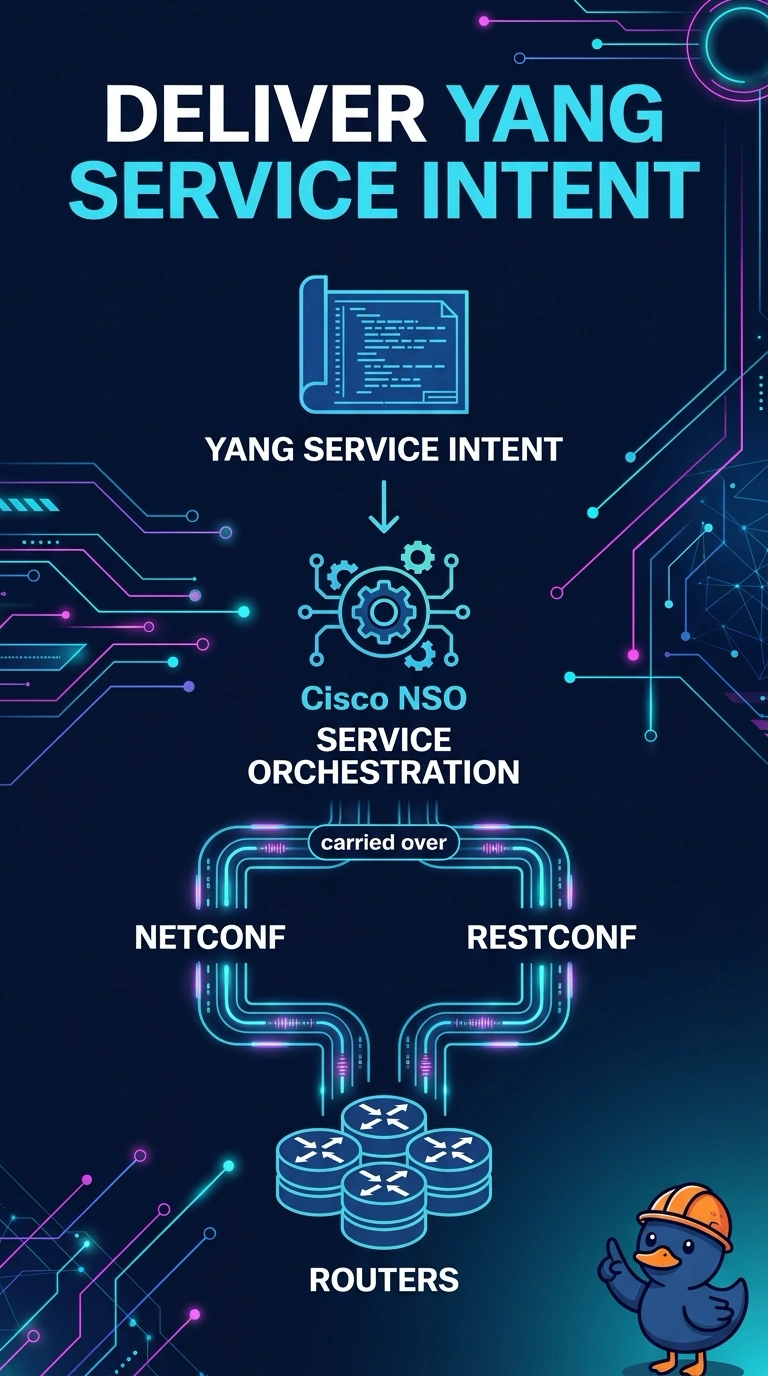
Short Explanation
Your virtual routers are already onboarded, so you can focus on sending the service intent. NSO maps the YANG service input to device-specific configuration and deploys it through the appropriate NED. Use a NETCONF or RESTCONF NED where the device supports it.
Full Explanation
Onboarding a virtual router covers the image, the flavor, and day-0 connectivity, and that work is finished here. NSO maps the YANG service input to device-specific configuration and deploys it through the appropriate NED. Use a NETCONF or RESTCONF NED where the device supports it. OpenStack deployed as the WAN controller that pushes the full service intent is the wrong fit: OpenStack is a VIM for instances, networks, and flavors, not the controller that pushes WAN service intent. A generic REST call that carries no YANG model of the requested service is also the wrong fit: a general REST API can carry many payloads, but it does not provide the YANG service model this intent requires. Another onboarding pass that only reloads the image, the flavor, and day-0 access is wrong because those steps are already complete, and repeating them does not distribute the service intent. Exam caveat: NETCONF and RESTCONF carry YANG for the orchestrated service; a generic REST API and the VIM do not become that service model on their own. Practical check: verify that NSO applies the same service intent on every virtual router, and that the VIM was not used as the WAN configuration path.