
A virtual firewall image and its flavor are already registered on the VIM, but the instance boots with no management reachability. What gives the instantiated firewall its first management reachability?
Select an answer to reveal the explanation.
Short Explanation
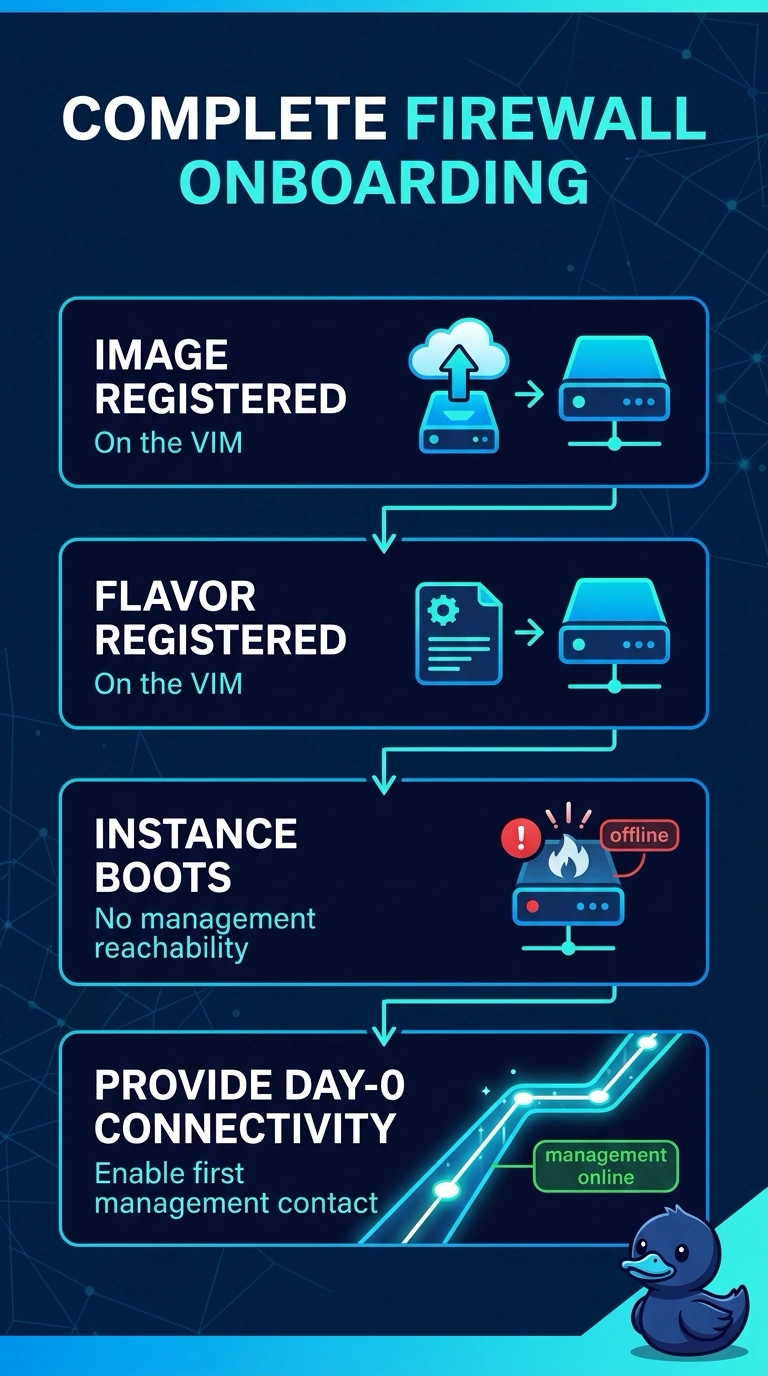
A shipped appliance still needs an address before you can call it. You finish onboarding with day-0 connectivity so the registered image and flavor can actually be managed. Service intent, a general REST call, and gNMI telemetry all assume a management path that is not there yet.
Full Explanation
Onboarding a virtual network function is the image, the flavor, and day-0 connectivity. The image and flavor are already registered, so the missing piece is day-0 reachability that lets the first management contact succeed. Attach the configured day-0 management network and verify address assignment and reachability. This validates deployment and bootstrap separately from package onboarding. Network services orchestration pushes service intent after there is something reachable to configure. REST is general. gNMI over gRPC is a telemetry dial, and neither dial creates day-0 reachability. Day-0 connectivity so the new virtual firewall can be reached for its first management contact is the design that meets this requirement. A service-intent push from the network services orchestrator toward a firewall with no management path is the wrong fit because service intent configures a service across reachable devices, and it does not create the first management path. A general REST API call to a management endpoint on a firewall that has no management address is the wrong fit because REST needs a reachable management address, which this firewall does not have. A gNMI session over gRPC for telemetry on a firewall that has no management address yet is the wrong fit because gNMI over gRPC dials a target for telemetry or configuration, and it cannot replace the missing day-0 path.