
One bridged fabric already uses every 802.1Q identifier from 1 through 4094, and a new tenant still needs isolation. Which design adds that tenant?
Select an answer to reveal the explanation.
Short Explanation
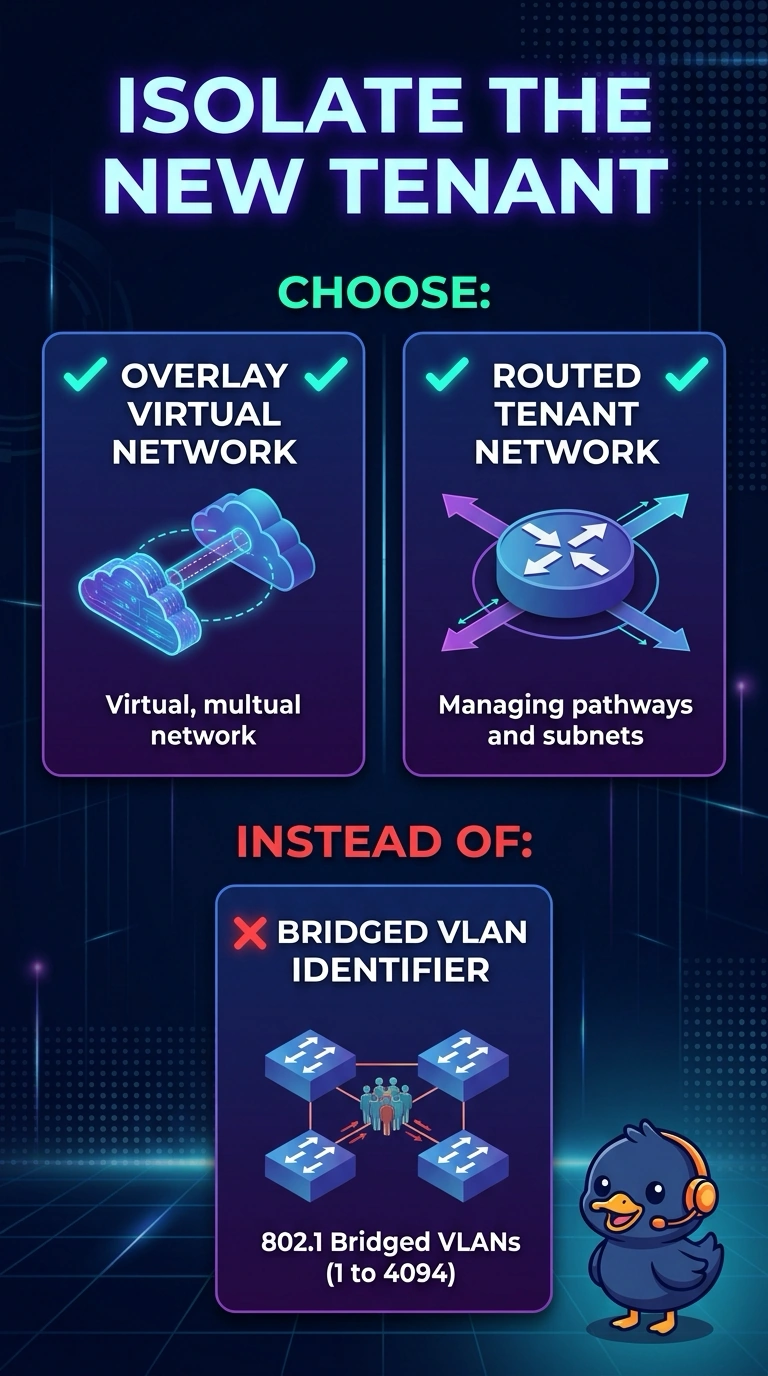
A garage with every numbered stall full does not grow a stall past the numbering plan. You place the new tenant in an overlay virtual network or a routed tenant network once 1 through 4094 are in use. A VLAN past that range, a shared tenant VLAN, and one flat VLAN for everyone fail the space or the isolation.
Full Explanation
The 802.1Q identifier is a 12-bit field, and the usable identifiers on one bridged domain are 1 through 4094. When that budget is spent, another bridged VLAN cannot be created by inventing a number outside that range. Segmentation then moves to an overlay virtual network or to routed tenancy so the new tenant is isolated without a new bridged identifier. Sharing a VLAN or collapsing every tenant into one VLAN removes the isolation. An overlay virtual network or a routed tenant network, instead of another bridged VLAN identifier is the design that meets this requirement. A new bridged VLAN identifier outside 1 through 4094 on the same fabric for this tenant is the wrong fit because the usable 802.1Q identifiers on one bridged domain stop at 4094, so a higher bridged ID is not available. Placement of the new tenant onto an existing tenant VLAN so they share one broadcast domain is the wrong fit because sharing an existing tenant VLAN removes the isolation the new tenant was supposed to receive. One flat VLAN stretched across every tenant so the fabric no longer separates their traffic is the wrong fit because one flat VLAN for every tenant collapses the broadcast domains the fabric was using to separate them. Exam caveat: Moving one tenant to an overlay or a routed network does not raise the bridged identifier budget on the remaining VLAN fabric, which still stops at 4094. Operational check: Confirm the bridged fabric has no free identifier from 1 through 4094, and confirm the new tenant is attached to an overlay virtual network or a routed network of its own.