
Several virtual routers are already onboarded. A transit provider now needs one L3VPN intent pushed consistently to all of them. What performs that job?
Select an answer to reveal the explanation.
Short Explanation
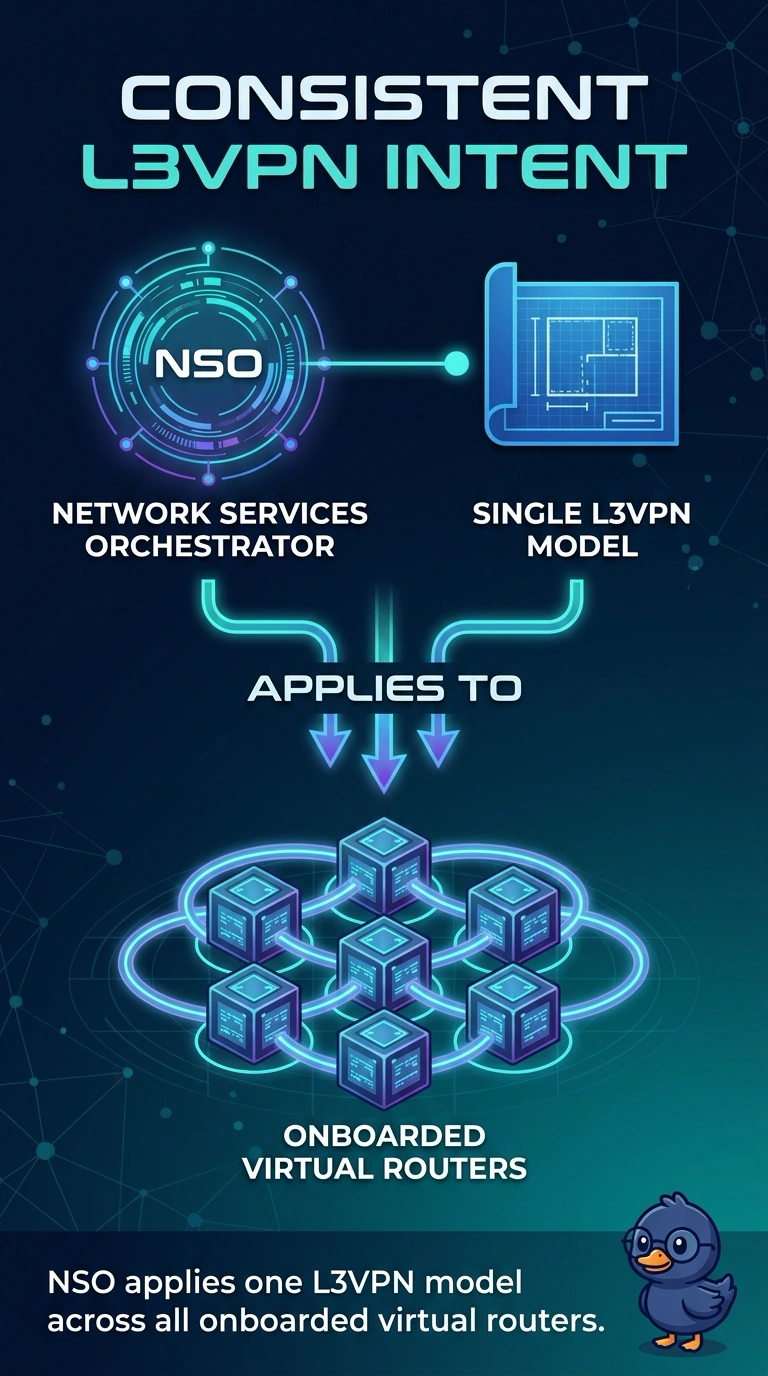
A conductor's score cues the whole orchestra, and hiring another musician does not write the piece. You push one L3VPN service intent with NSO across the virtual routers that are already onboarded. A fresh image and day-0 cycle, OpenStack as a WAN controller, and a general REST call miss that intent.
Full Explanation
NSO orchestration pushes one service intent across devices that already exist. These virtual routers are already onboarded, and the transit provider needs the same L3VPN model on all of them. NSO maps the YANG service input to device-specific configuration and deploys it through the appropriate NED. Use a NETCONF or RESTCONF NED where the device supports it. Onboarding is the earlier step of image, flavor, and day-0 connectivity. OpenStack is a VIM for instances and networks, not a WAN controller. NSO service intent that applies one L3VPN model across the virtual routers already onboarded is the design that meets this requirement. A new onboarding of image, flavor, and day-0 connectivity for routers that already exist is the wrong fit because these routers are already past image, flavor, and day-0. OpenStack used as the WAN controller that lays out paths across the provider core is the wrong fit because OpenStack is a VIM, not the WAN controller for this L3VPN intent. A general REST call that is not bound to the service YANG model those routers expect is the wrong fit because without the YANG service model and NED-based deployment it cannot apply one consistent L3VPN intent. Operational check: Push the intent once and confirm each virtual router received the same service model.