
A virtual router is already onboarded with an image, a flavor, and day-0 reachability. One VPN description must now be applied the same way on several provider routers. Which system does that job?
Select an answer to reveal the explanation.
Short Explanation
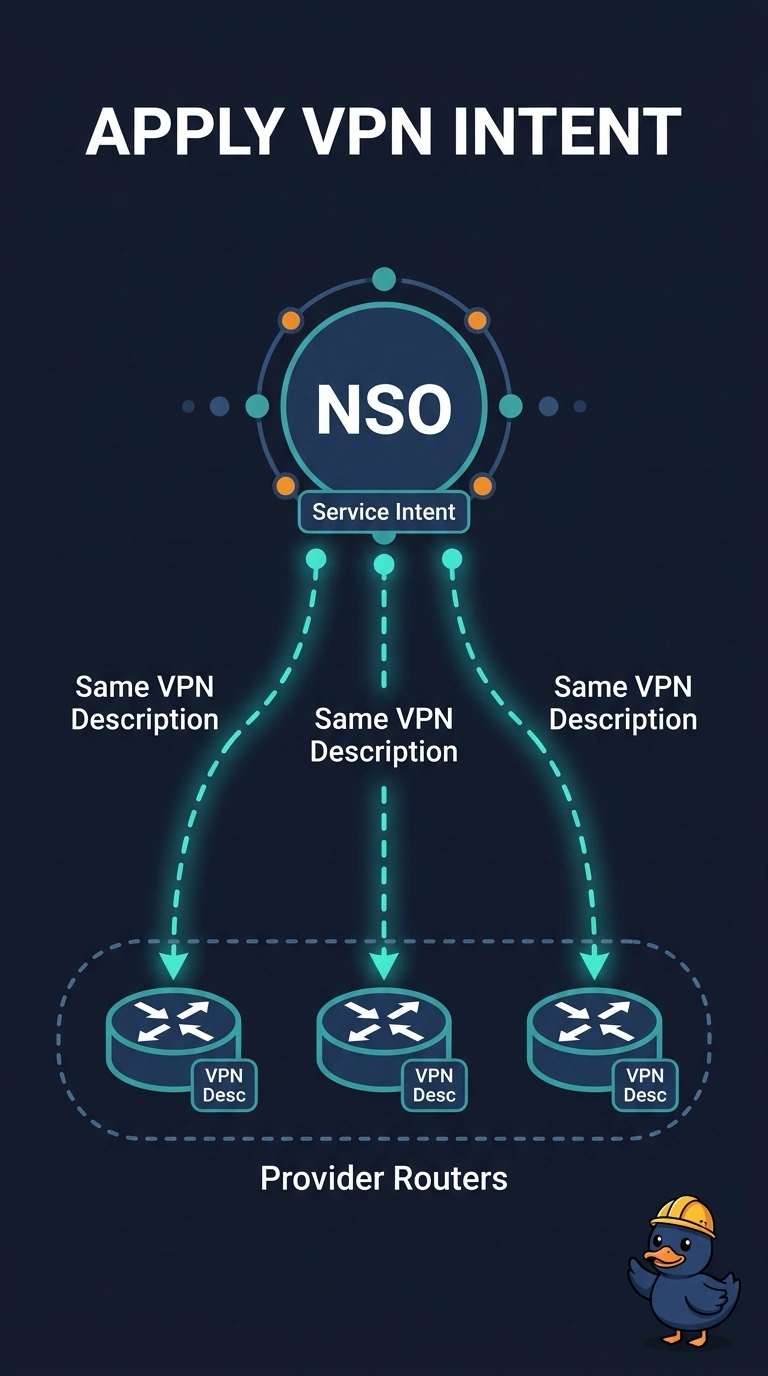
You’ve already onboarded the virtual router, so the remaining job is to apply one VPN service intent across several provider routers. NSO does that; another onboarding pass, OpenStack computing WAN paths, or a NETCONF edit on one router does not distribute the VPN description.
Full Explanation
The virtual router is already onboarded, so the remaining requirement is to apply one VPN description consistently across several provider routers. NSO service intent is the right fit because it orchestrates that shared VPN configuration across the routers. A fresh onboarding that reloads the image, flavor, and day-0 management network repeats work already completed; onboarding provides the virtual router’s initial setup, not the multi-router VPN service. OpenStack operating as a WAN controller is also wrong: OpenStack manages instances, networks, and flavors as a VIM, but it does not compute paths across the provider core. A single NETCONF session can edit the YANG running datastore on one provider router, but it does not coordinate the service across every router in the VPN. Exam caveat: NETCONF carries YANG configuration, but a device-level protocol session is not a substitute for the service-intent orchestrator. Practical check: verify that one VPN service intent in NSO is applied on each provider router, without requiring a new image or flavor onboarding.