
A virtual router at a packet fabric forwards in the kernel, and that kernel path stalls at the required packet rate while the software switch toward the guest does not. What should take over forwarding?
Select an answer to reveal the explanation.
Short Explanation
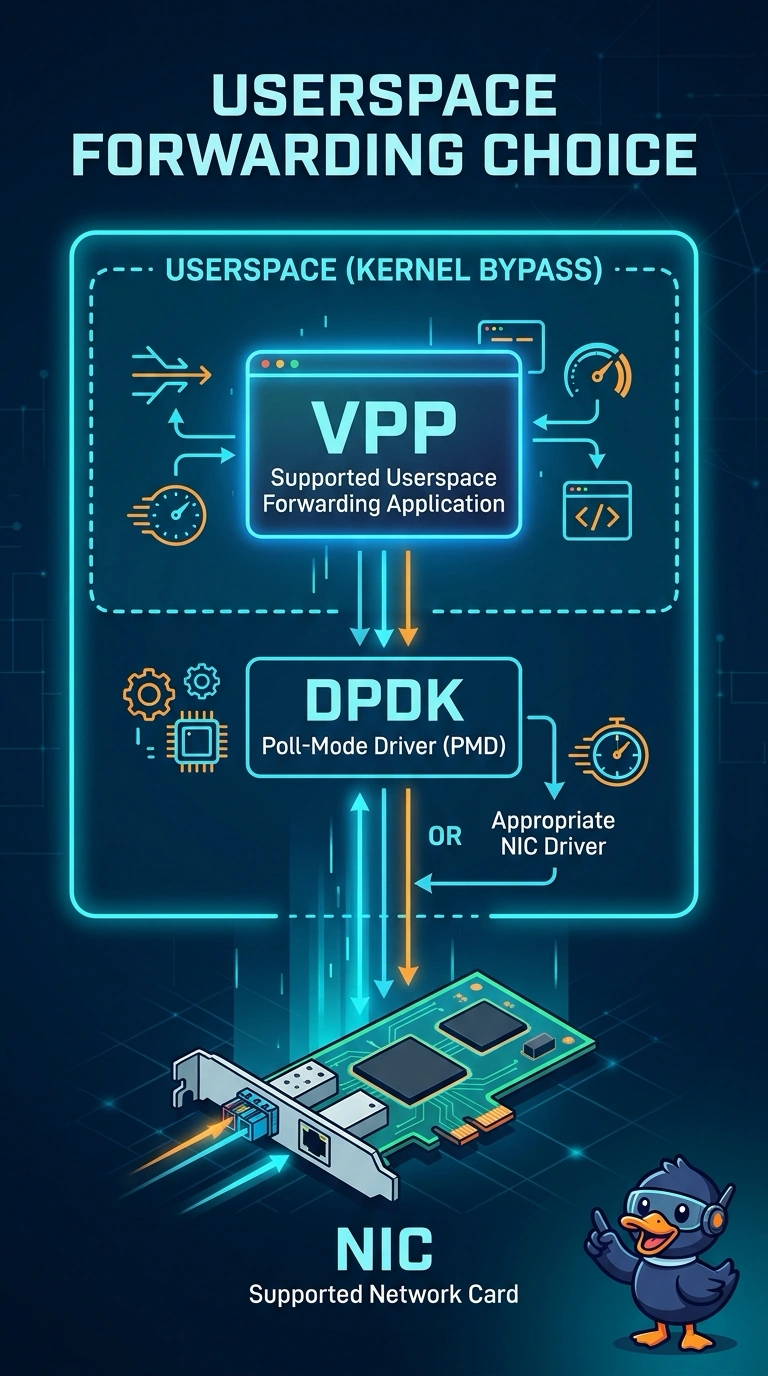
You’ve identified the kernel path as the bottleneck, not the software switch toward the guest. Use a supported userspace forwarding application, such as VPP, with an appropriate NIC driver or DPDK poll-mode driver to move forwarding out of that path. SR-IOV bypasses a switch that isn’t constrained, a larger flavor keeps forwarding on the stalled kernel path, and tuning a low-rate management guest won’t address this packet rate.
Full Explanation
SR-IOV gives a guest a virtual function on the physical NIC so packets skip the software switch. DPDK supplies packet-I/O libraries and drivers, while VPP implements forwarding; userspace processing can also be combined with an SR-IOV virtual function. Here, the router stalls in the kernel at the required packet rate, while the software switch toward the guest is not the constraint. Use a supported userspace forwarding application, such as VPP, with an appropriate NIC driver or DPDK poll-mode driver. This moves forwarding into user space so the kernel path is no longer the stall. SR-IOV that gives the guest a virtual function and skips the software switch does not fit because that switch is not the bottleneck. A larger flavor that keeps forwarding on the same kernel path inside the router does not resolve the limit because forwarding remains on the path that is already stalling. A tuning pass on a low-rate management guest that stays below this packet rate does not address the forwarding problem. Exam caveat: use SR-IOV when the software switch is the limit, and userspace forwarding when the kernel forwarding path is the limit. Practical check: measure packet rate before and after the userspace forwarder, and confirm that the kernel path was the stall.