
A virtual inspection guest must raise its packet rate. Profiles show the guest kernel network stack is the bottleneck, and the host software switch is not saturated. What change fits?
Select an answer to reveal the explanation.
Short Explanation
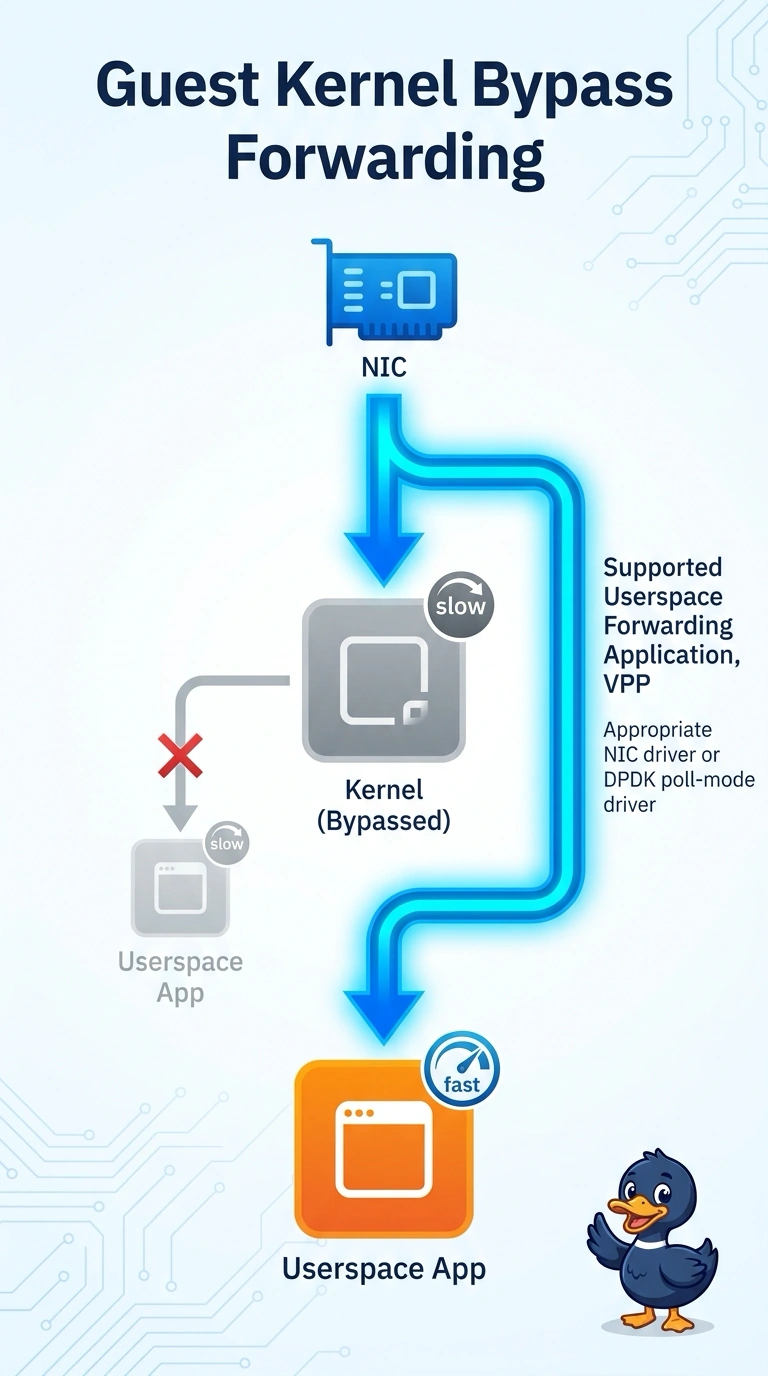
The checkout line is slow because the cashier is the bottleneck, not the door into the store. You move forwarding into user space with DPDK or VPP so the guest kernel is no longer the limit. An SR-IOV virtual function, a second logging guest, and a larger disk do not speed that kernel path.
Full Explanation
Use a supported userspace forwarding application, such as VPP, with an appropriate NIC driver or DPDK poll-mode driver to move forwarding out of the guest kernel. DPDK supplies packet-I/O libraries and drivers, and VPP implements forwarding. Userspace processing can be combined with an SR-IOV VF. Profiles show the guest kernel network stack is what limits this inspection guest, and the host software switch is not saturated, so the packet-rate fix is user-space forwarding. An SR-IOV virtual function that skips a host software switch that is not saturated is the wrong fit because an SR-IOV virtual function skips the host software switch, and that switch is not the saturated path. A second low-rate logging guest that does not forward the inspection packets is the wrong fit because a second logging guest can collect records and does not move the inspection forwarding out of the kernel. A larger disk on the inspection guest while the kernel forwarding path stays in place in that other design is the wrong fit because a larger disk adds storage and leaves the guest kernel network stack on the forwarding path. Caveat: SR-IOV is the right move when the host software switch is the limit. It does not repair a guest kernel path that is already the bottleneck here. Operational check: After the move, confirm the packet rate rises and the profile no longer shows the kernel as the limit.