
One tenant virtual firewall is unreachable. The VIM API still creates other instances, the compute host is up, and storage volumes still attach. The firewall’s console confirms its forwarding process has stopped and the vNIC path was verified independently. Which fault matches the evidence?
Select an answer to reveal the explanation.
Short Explanation
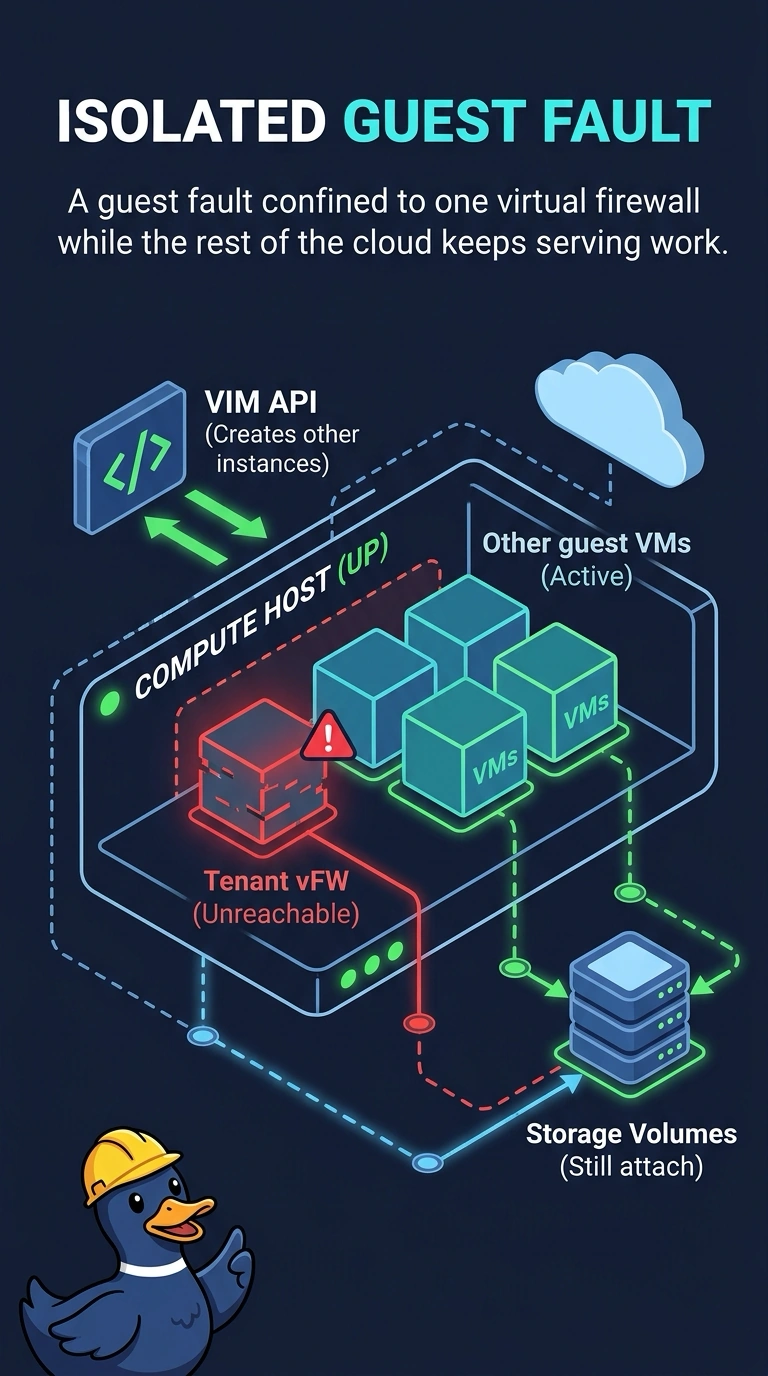
You can treat this as a guest fault because only that virtual firewall is unreachable, while the rest of the cloud continues serving other work. The VIM API, compute host, and storage evidence does not point to a fault in those services.
Full Explanation
A guest that is unreachable is not, by itself, enough to establish a guest fault; the cause could still lie outside the guest. Here, the firewall’s console confirms that its forwarding process has stopped, and its vNIC path was verified independently, so the evidence points to a fault confined to that virtual firewall. The VIM API still creates other instances, the compute host is up, and storage volumes still attach. A guest fault confined to that virtual firewall while the rest of the cloud keeps serving other work fits because the failure is isolated while those services continue operating. A VIM API fault that stops the controller from creating instances, networks, and flavors does not fit: the API is still creating other instances. A compute fault that takes the hypervisor down along with every guest scheduled on that host in that other design does not fit: the reported compute host is up. A storage fault that stops new volumes from attaching to instances that request them does not fit: volumes still attach. The exam caveat is that unreachability alone does not prove the fault is inside the guest. As a practical check, confirm the stopped forwarding process at the console and independently verify the vNIC path before attributing the failure to the guest.