
Customers of a water utility transit router can send packets to the router loopback, while ordinary transit must still be forwarded. Which control stops packets aimed at the router?
Select an answer to reveal the explanation.
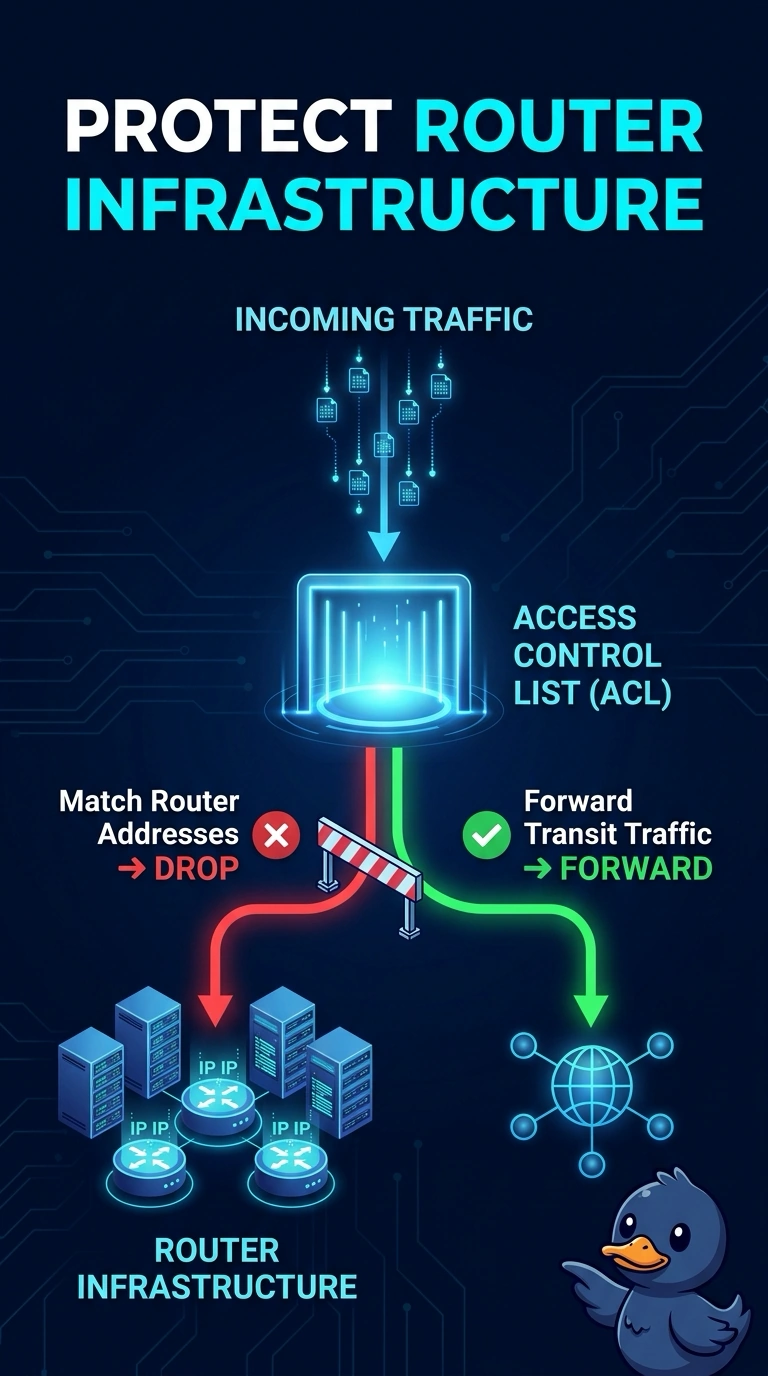
Short Explanation
A door list that turns away visitors aimed at the office itself is like an access list for infrastructure addresses. You drop packets toward the water utility router and still forward ordinary transit. Unicast reverse-path forwarding, TACACS administration, and MACsec each check a source path, a login, or a link cipher instead.
Full Explanation
An access list can drop packets destined to infrastructure addresses while transit still forwards. Customers can send packets to this water utility router loopback, and ordinary transit must pass. The access list matches that split. Unicast reverse-path forwarding tests the source path, not these destinations. TACACS accounts operator logins and does not filter packets. MACsec encrypts the Ethernet hop and does not filter those destinations. An access list that drops packets toward the router infrastructure addresses and still forwards transit is the design that meets this requirement. Unicast reverse-path forwarding that tests the source route back out the arrival interface is the wrong fit because reverse-path forwarding tests whether the source returns out the arrival interface and does not filter those destinations. TACACS device administration that accounts operator logins and does not filter packets is the wrong fit because TACACS accounts operator logins to the router and does not drop customer packets toward the loopback. MACsec on the Ethernet hop that encrypts the link and does not filter destinations is the wrong fit because MACsec encrypts the Ethernet hop and does not choose which packets may be addressed to the router. Exam caveat: An access list on infrastructure destinations does not stop a spoofed source that is otherwise forwarded, and reverse-path forwarding remains the control for that source test. Operational check: From a customer port, confirm packets toward the router loopback are dropped and that ordinary transit traffic through the router still passes.