
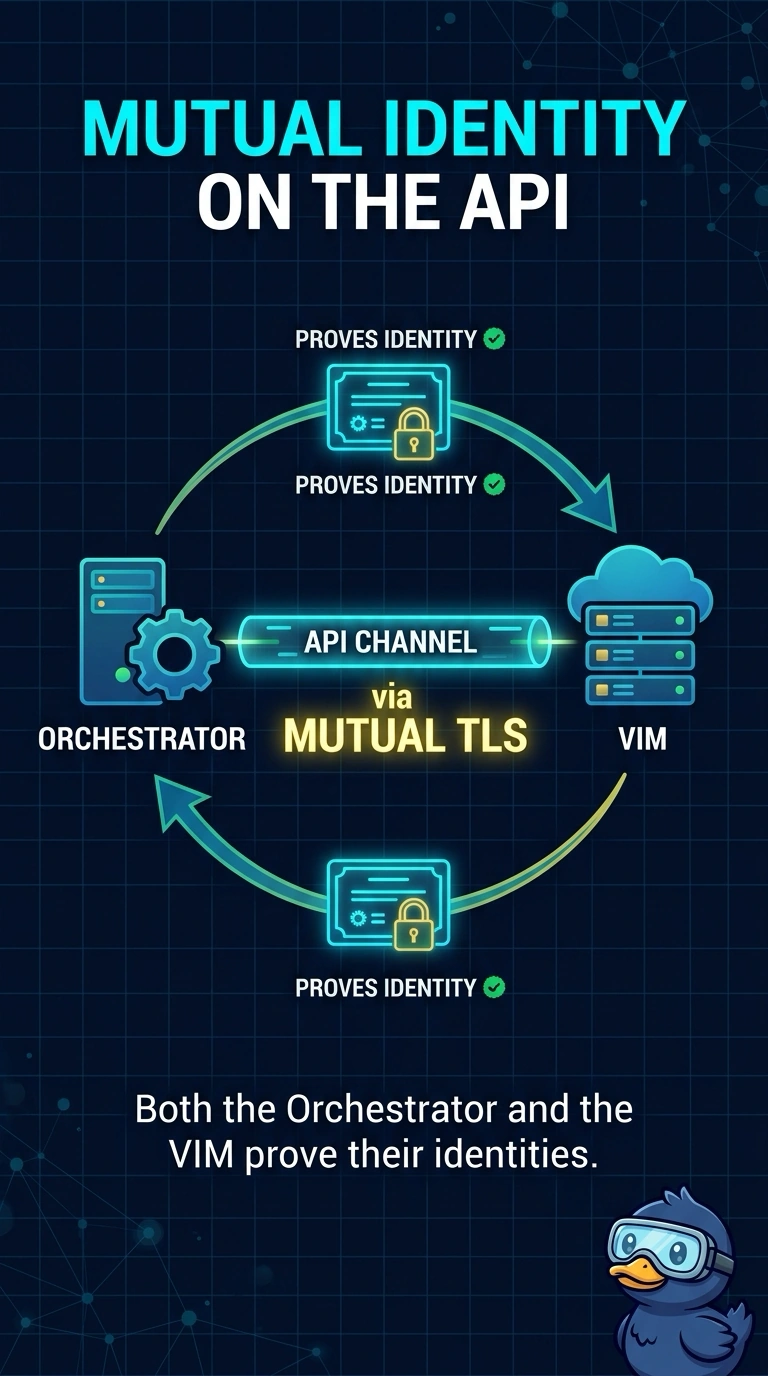
An orchestrator must prove its identity to the VIM, and the VIM must prove its identity back, on the API channel used to manage tenant functions. What protects that exchange?
Select an answer to reveal the explanation.
Short Explanation
A doorway that checks both badges is stricter than a door that only checks the building. You use mutual TLS so the orchestrator and the VIM each prove identity on the API channel. One-way TLS, tenant segmentation, and putting the control plane on a tenant subnet do not prove both peers.
Full Explanation
Mutual TLS proves both ends of a channel. The orchestrator must prove itself to the VIM, and the VIM must prove itself to the orchestrator, on the API that manages tenant functions. TLS that checks only the server leaves the client unproven. Segmenting tenants separates workloads and does not authenticate those API peers. Putting the control plane on a tenant subnet exposes management instead of proving both sides. Mutual TLS on the API channel so both the orchestrator and the VIM prove their identities is the design that meets this requirement. TLS that authenticates only the VIM and leaves the calling orchestrator unproven is the wrong fit because TLS that checks only the server proves the VIM and leaves the orchestrator unverified on that API channel. Tenant segmentation that separates workloads and does not authenticate the API peers is the wrong fit because tenant segmentation separates workloads from one another and does not prove the orchestrator or the VIM on the API. A path that places the cloud control plane on a tenant subnet reachable by workloads is the wrong fit because placing the control plane on a tenant subnet exposes management to workloads and does not make both API peers prove identity. Exam caveat: Keep the cloud control plane off tenant workloads even after mutual TLS is in place, because authenticating the API peers does not make that plane safe to expose. Operational check: Confirm the API handshake requires a client certificate from the orchestrator and a server certificate from the VIM, and that tenant subnets have no route to that control plane.