
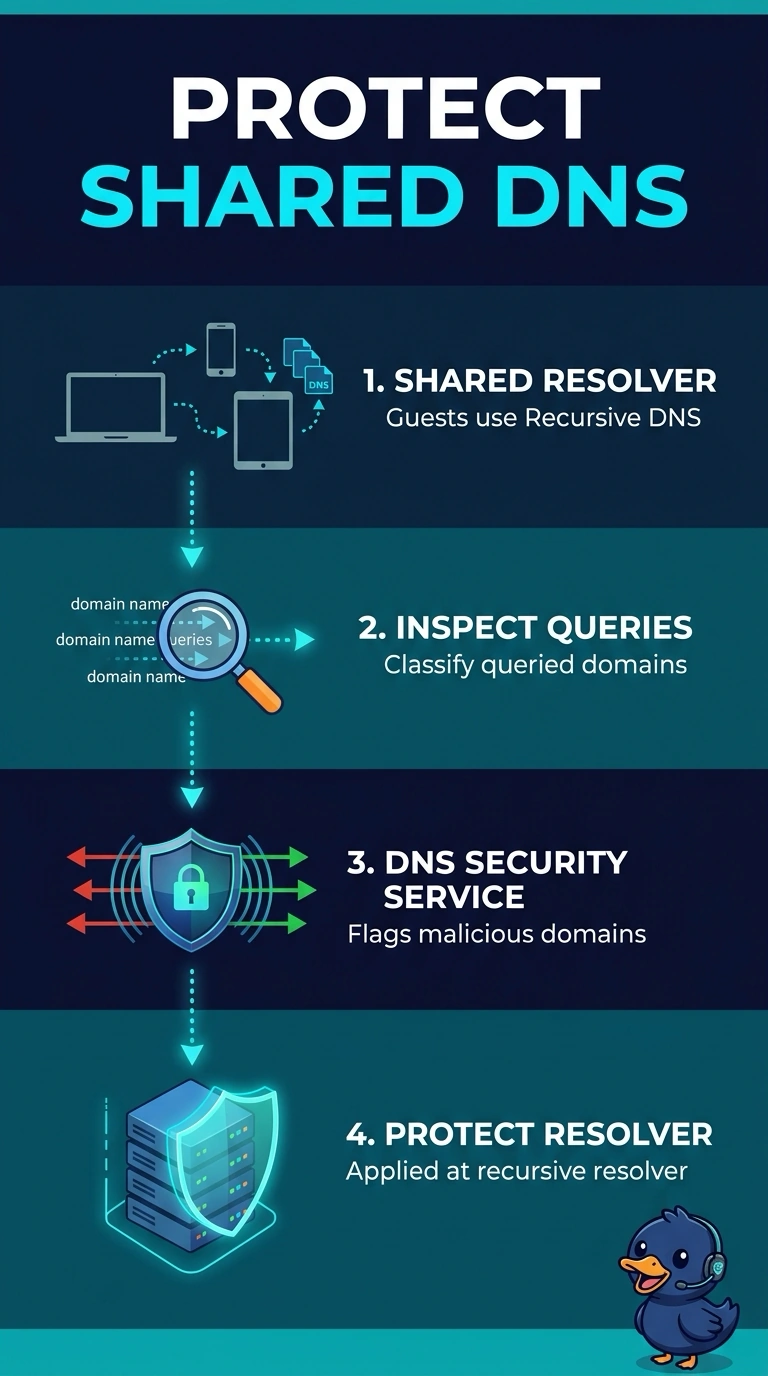
Tenant guests resolve names through a shared recursive resolver, and the operator must flag queries for malicious domains. Guest disks are out of scope. Which service fits?
Select an answer to reveal the explanation.
Short Explanation
You’re looking for DNS security on the shared recursive resolver, where queried domain names are visible and can be flagged. A malware scanner on each guest disk checks files, an exploit detector on the guest watches process behavior, and an access list denying packets to the resolver blocks queries rather than classifying names.
Full Explanation
DNS security belongs on the shared recursive resolver because that is where the queried domain name—the signal you need to flag—is visible. A DNS security service on the recursive resolver that classifies the domain names being queried meets the requirement. A malware scanner on each guest disk that looks for infected files in the tenant workload is the wrong fit: it examines files on guest disks, not names in DNS queries. An exploit detector on the guest that watches process behavior inside the tenant workload is also the wrong fit: it monitors workload behavior rather than classifying queried names. An access list that denies every packet from the tenant guests toward the shared resolver can block traffic to the resolver, but it does not identify or flag the domain name in a query. Exam caveat: DNS security does not scan guest disks, and a disk scanner does not classify recursive queries; blocking the resolver hides queries rather than flagging malicious names. Practical check: Send a test query through the shared resolver and confirm that the DNS security service records the queried name, without relying on a guest disk scan for the alert.