
Every call that creates a VNF must prove the identity of both the orchestration client and the VIM API. Which control meets that requirement?
Select an answer to reveal the explanation.
Short Explanation
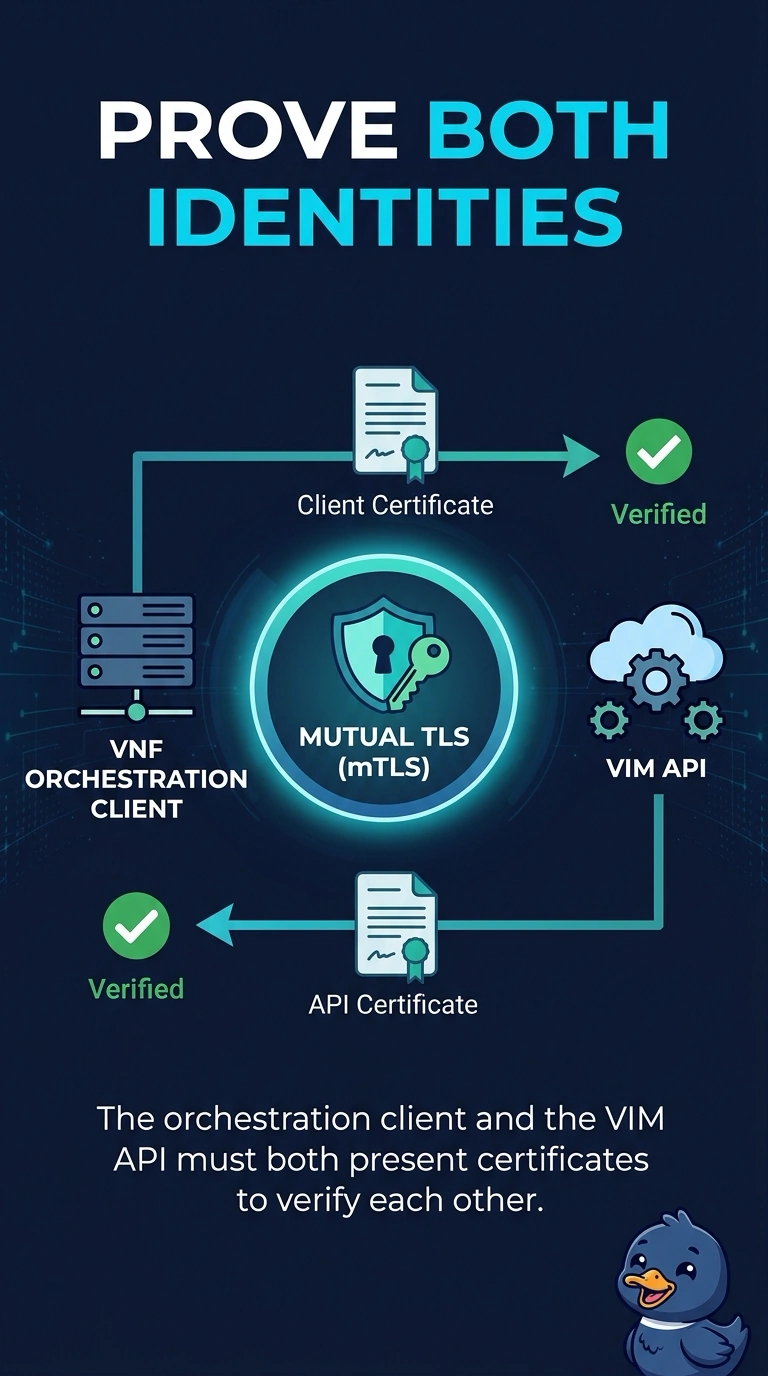
A door that checks your badge and its own badge is stricter than a one-way peephole. You use mutual TLS when both the orchestration client and the VIM API must prove identity. Server-only TLS, tenant segmentation, and hiding the API from guests answer different needs.
Full Explanation
Mutual TLS authenticates both ends of the VIM API call. The orchestration client presents a certificate and the API presents its own. Server-only TLS protects the channel and can prove the API, but it does not prove the caller. Tenant segmentation separates networks. Keeping guests off the control plane is a reachability control, not mutual proof of identity. Mutual TLS on the VIM API with a certificate from both the orchestration client and the API is the design that meets this requirement. Server-only TLS that encrypts the VIM API channel and authenticates the API endpoint alone is the wrong fit because it protects the channel and can prove the API alone, without a certificate from the orchestration client. Tenant segmentation that keeps each tenant subnet apart from the other tenants in the cloud is the wrong fit because it separates tenant networks from one another and does not prove identity on the VIM API call. A control-plane boundary that stops tenant workloads from reaching the cloud management API is the wrong fit because it keeps guest workloads off the management API and does not prove either party with a certificate. Exam caveat: TLS on the API channel is not the same control as mutual TLS. Reachability limits and tenant segmentation remain useful, and they do not identify both parties. Operational check: Confirm a call that presents the orchestration client certificate succeeds, and a call with no client certificate is rejected by the VIM API.