
A virtual firewall has two uplinks that both terminate on the same provider edge router. Which change actually multi-homes it?
Select an answer to reveal the explanation.
Short Explanation
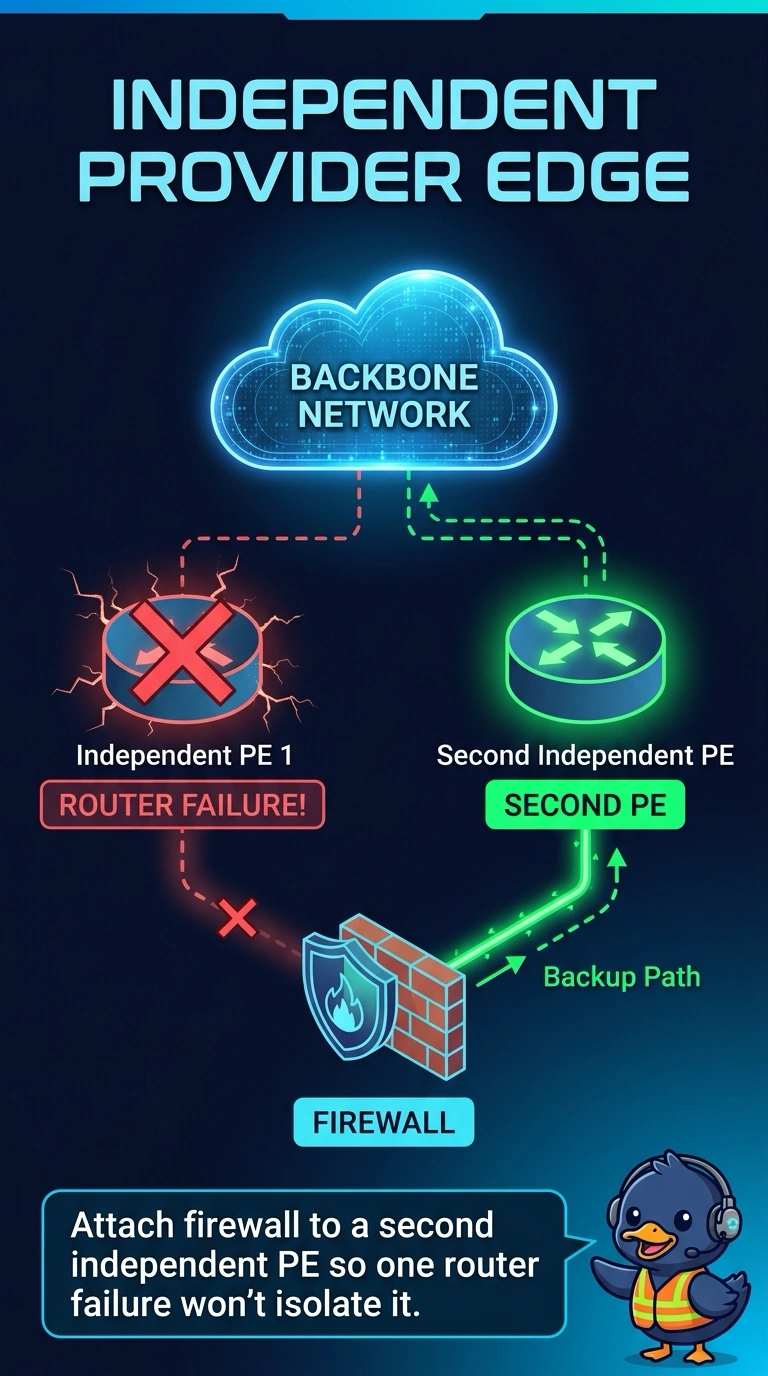
Two leashes tied to the same post still leave you with one post. You multi-home the firewall to a second independent edge so one router can fail without isolating it. Another link to that same router, equal-cost paths over those links, and a second address on the same attachment keep the single failure.
Full Explanation
Multi-homing attaches a function to two independent providers or two independent devices so one failure does not isolate it. Both current uplinks share one provider edge, so that router failing still isolates the firewall. A third link to the same router, equal-cost forwarding across those links, and a second address on the same attachment all remain behind that one device. Attach the firewall to a second independent provider edge so one router failure does not isolate it is the design that meets this requirement. Add a third uplink that still terminates on the same provider edge router as the first two is the wrong fit because another link to the same router still shares that router, so its failure isolates the firewall. Enable equal-cost multipath across the two uplinks that already share that one provider edge is the wrong fit because equal-cost forwarding across links on one router adds capacity on the same failure, not a second device. Add a second address on the same attachment that still ends at the same provider edge router is the wrong fit because a second address on the same attachment is still one device, so that device remains a single failure. Exam caveat: Two independent edges remove the shared router failure, and they still need diverse facilities if a single building outage must also be survived. Operational check: Confirm the two firewall attachments terminate on different provider edge routers, and confirm shutting either router alone leaves the other attachment forwarding.