
A credit-union firewall has two circuits that both fail when one upstream carrier has an outage. One provider failure must leave another provider in service. What attachment meets that goal?
Select an answer to reveal the explanation.
Short Explanation
Multihoming connects the site or device through multiple attachments. To survive the failure in this scenario, put the attachments in separate failure domains and verify that traffic can use either path, so you keep service when one carrier fails. For a stateful firewall, verify session continuity separately from reachability.
Full Explanation
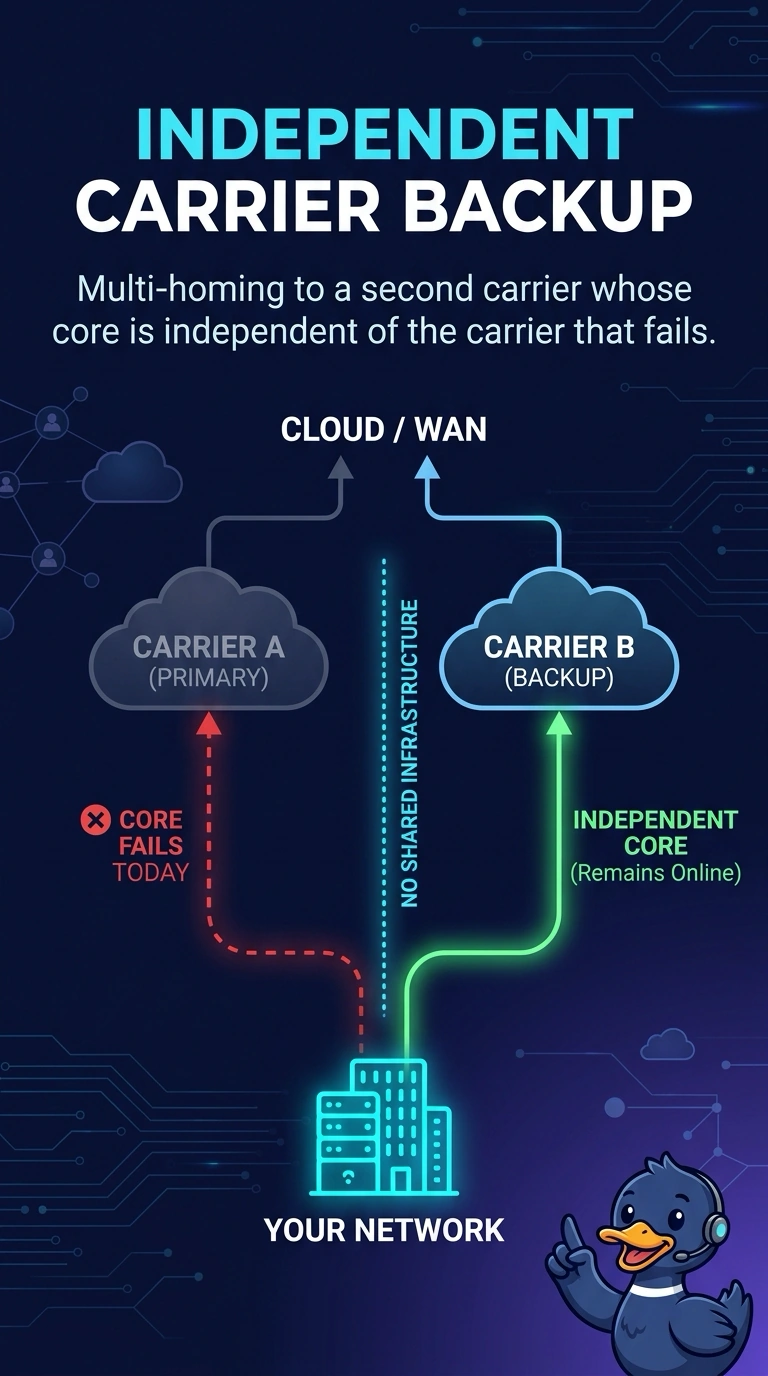
Multihoming connects the site or device through multiple attachments. To survive the failure in this scenario, put the attachments in separate failure domains and verify that traffic can use either path. Both circuits today share one carrier core, so that carrier is a single upstream failure. Multi-homing to a second carrier whose core is independent of the carrier that fails today is the design that meets this requirement. For a stateful firewall, verify session continuity separately from reachability. A second circuit that still terminates on the same carrier core as the existing circuit is the wrong fit because another circuit on the same carrier core still fails when that carrier fails, so the firewall is not independently attached. A control-plane standby inside the same VIM with no second provider attached to the firewall is the wrong fit because a control-plane standby in the same VIM keeps a process up and does not attach the firewall to a second provider. An Ethernet bundle toward two edges that both belong to the same upstream carrier is the wrong fit because two edges of one carrier can still share that carrier failure, so the bundle is not a second independent provider. Exam caveat: Two physical links are not multi-homing when they share one upstream failure. Operational check: Fail the original carrier and confirm the firewall still forwards.