
Two rail yards are joined only by a pseudowire. Signaling for that pseudowire is up, small frames cross, and large frames are dropped. A separate EVPN service between other sites is healthy. What explains the large-frame drops?
Select an answer to reveal the explanation.
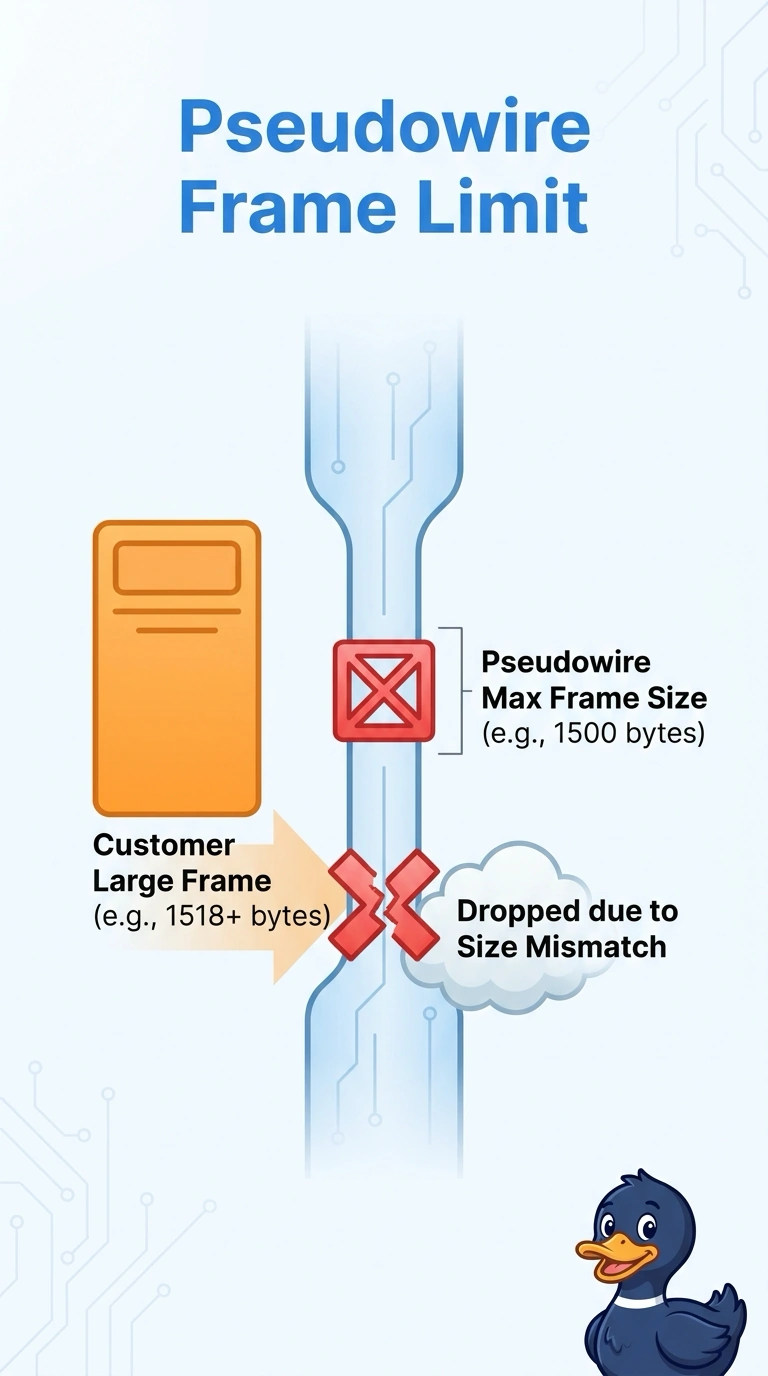
Short Explanation
You can picture a small note slipping under the door while a poster will not fit. Your signaling is up and small frames cross, so the pseudowire is working. Your large frames exceed the effective supported frame size along that pseudowire service.
Full Explanation
A pseudowire with signaling up can still drop frames larger than the effective supported frame size along that pseudowire service while smaller frames pass. That matches the symptoms: signaling is up, small frames cross, and large frames are dropped, pointing to the attachment-circuit and pseudowire MTUs, plus transport MTU including encapsulation overhead as the limit to check. The healthy EVPN service is between other sites; it is not the circuit joining these yards, so its health does not explain the drops. A failed PW forwarding state is a different hypothesis from the explicitly up PW here; loss of a control session does not universally imply immediate loss of existing forwarding state, and the observed small-frame success with active signaling conflicts with a down forwarding path for this pseudowire. A missing VXLAN identifier applies to a tunnel endpoint this yard circuit does not use, so it does not account for the drops either. For LDP-signaled PWs under RFC 8077, unequal advertised interface-MTU parameters must prevent enablement unless a documented platform override is in use. Practical check: send a small probe and a large probe across the same pseudowire, verify that only the large one is dropped, and confirm that signaling remains established. This isolates the frame-size limit while keeping the separate EVPN service between the other sites out of the diagnosis.