
A hospital already sends imaging traffic over a provider MPLS VPN. The new contract says the payload must be encrypted on that path, not merely separated by the provider. What should be added?
Select an answer to reveal the explanation.
Short Explanation
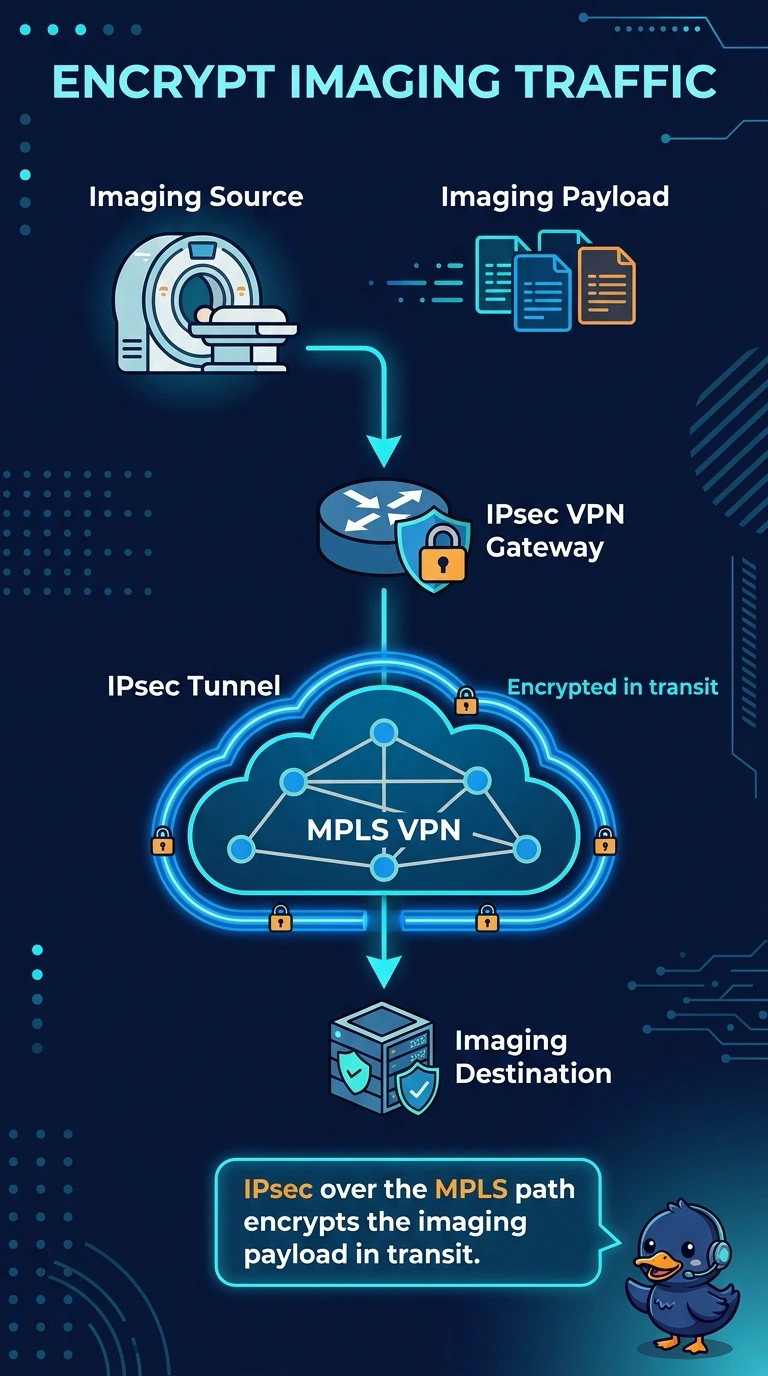
A private road is not a locked box. You already have MPLS separation, and the contract now wants the imaging payload encrypted, so you add IPsec. Treating MPLS as encryption, calling a private interconnect encryption, and using GRE as encryption leave the payload readable.
Full Explanation
An MPLS VPN is provider transport with label separation, not encryption. A private interconnect is a dedicated path, and that privacy is not IPsec. GRE only encapsulates. When the contract requires the imaging payload to be encrypted on a path the provider still switches, add IPsec. The MPLS VPN can remain the transport underneath. Encryption is the new requirement. IPsec over the MPLS path so the imaging payload is encrypted in transit is the design that meets this requirement. Treat the MPLS VPN label separation as the encryption the contract requires is the wrong fit because MPLS separates traffic with labels and does not encrypt the imaging payload the contract now requires. Replace the VPN with a private interconnect and call that interconnect encryption is the wrong fit because A private interconnect is a dedicated path into a cloud or site and is not encryption by itself. Add a GRE tunnel and treat the GRE header as encryption of the payload is the wrong fit because GRE encapsulates packets and does not encrypt them, so the payload is still readable on the path. Exam caveat: IPsec supplies encryption. It does not replace a need for traffic engineering, and a private interconnect does not become IPsec just because the port is dedicated. Operational check: On a capture outside the tunnel, confirm imaging payloads are ciphertext, and confirm the MPLS VPN still carries the tunnel between the sites.