
Two hospital buildings extend a tenant with EVPN and VXLAN. Underlay pings between the tunnel endpoints succeed, and the far building's EVPN route is in the local BGP table. Frames for that tenant still do not forward, and the local tunnel endpoint has no configuration for this tenant's VXLAN identifier. Where is the fault?
Select an answer to reveal the explanation.
Short Explanation
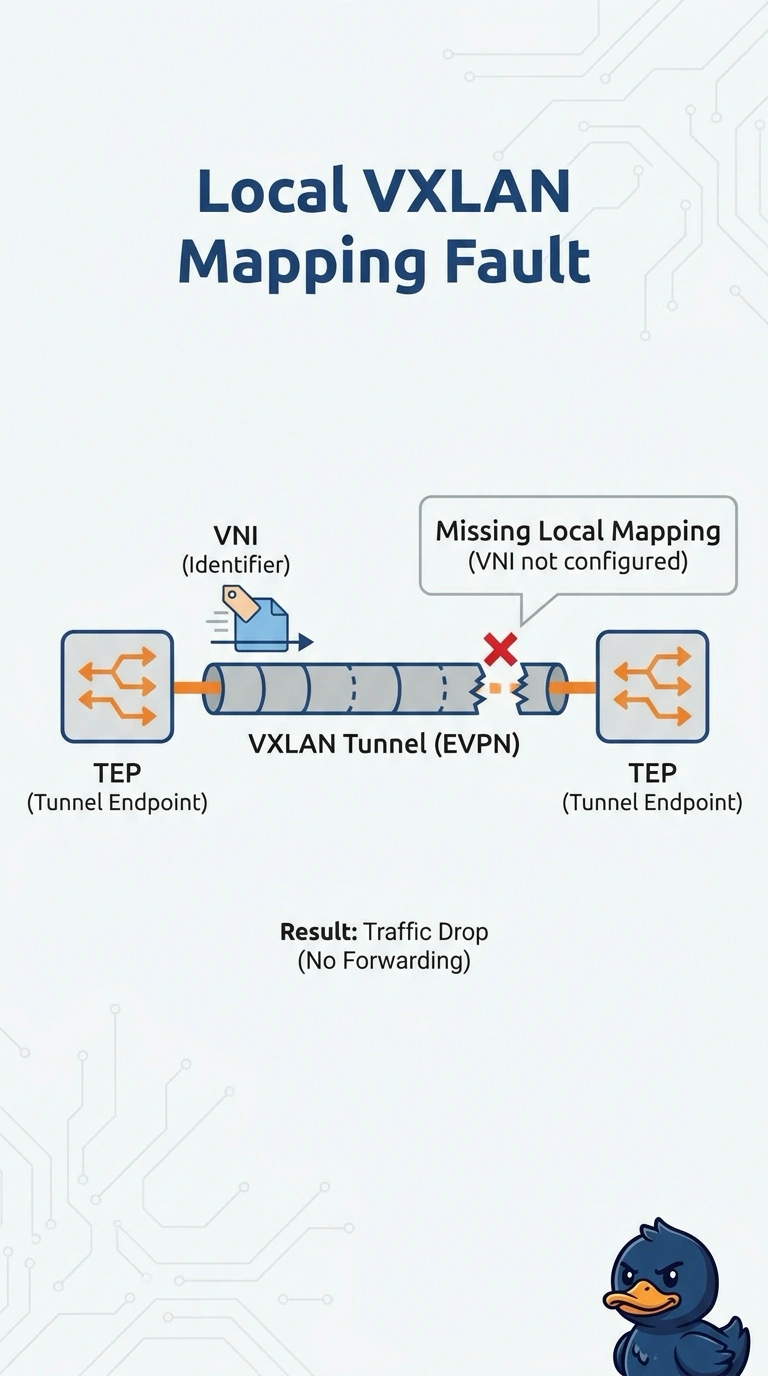
The invitation arrived, and the front door for that guest was never cut. Your EVPN route is in the BGP table and the underlay pings, yet this tenant's VXLAN identifier is not configured on the local tunnel endpoint. That missing local mapping is why the frames have nowhere to go.
Full Explanation
EVPN can deliver a route for the remote tenant while forwarding still needs a local VXLAN network identifier on the tunnel endpoint. Without that mapping, the received route has no local forwarding entry, so frames for the tenant do not go out a VXLAN tunnel even though BGP has the route and the underlay pings. Successful basic pings do not exclude underlay MTU or VXLAN transport filtering, but neither repairs the known missing local VNI mapping. A pseudowire is not the service carrying this tenant; the buildings extend it with EVPN and VXLAN. Changing an underlay SR policy would not create this missing local VXLAN mapping; EVPN/VXLAN alone does not prove whether the underlay uses SR. Exam caveat: a route in the BGP table proves the control plane delivered it, not that the data plane has a tunnel for that identifier. Operational check: on the local tunnel endpoint, check that this tenant's VXLAN identifier exists and is bound to the tunnel source, then repeat the frame test. Add the missing identifier on the local tunnel endpoint and bind it to the tunnel source before you chase a core technology this tenant is not using.