
A bank must enter its public cloud on a dedicated private path from a meet-me room, and encryption is not the requirement. Which attachment provides that private path?
Select an answer to reveal the explanation.
Short Explanation
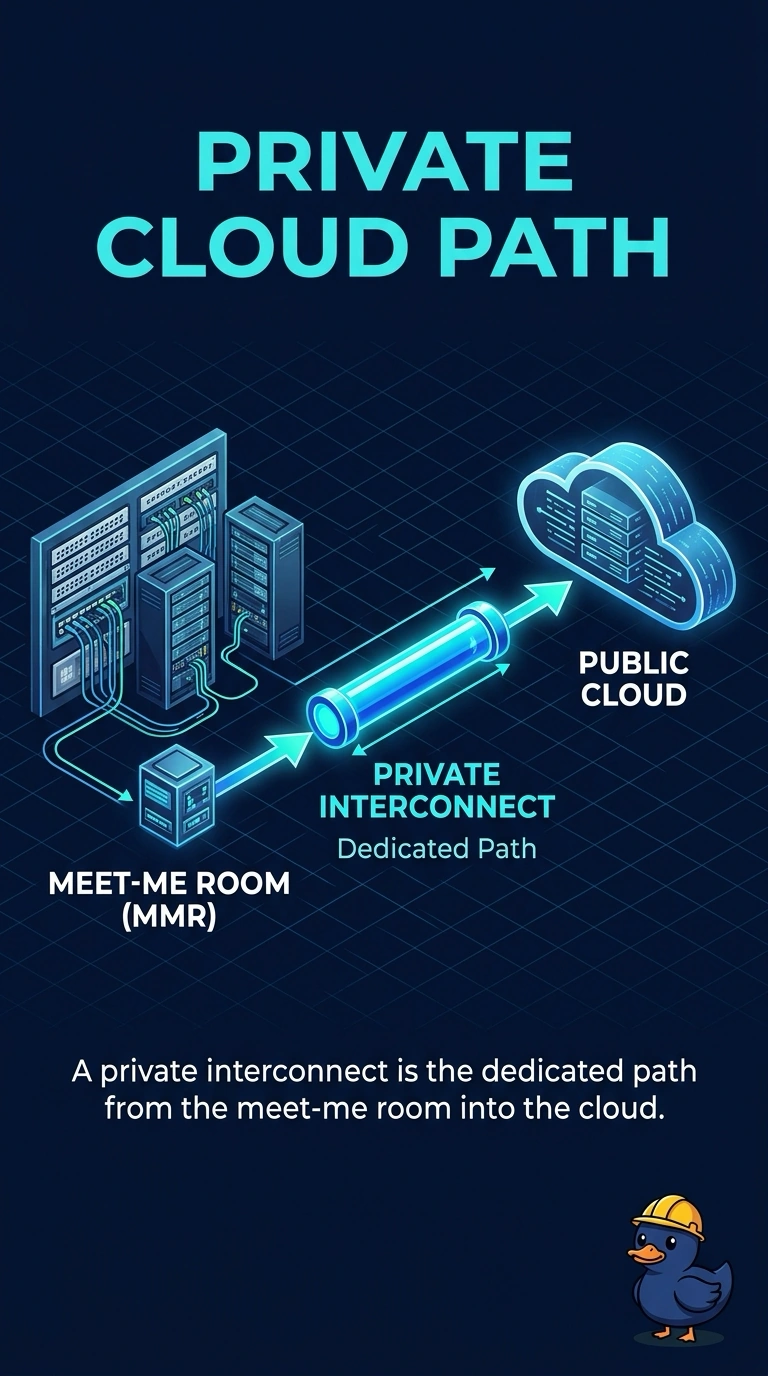
You can think of a private interconnect as a dedicated driveway into the cloud, rather than a locked envelope carried on a public road. You attach the bank to the cloud with a private interconnect from the meet-me room. An IPsec tunnel across the internet, MPLS label steering, and a GRE tunnel address encryption or transport, not the dedicated path you need.
Full Explanation
A private interconnect provides a dedicated path from a facility such as the meet-me room into the cloud, so it meets the bank’s requirement. It is not an encrypted tunnel by itself. An IPsec tunnel across the internet provides encryption over an internet path, but it does not provide the dedicated private connection from the meet-me room into the cloud; encryption is not the requirement here. MPLS label steering across the provider core steers provider transport, but it does not itself provide the private cloud attachment. A GRE tunnel toward the cloud encapsulates packets, but its header does not create a dedicated private interconnect. The private interconnect is therefore the appropriate attachment for this design. Exam caveat: Use IPsec ESP with encryption wherever policy requires network-layer confidentiality, including on a private circuit; the dedicated attachment itself does not guarantee end-to-end encryption. Practical check: From the meet-me room, confirm that the bank’s cloud attachment is a dedicated private interconnect and that its privacy does not depend on an internet tunnel.