
A manufacturer must steer a flow across the provider core on a chosen low-delay path. The payload stays on that private core and does not need encryption. What provides the steering?
Select an answer to reveal the explanation.
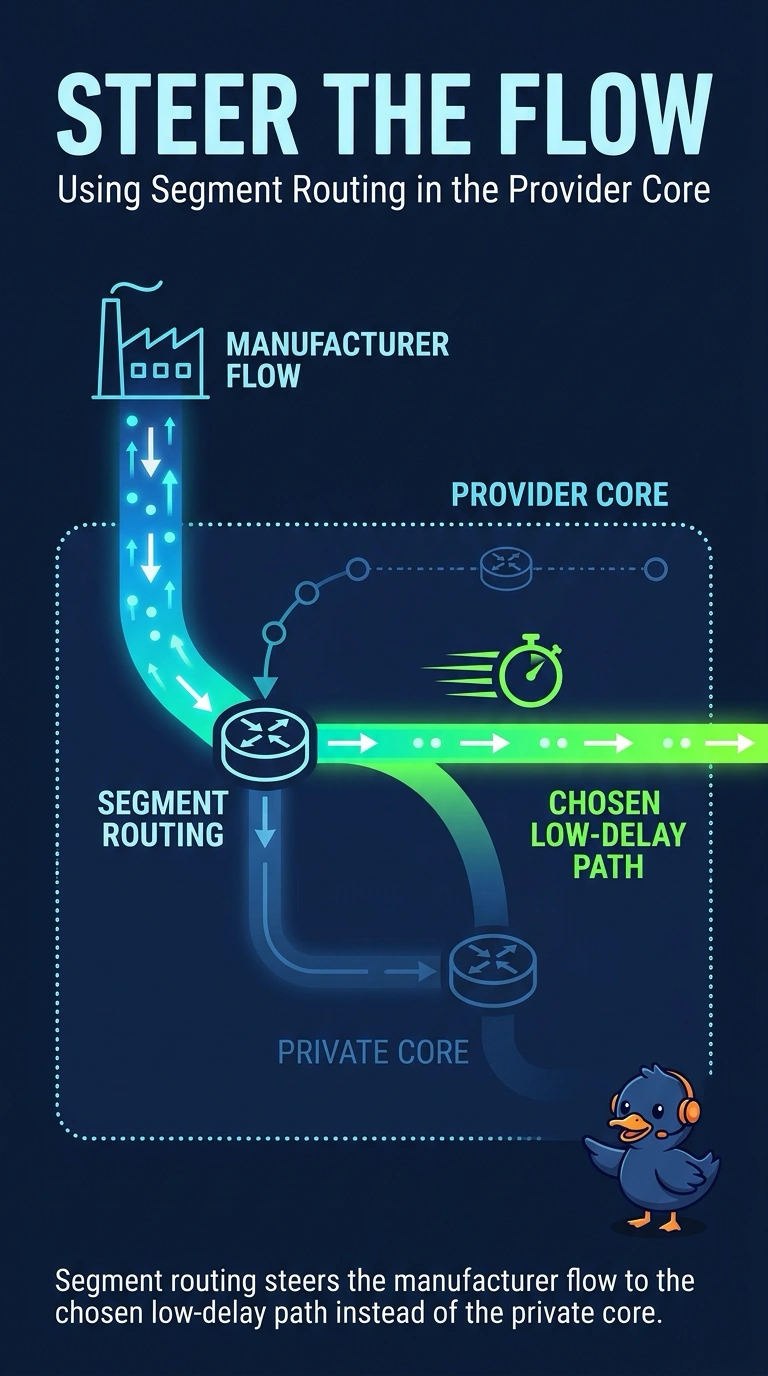
Short Explanation
You can picture segment routing as railroad switches guiding your flow onto the chosen track; a lock on the cargo does not choose the track. Because your payload stays private on the provider core, segment routing steers it along the chosen low-delay path. IPsec encrypts an untrusted hop, a private interconnect provides a cloud on-ramp, and GRE encapsulates packets without steering the core.
Full Explanation
Segment routing in the provider core can steer a flow onto a chosen path, which meets the manufacturer’s need for a low-delay route. Because the payload stays on the private core, encryption is not the requirement. IPsec on an untrusted internet hop provides encryption, but it does not provide the requested core-path steering; it would fit when traffic needs confidentiality across an untrusted hop. A private interconnect provides a dedicated on-ramp into one cloud, but does not steer a path across the provider core. A GRE tunnel between two edges encapsulates packets, but does not steer them onto a chosen provider-core path. Segment routing in the provider core is therefore the design that follows the flow along the chosen low-delay path. Exam caveat: Use IPsec ESP with encryption wherever policy requires network-layer confidentiality, including on a private circuit; the dedicated attachment itself does not guarantee end-to-end encryption. Practical check: Confirm the manufacturer flow is classified onto the intended segment-routed path and that the core hop carries the segment list rather than an IPsec or GRE header.